Lesson 04 — Facilitating, Not Forcing: A Solution Everyone Can Accept
Learners learn to facilitate a group conflict rather than force or avoid it: set the ground, hear every side, name the needs and interests behind positions, and build a solution everyone can accept. They watch the steps modeled, then practice facilitating an invented conflict with a talking piece, staying neutral so the group owns the outcome.
Objectives
Objectives
- D02.S1.08.02 Manage conflict in a group by facilitating discussion and seeking a solution all can accept.
Essential question
How do I facilitate a group conflict toward a solution everyone can accept — without forcing or taking over?
Key vocabulary
Materials
Standard materials
- Facilitation steps card · 1 per learner A four-step card — set the ground, hear every side, name needs and interests, build agreement — with guiding questions
- Facilitation scenario · 1 per group An invented, low-stakes group conflict (a shared space, a group task, a decision) for practice
Low-tech / no-cost
- Voice and a talking piece Pass a stone or stick so each person speaks in turn; build the steps aloud on any surface
- A circle of chairs or stones Sit in a circle so no one is at the head; the shape itself is a tool
Enriched / lab & device
- A printed facilitation poster · 1 The four steps and guiding questions displayed where the group can return to them
- A recorded model mediation · 1 A short audio or video of a peer mediation, to notice the steps in action
Works in different contexts
- large-group Model one facilitation in a fishbowl, then small groups each facilitate one scenario and report the agreement reached
- multi-age Younger learners practice the listening turn with the talking piece; older learners facilitate all four steps and reflect on staying neutral
- self-directed A learner writes the four steps applied to an invented scenario and self-checks that every side was heard and a solution all could accept was reached
- level-grouped Learners ready to extend identify where a facilitator took a side and what staying neutral would have changed
- outdoor-only Facilitate the scenario in a circle outdoors with a found-object talking piece, and discuss how the calm space changes the conflict
Lesson 4 — Facilitating, Not Forcing: A Solution Everyone Can Accept
Summary
Learners learn to facilitate a group conflict rather than force or avoid it: set the ground, hear every side, name the needs and interests behind positions, and build a solution everyone can accept. They watch the steps modeled, then practice facilitating an invented conflict with a talking piece, staying neutral so the group owns the outcome.
Objectives
- Manage conflict in a group by facilitating discussion and seeking a solution all can accept. (D02.S1.08.02)
Connection
When people disagree, two common moves are to force an answer (“do it my way”) or to avoid the problem until it festers. There is a third move: facilitation — helping a group talk so that every side is heard and the group itself finds a way forward that everyone can live with. In a family deciding chores, a class planning an event, a neighborhood sharing a water tap, a team dividing work — a facilitator does not hand down the answer; they hold the space where the group finds it. Today you learn that skill.
Materials
- Facilitation steps card
- Facilitation scenario
Preparation
- Copy the facilitation steps card and scenario.
- Retrieval: recall Lesson 3’s lesson that checking beats assuming, and Grade 7’s repair steps (listen, take responsibility, repair). Facilitation turns listening into a structure a whole group can use.
Facilitator note
This lesson is written to the learner (“you”). The ideas to land: (1) to facilitate is to guide a process, not to impose a solution — the facilitator stays neutral and the group owns the outcome; (2) the four steps are: set the ground, hear every side, name needs and interests (not just positions), and build a solution all can accept; (3) a solution “all can accept” is not “everyone got everything” — it is one nobody is left unable to live with. The step shape follows restorative and mediation practice (IIRP, S-022) and the needs-language of Nonviolent Communication (Rosenberg, S-148); model once as a worked example (S-011). Safety: use only invented, low-stakes conflicts; never stage a real fight, and never force a learner to disclose a real dispute. Accessibility: the talking piece passes to however each person communicates — speech, sign, writing, a device, or a gesture — and a facilitator may paraphrase by any of those modes; being heard does not require a speaking voice, and the circle and passed object already support learners who are deaf, non-speaking, or low vision (the turn is visible and tactile, not only audible). The ethics lens: the point is fairness, not victory — a facilitator cares that the process is just, not that their own side wins. The egalitarian lens: a circle and a talking piece give the quieter and less powerful a turn, so the loudest does not decide; this is the heart of the method. The global & anthropological lens: the circle and talking piece have deep roots in Indigenous and community traditions of peacemaking — among them Māori and First Nations circle practice and Ubuntu-rooted reconciliation — and mediation appears across cultures in many forms; the four steps are one modern expression held side by side, not above, those older ways (S-022). The technology & environment lens: facilitation also works when the group is partly on a screen — the same steps (hear every side, name needs, build agreement) apply, with extra care for the missing cues from Lesson 3. The critical-thinking lens: a facilitator distinguishes a position (“I want the front seat”) from the need behind it (“I get carsick in back”) — the solution usually lives in the needs, not the positions.
Procedure
- Recall (5 min). From Grade 7, what were the three repair steps after harm? And from Lesson 3, why is checking better than assuming? Today you become the person who helps a group do both.
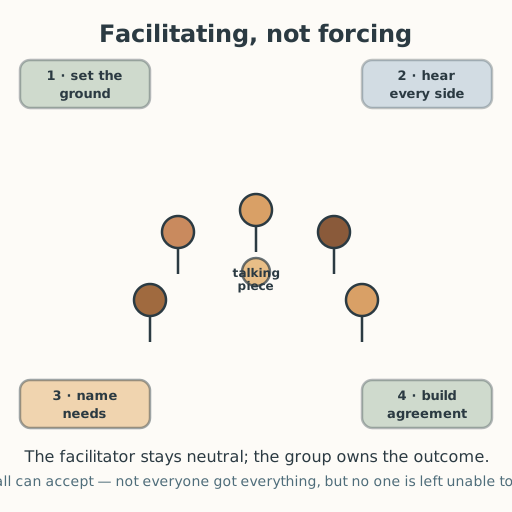
- Meet the four steps (10 min). Look at the facilitation steps card. Set the ground — one voice at a time, no interrupting, the talking piece passes around. Hear every side — each person says what happened and how they see it. Name needs — behind each “I want ___” find the “I need ___.” Build agreement — the group finds a solution everyone can accept.
- Model it (10 min). Watch a facilitator work an invented conflict: A group has one shared device for a project, and two members argue over who uses it first. Notice: the facilitator does not choose; they ask each person, “What do you need?” — one needs it early to leave on time, the other needs a turn before dinner. The group agrees on a schedule. The facilitator stayed neutral; the group found the answer.
- Practice facilitating (20 min). In a group, choose an invented conflict. Pick one facilitator; everyone else is a party to the conflict. Pass the talking piece. Run all four steps. The goal is a solution all can accept — not a perfect ending.
- Close (5 min). Share one thing facilitation made possible. Remember: a facilitator is not a judge — they are the person who makes sure everyone is heard.
Differentiation
- Support: Practice only the “hear every side” step with the talking piece before attempting all four; give a neutral-phrase starter (“So what I hear you needing is ___”).
- Extension: Identify a moment in a scenario where a facilitator took a side, and write what staying neutral would have changed.
Assessment
- Formative (observation): Can the learner name the four steps and use them while staying neutral in a role-play?
- Performance + peer: The facilitated conversation, observed for hearing every side, naming needs, and reaching a solution all can accept; peers give one kind, specific piece of feedback.
Home connection
At home, when a disagreement comes up, try being the one who asks each person, “What do you need?” instead of arguing a side. Notice what changes.
Resources
- On restorative and mediation practice (hearing every side, finding a solution all can accept): International Institute for Restorative Practices, https://www.iirp.edu/ (S-022).
- On naming needs behind positions (“I” statements): Marshall B. Rosenberg, Nonviolent Communication: A Language of Life (S-148).
- On explicit instruction and worked examples: Kirschner, Sweller & Clark (2006), https://doi.org/10.1207/s15326985ep4102_1 (S-011).
- On relationship skills and social awareness: CASEL, https://casel.org/fundamentals-of-sel/ (S-001).