Lesson 05 — One Conflict, Many Sides: Taking Perspectives I Don't Share
Learners learn to analyze a conflict from multiple perspectives, including ones they disagree with, by mapping each party's view, needs, and strongest evidence. They practice reconstructing a view they do not share "charitably" — as its holder would state it — before evaluating it, discovering that understanding is not the same as agreeing.
Objectives
Objectives
- D02.S2.08.01 Analyze a conflict from multiple perspectives, including ones they disagree with.
Essential question
How do I analyze a conflict from multiple perspectives — including ones I disagree with?
Key vocabulary
Materials
Standard materials
- Conflict scenario · 1 per group An invented conflict with at least three distinct parties, for analysis from each side
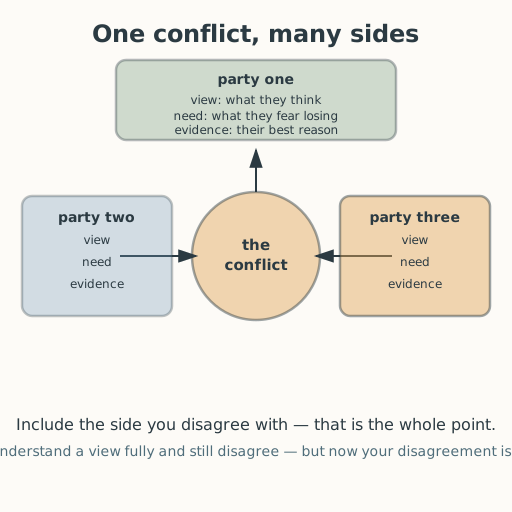
- Perspective map · 1 per learner A radial map — the conflict in the center, each party's view, needs, and strongest evidence in a ring around it
Low-tech / no-cost
- Voice and a shared surface Draw the perspective map on any board or the ground and fill it aloud; no cards needed
- A circle of viewpoints Each learner stands in a different place in the room or field and speaks "from" one party's view
Enriched / lab & device
- A short news-style account · 1 One age-appropriate real conflict, reported to include more than one side, analyzed as a class
- A projected perspective map · 1 Build the map large and editable so the whole group can add to it
Works in different contexts
- large-group Analyze one conflict together on the board, then small groups each take a different party and present that party's strongest case
- multi-age Younger learners name each party and one feeling; older learners reconstruct the strongest evidence for the view they disagree with
- self-directed A learner fills the perspective map for an invented conflict, then writes the strongest one-paragraph case for the side they least agree with
- level-grouped Learners ready to extend analyze a real conflict and identify where a party's evidence is strongest and where it is weakest
- outdoor-only Stand in different places for each party and speak their view from that spot, then reflect on how the view changes with the place
Lesson 5 — One Conflict, Many Sides: Taking Perspectives I Don’t Share
Summary
Learners learn to analyze a conflict from multiple perspectives, including ones they disagree with, by mapping each party’s view, needs, and strongest evidence. They practice reconstructing a view they do not share “charitably” — as its holder would state it — before evaluating it, discovering that understanding is not the same as agreeing.
Objectives
- Analyze a conflict from multiple perspectives, including ones they disagree with. (D02.S2.08.01)
Connection
Two neighbors argue about a tree that shades one garden but drops leaves into the other. Each is sure they are right — and each is partly right. A conflict almost always has more than one side, and the sides you do not share are the ones you understand least. Seeing a disagreement from every angle is not a way of giving in; it is how you come to understand it fully enough to judge it fairly. Today you practice seeing through eyes that are not your own.
Materials
- Conflict scenario
- Perspective map
Preparation
- Copy the conflict scenario and perspective map.
- Retrieval: recall Grade 7’s work on where a point of view comes from (background, culture, experience) and on empathy across difference. Today you turn that into a structured analysis of a conflict.
Facilitator note
This lesson is written to the learner (“you”). The ideas to land: (1) a conflict has parties, and each party has a view (what they think), needs (what they want or fear losing), and evidence (the strongest reasons for their view); (2) analyzing means reconstructing each party’s case as its holder would state it — “charitably” — before evaluating; (3) understanding a view is not agreeing with it. Perspective-taking is a well-studied route to prosocial behavior and reduced aggression (Decety & Cowell 2014, S-231); model the map once as a worked example (S-011). Safety: use invented conflicts, and do not press learners to “defend” a real view that harms them or others; the skill is analysis, not endorsement. The ethics lens: fairness requires hearing the strongest version of every side, not a straw-man. The egalitarian lens: in a conflict, some parties have more power or louder voices — mapping every side gives the quieter parties their turn on the page. The global & anthropological lens: the same conflict would be read differently in different places and traditions — name whose perspective is still missing from the map. The technology & environment lens: conflicts now also happen on screens and across distances, where the parties never meet — the same mapping works, with extra care from Lesson 3. The critical-thinking lens: separate the task of understanding a view from the task of evaluating it — you may understand fully and still disagree.
Procedure
- Recall (5 min). In Grade 7 you learned that a point of view comes from background, culture, and experience. Say to a partner: what shapes your own view of a disagreement? Today we map everyone’s.
- Meet the perspective map (10 min). Look at the map. In the center is the conflict. Around it, for each party, write three things: their view (what they think), their needs (what they want or fear losing), and their strongest evidence (their best reason). Include the side you disagree with — that is the whole point.
- Model it (10 min). Watch a conflict be mapped: A shared courtyard is wanted by one group for a football game and by another for a vegetable garden. Party one: view “we need space to play”; need — exercise, belonging; evidence — many children, no other flat space. Party two: view “we need space to grow food”; need — food, family income; evidence — rising prices, sunny soil. Notice: each side’s strongest case is real, even though they clash.
- Analyze in groups (20 min). Take an invented conflict. Fill the map for every party. Then each learner writes one paragraph stating — as fairly as they can — the strongest case for the view they least agree with. Read it to the group. Then, and only then, evaluate: where is each side’s evidence strong, and where is it weak?
- Close (5 min). Share what changed when you stated the other side well. Remember: you can understand a view fully and still disagree — but now your disagreement is informed.
Differentiation
- Support: Provide a two-party starter map with the views pre-filled, and a sentence frame (“The strongest thing this side can say is ___”).
- Extension: Add a fourth “missing party” to the map — someone affected but not named — and reconstruct their case too.
Assessment
- Formative (observation): Can the learner name each party’s view, needs, and evidence, including for the side they disagree with?
- Portfolio artifact: The completed perspective map plus the “strongest case for the view I disagree with” paragraph, kept in the unit portfolio.
Home connection
At home, take a disagreement (about chores, plans, or a shared thing) and state out loud the strongest case for the other person’s view before saying your own. Notice what happens.
Resources
- On perspective-taking and empathic responding as routes to prosocial behavior: Decety & Cowell, “The Complex Relation Between Morality and Empathy,” Trends in Cognitive Sciences 18(7), 2014 (S-231).
- On empathic concern as a motive for helping: Batson et al., “Distress and Empathy,” Journal of Personality 55(1), 1987 (S-230).
- On explicit instruction and worked examples: Kirschner, Sweller & Clark (2006), https://doi.org/10.1207/s15326985ep4102_1 (S-011).
- On social awareness: CASEL, https://casel.org/fundamentals-of-sel/ (S-001).