Lesson 04 — Composing in a Chosen Style
Learners compose a short piece in a chosen style or tradition by choosing from its four ingredients — **scale or mode, rhythm, texture and timbre, and form** — and then reflect in writing on the choices that shaped it. They meet the idea that every tradition has its own scale and conventions, such as the Indian raga and the Arab, Turkish, and Persian maqam.
Objectives
Objectives
- D07.S2.08.01 Compose a piece in a chosen style or tradition and reflect on the choices that shaped it.
Essential question
How do I compose a piece in a chosen style or tradition, and reflect on the choices that shaped it?
Key vocabulary
Materials
Standard materials
- Style ingredients card · 1 per learner A card naming the four ingredients of a style — scale or mode, rhythm, texture and timbre, and form — with two example traditions
- Composition choices sheet · 1 per learner A page to record each choice made while composing and the reason for it
Low-tech / no-cost
- Voice, body, and found sound Compose using humming, clapping, tapping, or found objects; no instruments required
- A shared board or large paper Sketch the shape of the piece (beginning, middle, end) with marks or words instead of notation
- A visual or felt score Compose as shapes and marks (a graphic score) on paper, or as a rhythm tapped on the body or a drum that can be felt — a full path for Deaf and hard-of-hearing learners
Enriched / lab & device
- Simple instruments or a music app · 1 set per group Tuned percussion, a keyboard, or a simple digital sequencer to realize the composition
- A recording device · 1 per group Record the piece to listen back and revise
Works in different contexts
- large-group Compose in small groups, each choosing a tradition, then perform for the class and explain one choice
- multi-age Younger learners compose a short rhythm or melody on one ingredient; older learners compose a full piece with all four ingredients and a written reflection
- self-directed A learner chooses a tradition, composes alone using voice or a device, and writes the choices reflection
- level-grouped Learners ready to extend compose in a specific scale or mode (a raga or maqam) and name the notes they chose
- outdoor-only Compose with sounds found outdoors — wind, water, stones, leaves — arranged into a short piece
Lesson 4 — Composing in a Chosen Style
Summary
Learners compose a short piece in a chosen style or tradition by choosing from its four ingredients — scale or mode, rhythm, texture and timbre, and form — and then reflect in writing on the choices that shaped it. They meet the idea that every tradition has its own scale and conventions, such as the Indian raga and the Arab, Turkish, and Persian maqam.
Objectives
- Compose a piece in a chosen style or tradition. (D07.S2.08.01)
- Reflect on the choices that shaped the piece. (D07.S2.08.01)
Connection
You already “compose” every time you hum a tune that did not exist before, or tap a rhythm while you wait. Composing is just that — choosing sounds on purpose. A style or tradition is a shared set of choices: which notes a melody may use, what rhythm carries it, what voices or instruments sound like, and how the piece is shaped from start to finish. When you compose in a style, you are borrowing a language that a whole community has been speaking for a long time — and adding your own sentence to it.
Materials
- Style ingredients card
- Composition choices sheet
Preparation
- Copy the style ingredients card and composition choices sheet.
- Retrieval: from Grade 7, recall performing with attention to dynamics, phrasing, and ensemble — today we move from performing to composing.
Facilitator note
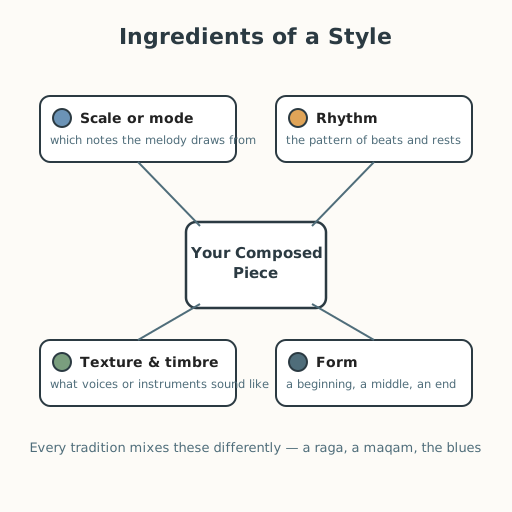
This lesson is written to the learner (“you”). The skill to land: composing in a style means choosing from that style’s ingredients — (1) scale or mode (which notes the melody may draw from), (2) rhythm (the pattern of beats and rests), (3) texture and timbre (what the voices or instruments sound like), and (4) form (a beginning, middle, and end) — and then reflecting on those choices. This is a skill, so model a short example first (compose a four-phrase melody together, naming each choice), then let learners compose independently (explicit instruction carries novice skills — S-011). The global lens is central and must be handled with care: different traditions use different scales and conventions — Indian classical music is built on the raga, a melodic framework with a specific scale, notes, and mood (S-366), and Arab, Turkish, and Persian music is built on the maqam, a modal system with characteristic intervals (S-367). Teach these as living traditions to honor with respectful questions, never as specimens to imitate carelessly — a learner should not pretend to “do a raga” without understanding; they may choose to explore a tradition they know or have been welcomed into (S-056). The egalitarian lens: composition needs only voice and body — no instrument is required. The ethics lens: borrowing from a living tradition carries responsibility; name the tradition, ask before taking, and give credit (a preview of Grade 10’s appreciation-vs-appropriation work). The intellectual lens: the choices reflection — why this scale, this rhythm, this form — is where the learning lives. Keep assessment mastery-based: a piece that is not finished is “not yet,” never a failure.
Procedure
- Recall (5 min). From Grade 7: what did you pay attention to when you performed — dynamics, phrasing, ensemble? Today we move from performing to composing.
- Meet the ingredients (10 min). Look at the style ingredients card. A style has four ingredients: scale or mode (which notes), rhythm (beats and rests), texture & timbre (what it sounds like), and form (beginning, middle, end). Two examples: the Indian raga (S-366) and the Arab, Turkish, and Persian maqam (S-367) each have their own scales and moods.
- Modeled composition (10 min). Together, compose a short four-phrase melody, naming each choice as you go: “we use these three notes, this rhythm, a clap for texture, and an A–B–A form.” Notice the choices.
- Compose your own (20 min). Choose a style or tradition you know — a song form from your family, a scale you like, a rhythm you feel. Compose a short piece (about 30 seconds to a minute) using voice, body, found sound, or an instrument. On the choices sheet, record each choice and its reason.
- Reflect (5 min). Write two or three sentences: what did you choose, and why? What would you change if you had more time?
- Close (5 min). Share your piece or your choices with a partner. A composer is someone who can say why the piece sounds the way it does.
Differentiation
- Support: Compose a single phrase using three notes and one rhythm; record one choice and reason.
- Extension: Compose within a specific scale or mode, name the notes you used, and explain how that scale shapes the mood.
- Access (non-auditory): A piece can be composed as a drawn score — shapes and marks for rhythm, pitch, and form — or as a rhythm tapped on a drum or the body so it can be felt. “Texture and timbre” can be explored as vibration, or as different surfaces struck to feel their difference.
- Access (performance anxiety): Sharing the piece is a choice, never a requirement. A learner may instead share the choices sheet, a drawn or felt score, a recording, or the piece with a single trusted partner. The goal is the composing and the choices reflection — not performing in front of a group.
Assessment
- Formative (observation): Can the learner name the ingredients and explain one choice they made?
- Performance/portfolio artifact: The performed or recorded piece plus the choices reflection, kept in the portfolio.
Home connection
At home, find a song or chant your family knows. Ask what tradition it comes from and what makes it sound the way it does. Bring one thing you learned to the next lesson.
Resources
- On the raga as a melodic framework in Indian classical music: Encyclopaedia Britannica, “Raga,” https://www.britannica.com/art/raga (S-366).
- On the maqam as a modal system of Arab, Turkish, and Persian music: Encyclopaedia Britannica, “Maqam,” https://www.britannica.com/art/maqam-music (S-367).
- On honoring living traditions with respect: UNESCO, Intangible Cultural Heritage, https://ich.unesco.org/ (S-056).
- On explicit instruction and worked examples: Kirschner, Sweller & Clark (2006), https://doi.org/10.1207/s15326985ep4102_1 (S-011).