Lesson 05 — Critiquing a Musical Work: Elements, Context, Effect
Learners critique a musical work with **evidence**, using the eight **elements of music** — melody, rhythm, harmony, timbre, dynamics, tempo, texture, and form — plus **context** and **effect**, and separating observation from judgment. They listen to works from different traditions.
Objectives
Objectives
- D07.S2.08.02 Critique a musical work using evidence about its elements, context, and effect, separating observation from judgment.
Essential question
How do I critique a musical work using evidence about its elements, context, and effect — separating observation from judgment?
Key vocabulary
Materials
Standard materials
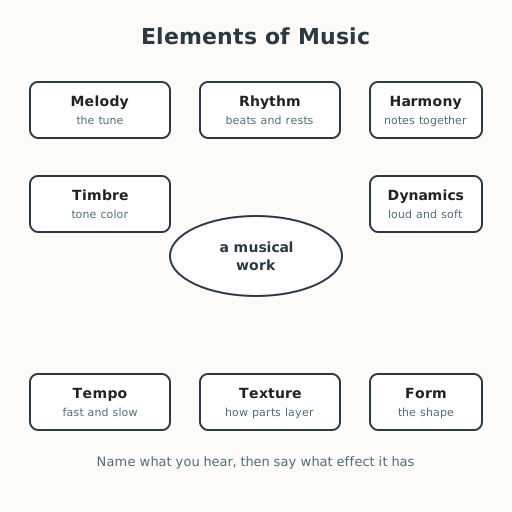
- Elements of music card · 1 per learner A card naming the eight elements of music — melody, rhythm, harmony, timbre, dynamics, tempo, texture, form — with a one-word reminder for each
- Two musical works to critique · 2 per pair Short recorded pieces from different traditions, chosen to be rich in elements and clear in effect
Low-tech / no-cost
- Live singing or clapping Critique a song sung or a rhythm clapped live in the room instead of a recording
- The learners' own compositions from Lesson 4 Critique a peer's composed piece as the subject
- A visual or felt music source For Deaf and hard-of-hearing learners, critique the piece through its written or drawn score, or by feeling the vibration of a drum, a speaker, or the floor — rhythm and dynamics can be felt, not only heard
Enriched / lab & device
- A listening device and curated playlist · 1 per group Headphones and a short playlist of contrasting works from several traditions
- A shared document or slide · 1 per group Write the critique collaboratively and compare evidence
Works in different contexts
- large-group Listen once as a whole group and model the critique, then pairs critique a second work and share one evidence-based sentence each
- multi-age Younger learners name two elements they hear; older learners complete the full critique with context and effect
- self-directed A learner listens twice, fills the critique frame alone, and self-checks that every judgment cites an element heard
- level-grouped Learners ready to extend compare the *effect* of two works on one shared theme (celebration, grief) and explain the difference with evidence
- outdoor-only Critique sounds outdoors — a bird's song, water, a chant, a drum — using the same elements where they apply
Lesson 5 — Critiquing a Musical Work: Elements, Context, Effect
Summary
Learners critique a musical work with evidence, using the eight elements of music — melody, rhythm, harmony, timbre, dynamics, tempo, texture, and form — plus context and effect, and separating observation from judgment. They listen to works from different traditions, treating each as a living practice to honor with questions.
Objectives
- Critique a musical work using evidence about its elements, context, and effect. (D07.S2.08.02)
- Separate observation from judgment. (D07.S2.08.02)
Connection
You have said “this song makes me happy” or “that music is sad.” That is a start — but why does it feel that way? Is it the fast tempo, the high melody, the loud dynamics, the sound of a particular voice or instrument (timbre)? Music does not move you by magic; it moves you through specific, nameable choices. When you learn to name them, you stop being someone music happens to and become someone who can hear how it works — and that skill deepens every song you love.
Materials
- Elements of music card
- Two musical works to critique
Preparation
- Copy the elements of music card; choose and prepare two short recorded works (or plan two live performances) from different traditions.
- Retrieval: from Grade 7, recall how sound is used in media to shape mood and meaning — today we turn that into a full, evidence-based critique.
Facilitator note
This lesson is written to the learner (“you”). The skill to land: a musical critique names the elements heard — melody (the tune), rhythm (beats and rests), harmony (notes sounding together), timbre (tone color), dynamics (loud and soft), tempo (fast and slow), texture (how parts layer), and form (the shape) — then states the work’s context and its effect, and separates observation from judgment, with judgment citing evidence. The eight elements are standard music-education vocabulary (S-368). This is a skill, so model the critique once on a first work, then let learners practice in pairs (explicit instruction carries novice skills — S-011). The critical-thinking lens: “name what you hear, then say what effect it has” is the evidence habit applied to sound. The ethics lens: a critique describes the work, never the musicians, and can disagree without disrespect — and when a classmate’s piece is the subject, it is critiqued only with their consent, saying what is true and kind. The egalitarian lens: every listener’s evidence-based judgment is valid; no one’s taste is “better.” Music is felt and read as well as heard — vibration, a score, or a drawn shape are full ways in for Deaf and hard-of-hearing learners, and the same elements apply. The global lens: the same eight elements help you listen across traditions, but context matters — a rhythm or scale means something inside its own tradition, so honor the work’s context rather than ranking it by one tradition’s rules (S-056). Keep the tone generative: critique deepens listening, it does not shut it down.
Procedure
- Recall (5 min). From Grade 7: how does sound shape mood and meaning in a film or ad? Today we turn that into critique.
- Meet the elements (10 min). Look at the elements of music card. Eight elements: melody, rhythm, harmony, timbre, dynamics, tempo, texture, form. Say each with its one-word reminder. These are the words that make a critique precise.
- Modeled critique (10 min). Listen to the first work twice. Together, name what you hear (its melody, rhythm, tempo, timbre), state its context (where and when it comes from), and describe its effect — with a reason drawn from the elements.
- Practice in pairs (20 min). Listen to a second work from a different tradition. Fill in the critique frame: elements, context, effect. Rule: every judgment sentence must name an element you heard.
- Peer-check (5 min). Swap frames. Check: is each judgment backed by evidence? Is observation separate from judgment? Fix what is missing.
- Close (5 min). Share one evidence-based sentence: “I heard ___, so it feels ___.” That is a critique.
Differentiation
- Support: Name two elements you hear and use a sentence starter (“The ___ is ___, so the music feels ___”).
- Extension: Compare two works on one shared theme (celebration, grief) and write how each uses the elements differently to create its effect.
- Access (non-auditory): The same elements can be read by other senses — tempo and rhythm from a score, a drawn waveform, or felt vibrations; dynamics from how strong the vibration is; form from the piece’s written or drawn shape. A critique can cite what is felt or read, not only what is heard.
Assessment
- Formative (observation): Can the learner name an element heard and connect a judgment to it?
- Peer/portfolio artifact: The completed critique frame, kept in the portfolio.
Home connection
At home, listen to any song and write one evidence-based sentence: “I hear ___, so I feel ___.” Bring it to the next lesson.
Resources
- On the elements of music as the vocabulary of listening: “Elements of music,” https://en.wikipedia.org/wiki/Elements_of_music (S-368).
- On honoring musical traditions as living practices: UNESCO, Intangible Cultural Heritage, https://ich.unesco.org/ (S-056).
- On explicit instruction and worked examples: Kirschner, Sweller & Clark (2006), https://doi.org/10.1207/s15326985ep4102_1 (S-011).