Lesson 03 — Design Trade-offs: Cost, Safety, Access, Environment
Learners explain how **design decisions involve trade-offs among cost, safety, access, and the environment**, using the real example of lighting a home without grid electricity — a kerosene lamp versus a solar lamp. They see that no design is best at everything, and that a good design names what it is trading away.
Objectives
Objectives
- D10.S1.08.02 Explain how design decisions involve trade-offs among cost, safety, access, and the environment, using a real example.
Essential question
How do design decisions involve trade-offs among cost, safety, access, and the environment?
Key vocabulary
Materials
Standard materials
- Trade-off sheet · 1 per learner A four-corner organizer (cost, safety, access, environment) with a space to write the trade-off for a real example
- Case cards · 1 set per group Two competing designs for lighting a home without grid electricity — a kerosene lamp and a solar lamp — with facts about each
Low-tech / no-cost
- A shared board or large paper Draw the four corners and record trade-offs together; no printed sheet needed
- Voice and a partner Argue one corner each aloud and find where the trade-off is
Enriched / lab & device
- A short video on off-grid solar · 1 Shows how solar lamps and panels reach homes the grid does not
- A digital four-corner table · 1 per group Build and sort the trade-off facts collaboratively and present them
Works in different contexts
- large-group Model the first corner as a whole class, then small groups fill the rest and report one trade-off each
- multi-age Younger learners sort each fact into one of the four corners; older learners state the trade-off in one "you can't have both at once" sentence
- self-directed A learner fills the sheet alone and writes one paragraph explaining the central trade-off
- level-grouped Learners ready to extend choose a second design decision (a bridge, a phone, a water pump) and map its four trade-offs
- outdoor-only Look at a real built thing outdoors (a path, a wall, a pump) and name one trade-off its designers faced
Lesson 3 — Design Trade-offs: Cost, Safety, Access, Environment
Summary
Learners explain how design decisions involve trade-offs among cost, safety, access, and the environment, using the real example of lighting a home without grid electricity — a kerosene lamp versus a solar lamp. They see that no design is best at everything, and that a good design names what it is trading away.
Objectives
- Explain how design decisions involve trade-offs among cost, safety, access, and the environment, using a real example. (D10.S1.08.02)
Connection
When you choose between two ways to do one job — walk or ride, paper or screen — you are doing what every designer does: trading one thing for another. The walk is slower but cleaner and free; the ride is faster but costs money and fuel. Designers face the same four questions for every object: How much does it cost? Is it safe? Who can reach it? What does it do to the Earth? Today you learn to name the trade that lives inside every design.
Materials
- Trade-off sheet
- Case cards
Preparation
- Copy the sheet and case cards.
- Retrieval: from Lesson 2, recall the benefits-and-harms skill; today we look inside the design behind those benefits and harms.
Facilitator note
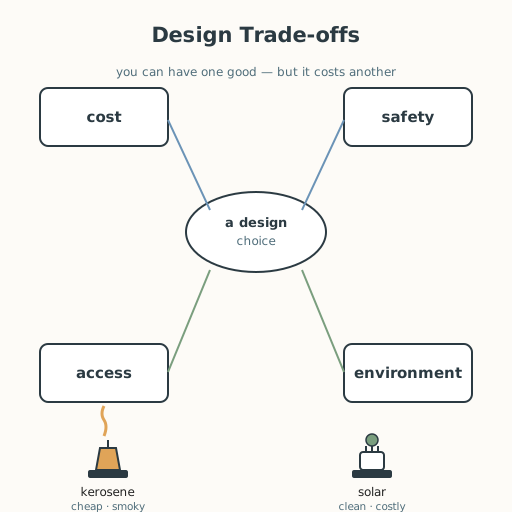
This lesson is written to the learner (“you”). The idea to land: every design trades one good for another; there is no perfect design, only designs that are honest about what they trade. The worked example: lighting a home without grid electricity. A kerosene lamp is cheap to buy — low upfront cost — but it is a fire hazard (unsafe), its smoke harms health (WHO household air pollution, S-219), and burning kerosene pollutes the environment and emits carbon. A solar lamp is clean and safe — better on safety and environment — but it costs more upfront, which limits access for people who cannot afford it, and it depends on sunlight and a battery that will one day be waste. So the trade-off is real: low cost now versus safety and a clean environment, with access caught in the middle. The egalitarian lens: “access” is the corner that asks who is left out — a lamp that costs too much stays out of the hands that need it most. The ethics lens: a designer who ignores safety or the environment to save cost is making a moral choice, not just a technical one. The global lens: this exact trade-off is being made right now in homes from Nairobi to the Himalayas, where off-grid solar is growing fast. The technology & environment lens: the “environment” corner is not optional decoration — it is one of the four things every real design must weigh (S-095, S-371). Keep the example factual; let learners argue which corner matters most and why, without forcing a single answer (philosophy §11).
Procedure
- Recall (5 min). From Lesson 2: the same technology helps some and harms others. Today we ask a deeper question: why does a technology land that way? Because of the design.
- Meet the four corners (10 min). A designer balances four things: cost (what it takes to make and buy), safety (does it hurt anyone?), access (who can actually reach and use it?), and the environment (what does it do to the living Earth?). Say each in your own words.
- Meet the case (10 min). Read the case cards: two ways to light a home without grid electricity — a kerosene lamp and a solar lamp. For each, sort the facts into the four corners.
- Find the trade (15 min). Worked example: the kerosene lamp — low cost, but unsafe (fire) and bad for health and environment (smoke, carbon). Now do the solar lamp: safe and clean, but higher cost and so less access. Write the trade in one sentence: “You can have ___ , but it costs ___ .”
- Weigh (7 min). If you had to choose for a family with little money and no grid, which lamp would you design toward, and which corner would you protect most? Why?
- Close (3 min). There is no perfect design — only designs that are honest about what they trade.
Differentiation
- Support: Provide the trade-off sentence starter and ask the learner to fill in two corners only.
- Extension: Choose a second design decision and map its four trade-offs, then defend which corner matters most in that case.
Assessment
- Formative (observation): Can the learner name the four corners and state one real trade-off in one sentence?
- Portfolio artifact: The completed trade-off sheet, kept in the portfolio.
Home connection
Look at one thing your household uses every day and ask: what trade-off did its designers make among cost, safety, access, and the environment? Discuss one.
Resources
- On the health harms of household air pollution from fuels like kerosene: WHO, “Household air pollution,” https://www.who.int/news-room/fact-sheets/detail/household-air-pollution-and-health (S-219).
- On renewable and nonrenewable energy sources: U.S. Energy Information Administration, “Energy Kids,” https://www.eia.gov/kids/energy-sources/ (S-095).
- On design as weighing a product’s life-cycle effects: U.S. EPA, “Sustainable Materials Management,” https://www.epa.gov/smm (S-371).
- On explicit instruction and worked examples: Kirschner, Sweller & Clark (2006), https://doi.org/10.1207/s15326985ep4102_1 (S-011).