Lesson 05 — Deepfakes and Altered Video: Is It Real?
Learners evaluate whether an **image or video might be altered or misleading — such as a deepfake** — and describe **at least one way to check**: look for unnatural edges, blinking, and lighting; trace who posted it and where it first appeared; and check it against independent reporting. They learn that a deepfake is a *tool*, and that checking it is a learnable, repeatable skill.
Objectives
Objectives
- D10.S2.08.02 Evaluate whether an image or video might be altered or misleading, such as a deepfake, and describe one way to check.
Essential question
How do I evaluate whether an image or video might be altered or misleading, and how do I check?
Key vocabulary
Materials
Standard materials
- Deepfake-check checklist · 1 per learner A short list — look for unnatural edges, blinking, and lighting; ask who posted it; find the original; check independent reporting
- Case cards · 1 set per group Two short video descriptions — one real, one a likely deepfake — to evaluate with the checklist
Low-tech / no-cost
- A shared board or large paper Draw the checklist together and evaluate the cases aloud; no printed cards needed
- Voice and a partner Describe a "too-perfect" video aloud and practice asking the checking questions
- A described or audio-only example Use a voice-clone audio sample (or a partner reading the same words in two different "voices") so checking works by listening, with no image or video
Enriched / lab & device
- A computer or tablet · 1 per group Practice a reverse video/image search and look at a detection tool's sample clips
- A short age-appropriate video on how deepfakes are made · 1 Shows the basic idea of face-swapping and voice cloning, clearly labeled as educational
Works in different contexts
- large-group Evaluate the first case as a whole class on the board, then small groups evaluate the second and report
- multi-age Younger learners name one thing that looks "off"; older learners run the full checklist and give a verdict
- self-directed A learner works the checklist on the case cards alone and writes a one-paragraph verdict
- level-grouped Learners ready to extend research one real deepfake case in the news and report how it was caught
- outdoor-only If a video of a real event can be faked, what extra care do we owe the people it shows?
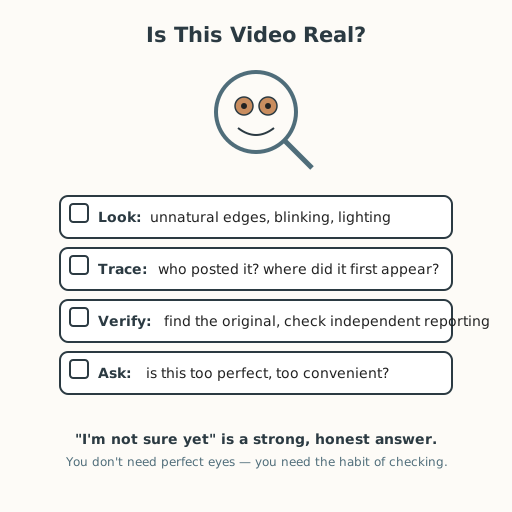
Lesson 5 — Deepfakes and Altered Video: Is It Real?
Summary
Learners evaluate whether an image or video might be altered or misleading — such as a deepfake — and describe at least one way to check: look for unnatural edges, blinking, and lighting; trace who posted it and where it first appeared; and check it against independent reporting. They learn that a deepfake is a tool, and that checking it is a learnable, repeatable skill.
Objectives
- Evaluate whether an image or video might be altered or misleading, such as a deepfake, and describe one way to check. (D10.S2.08.02)
Connection
You have probably seen a video that felt too strange, too perfect, or too convenient — a famous person saying something they would never say, a clip of an event that “proves” something too neatly. Some of those are deepfakes: videos made by a machine that swaps one face onto another or makes a voice say new words. The tool is real, but so is the skill of checking. Today you learn to spot the seams.
Materials
- Deepfake-check checklist
- Case cards
Preparation
- Copy the checklist and case cards.
- Retrieval: from Lesson 4, recall the three moves that change an image’s meaning (crop, caption, context). A deepfake is a more powerful version of the same idea — making the pixels lie.
Facilitator note
This lesson is written to the learner (“you”). The idea to land: a deepfake is a machine-made piece of synthetic media — a face or voice swapped or cloned so a person appears to say or do what they never did — and it is evaluated, not feared, by checking. Keep the definition simple and true (S-393): synthetic media includes face-swaps, voice clones, and full video puppets. The checking skill (S-393, S-394): (1) look — unnatural edges where face meets neck, odd blinking, strange lighting or shadows, blurry or glitching mouth; (2) trace — who posted it, and where did it first appear?; (3) verify — find the original and check it against independent reporting (lateral reading: leave the video and check the world around it). The ethics lens: a deepfake of a real person can harm them and mislead others, so making and sharing one carries responsibility. The egalitarian lens: deepfakes can be aimed at silencing or shaming people — especially women and public figures — and believing a fake can harm the very people it shows. The global lens: the same tools and tricks spread across every language and country, so the checking habit is a global one. The technology lens is this lesson’s core: the tool itself is neither good nor evil — like every technology, it helps or harms depending on how it is used and governed (philosophy §4). Reassure learners: no one is expected to be a perfect human detector — the goal is the habit of tracing and checking, and the comfort of saying “I’m not sure yet.” Keep the examples age-appropriate and non-graphic (philosophy §3); no learner should be asked to watch disturbing content.
Procedure
- Recall (5 min). From Lesson 4: how can a picture change its meaning? (Crop, caption, context.) A deepfake goes further — it makes the pixels themselves lie.
- Meet the deepfake (10 min). A deepfake is a video (or audio) made by a machine that swaps or clones a face or voice, so a person appears to say or do what they never did. It is synthetic media — media built, not recorded.
- Meet the checks (10 min). Read the checklist: look (edges, blinking, lighting, glitches), trace (who posted it, where did it first appear?), verify (find the original, check independent reporting). Say each in your own words.
- Worked example (10 min). Read case card 1 together. Walk the checklist step by step and reach a verdict: “This video is likely ___, because ___.”
- Practice (10 min). Evaluate case card 2 in your group and write your verdict using the same frame.
- Close (5 min). You don’t need perfect eyes — you need the habit of checking. “I’m not sure yet” is a strong, honest answer.
Differentiation
- Support: Provide the verdict sentence starter and ask the learner to complete one check only.
- Extension: Research one real deepfake case reported in the news and write a short account of how it was caught and what happened.
- Access (non-visual): The “trace” and “verify” checks need no sight — a learner who is blind or has low vision leans on who posted it, where it first appeared, and independent reporting, plus listening checks for audio (odd pauses, robotic rhythm, wrong emphasis). The “look” checks can be read aloud by a partner for those who use them; no one is expected to be a perfect visual detector.
Assessment
- Formative (observation): Can the learner describe one way to check a possibly-altered video and reach a reasoned verdict?
- Portfolio artifact: The completed deepfake-check checklist with one written verdict, kept in the portfolio.
Home connection
Watch one short video with someone at home and name one thing you would check if you weren’t sure it was real. Practice saying “let’s check” instead of instantly sharing.
Resources
- On synthetic media and how to think about deepfakes: WITNESS Media Lab, “Prepare, Don’t Panic: Synthetic Media and Deepfakes,” https://lab.witness.org/projects/synthetic-media-and-deep-fakes/ (S-393).
- On verification essentials (reverse image search, tracing the source): First Draft, “Verifying Online Information: The Absolute Essentials” (2019; archived after First Draft’s 2022 closure), https://web.archive.org/web/2019/https://firstdraftnews.org/latest/verifying-online-information-the-absolute-essentials/ (S-394).
- On media literacy as a teachable skill: UNESCO, “Media and Information Literacy,” https://www.unesco.org/en/media-information-literacy (S-217).
- On explicit instruction and worked examples: Kirschner, Sweller & Clark (2006), https://doi.org/10.1207/s15326985ep4102_1 (S-011).