Lesson 01 — All of Me: The Whole Self Made of Intersecting Identities
Learners recall the Grade-8 idea that identity is made of many parts and open the year's closing capstone by mapping their own **intersecting identities** — culture, gender, ability, language, and one of their choosing — into a **whole self** they are still becoming.
Objectives
Objectives
- D01.S2.08.01 Explain how multiple and intersecting identities, such as culture, gender, ability, and language, shape a whole self.
Essential question
Who am I becoming, as multiple and intersecting identities shape a whole self?
Key vocabulary
Materials
Standard materials
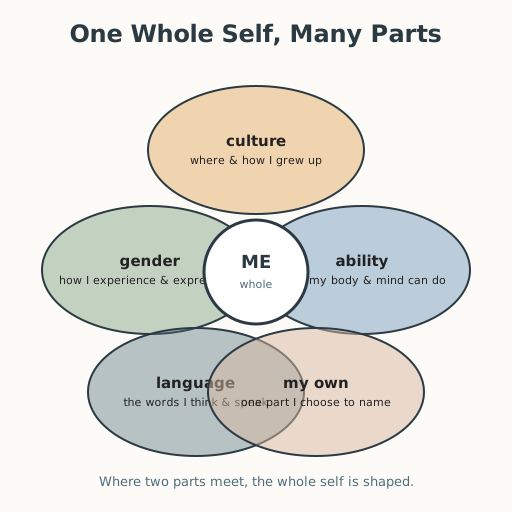
- Whole-self map sheet · 1 per learner A one-page map with a central "me" and five overlapping spaces for culture, gender, ability, language, and one identity of the learner's own choosing
- Recall cards · 1 set per group Cards recalling the Grade-8 identity ideas from Unit 1 — multiple identities, intersecting identities, self-worth vs. outside approval
Low-tech / no-cost
- A shared board or large paper Draw the whole-self map together on one big sheet; no printed sheets needed
- Voice and memory Recall the Unit-1 identity ideas aloud as a group instead of using cards
Enriched / lab & device
- A digital slide or drawing tool · 1 per learner Build the whole-self map as an image to keep in the digital portfolio
- A wonder box (physical or shared document) · 1 A place to collect questions about identity to revisit in the closing lesson
Works in different contexts
- large-group Do the recall round as a whole group with ideas recorded on the board, then each learner completes their own map and shares one identity
- multi-age Younger learners match each identity to a picture or symbol; older learners write a sentence about how two identities combine and why that matters
- self-directed A learner reads the map sheet, recalls the Unit-1 ideas in writing, and completes the map alone, then checks each space is filled
- level-grouped Learners ready to extend add a second identity of their own choosing and write how three (not two) identities intersect in one real moment
- outdoor-only Point to real people and roles outdoors (a farmer, a neighbor, a sibling, a teammate) and ask how several identities combine in one whole person
Lesson 1 — All of Me: The Whole Self Made of Intersecting Identities
Summary
Learners recall the Grade-8 idea that identity is made of many parts, and open the year’s closing capstone by mapping their own intersecting identities — culture, gender, ability, language, and one of their choosing — into a whole self they are still becoming. This is the first half of the unit’s first essential question.
Objectives
- Explain how multiple and intersecting identities — such as culture, gender, ability, and language — shape a whole self. (D01.S2.08.01)
Connection
Think of a moment when you were more than one thing at once: a child and a teammate, a person who speaks one language at home and another at school, someone who loves music and worries about an exam. No single label can hold all of you. Your identity is not one box you tick; it is the place where many parts of you meet and shape one whole person. Today you look at that meeting place — and begin to say who you are becoming.
Materials
- Whole-self map sheet
- Recall cards
Preparation
- Copy the whole-self map sheet and recall cards.
- Retrieval: from Unit 1 (Feelings, Identity & Purpose), recall (a) identity is made of many parts, (b) identities intersect rather than sit side by side, and (c) inner worth is different from outside approval. Today we rebuild that idea as a map of a whole self.
Facilitator note
This lesson is written to the learner (“you”). It is the opening and retrieval pass of the capstone, so the goals are modest: (1) recall that identity is many parts that intersect; (2) name the four intersecting identities the standard names — culture, gender, ability, and language — plus one of the learner’s own choosing; (3) map them into one whole self. Do not push for a finished autobiography today; the reflection deepens across the unit and is gathered in Lesson 5. The critical-thinking lens: “which parts of me are mine, and which are labels others stuck on me?” is the habit carried forward (S-334). The egalitarian lens: no identity ranks above another, and a person is never just one label — intersectionality names how overlapping identities shape experience together, not separately (S-334). The global lens: what counts as a core identity — clan, faith, nation, craft — differs across cultures; let learners name their own. The technology lens: online platforms often reduce a whole person to a few checkable labels; today we push back by mapping the whole. Identity is offered as a growing story, never a finished verdict (S-155); and “who I am becoming” names the possible selves a person imagines hoping to become and fearing to become — imagined possibilities, not a fixed verdict (S-399). Spacing note (S-039): this recall pass is what makes the capstone stick.
Procedure
- Recall (8 min). In a small group, review three recall cards — identity has many parts, identities intersect, inner worth vs. outside approval — reading them together aloud (or having them read to you). For each, say in one sentence what you remember from Unit 1.
- Meet the four (7 min). Four identities the whole year has circled back to: culture (where and how you grew up), gender (how you experience and express being you), ability (what your body and mind can do, and how the world meets it), language (the words you think, speak, and dream in). Say each in your own words.
- Map your whole self (15 min). On the whole-self map, write you in the center. In each of the five spaces — culture, gender, ability, language, and one identity you choose — write one short, honest note about that part of you. (No writing needed? Say each part aloud and have a partner or facilitator write it, or build the map from found objects — a stone for each identity, placed to touch in the middle.)
- Where two meet (12 min). Pick two of your identities and write one sentence about how they combine in you. Example: “My love of my home language and my love of science meet when I explain a discovery to my grandmother.” (Worked example — change the details to your own life.)
- Share one thread (8 min). With a partner, share one identity and one place where two of yours meet. Then listen to your partner’s. Notice: every person in the room is a whole made of many parts.
- Close (5 min). Today you began the answer to “who am I becoming?” Next: we look at what you will choose rather than react to.
Differentiation
- Support: Give sentence starters (“The part of me that ___ meets the part that ___ when…”). Choose two identities instead of five.
- Extension: Write how three identities intersect in one real moment of your life.
Assessment
- Formative (observation): Can the learner name the four intersecting identities and give one example of two of them meeting in their own life?
- Artifact: The completed whole-self map, kept in the portfolio and returned to in Lesson 5.
Home connection
Ask someone at home: “What are two or three parts of who you are, and where do they meet?” Bring one sentence of their answer (no private details needed) to the next lesson.
Resources
- On intersectionality as overlapping identities shaping experience together, not separately: Crenshaw (1989), “Demarginalizing the Intersection of Race and Sex” (S-334).
- On identity as a lifelong, developing story rather than a finished fact: Erikson, Childhood and Society (S-155).
- On “who I am becoming” as mapping imagined possible selves, not a fixed verdict: Markus & Nurius (1986), “Possible Selves” (S-399).
- On the payoff of spaced retrieval: Dunlosky et al. (2013) (S-039).
- On explicit modeling before independent work: Kirschner, Sweller & Clark (2006) (S-011).