Lesson 02 — What I Choose, Not What I React To: Impulse, Choice & Consequences
Learners practice the **pause** between an impulse and an action, then weigh **short-term against long-term consequences** for one real decision, writing a choice-and-consequences note they can carry forward.
Objectives
Objectives
- D01.S3.08.01 Manage impulses deliberately, choosing a response rather than reacting in emotionally charged moments.
- D01.S3.08.02 Explain the difference between short-term and long-term consequences and weigh them in a decision.
Essential question
What will I choose rather than react to, as I look ahead?
Key vocabulary
Materials
Standard materials
- Choice-and-consequences note sheet · 1 per learner A one-page sheet with a "pause" box and two columns — short-term and long-term — for weighing one real decision
- Scenario cards · 1 set per group Short, everyday scenarios with a tempting immediate choice and a delayed consequence (a message sent in anger, a skipped practice, an impulse buy)
Low-tech / no-cost
- A shared board or large paper Draw the two-column weigh-together on one big sheet; no printed sheets needed
- Voice and body Act out the pause — a held breath, a step back — instead of using cards
Enriched / lab & device
- A shared document or spreadsheet · 1 per learner Build the two-column weigh-in digitally and keep it in the portfolio
- A timer app or visible clock · 1 To practice a real 10-second pause between a trigger and a response
Works in different contexts
- large-group Model the pause once for the whole class, then learners weigh one scenario in pairs and report one consequence each
- multi-age Younger learners sort consequences into "now" vs. "later" with pictures; older learners write the decision and defend the weighing
- self-directed A learner reads the worked example, applies the four steps to one real decision of their own, and self-checks that both columns are filled
- level-grouped Learners ready to extend add a "for others" column and weigh consequences that fall on people beyond themselves
- outdoor-only Use a real outdoors decision (go inside when the storm comes, wait your turn at the water tap) and weigh it aloud with two columns drawn in the dirt or on paper
Lesson 2 — What I Choose, Not What I React To: Impulse, Choice & Consequences
Summary
Learners practice the pause between an impulse and an action, then weigh short-term against long-term consequences for one real decision, writing a choice-and-consequences note they can carry forward. This is the second half of the unit’s first essential question.
Objectives
- Manage impulses deliberately, choosing a response rather than reacting in emotionally charged moments. (D01.S3.08.01)
- Explain the difference between short-term and long-term consequences, and weigh them in a decision. (D01.S3.08.02)
Connection
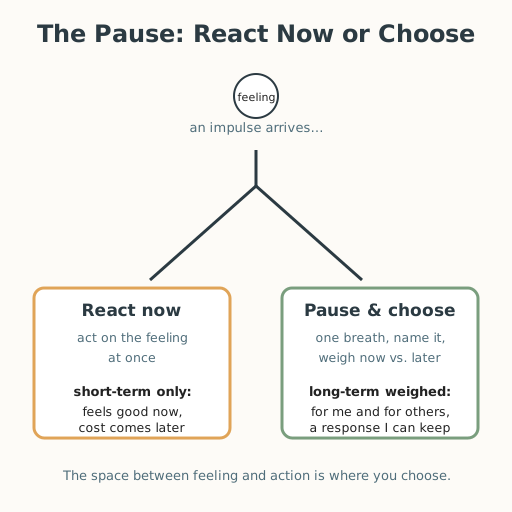
You feel a flush of anger or excitement and want to act right now — send the message, say the sharp thing, tap “buy,” quit the practice. That hot instant is real, and it is not the whole story. Between the feeling and the action there is a small space — a breath, a beat — where you can choose what happens next. Today you learn to find that space and use it to weigh now against later.
Materials
- Choice-and-consequences note sheet
- Scenario cards
Preparation
- Copy the note sheet and scenario cards.
- Retrieval: from Unit 1, recall the pause skill and the idea that short-term and long-term consequences are different things. Today we turn that into a written, repeatable decision tool.
Facilitator note
This lesson is written to the learner (“you”). The goal: each learner can (1) pause deliberately between an impulse and a response, and (2) weigh short-term against long-term consequences in one real decision. Model the four steps — pause, name the feeling, weigh now vs. later, choose — as a worked example before independent practice (S-011); the pause is a skill, so it is taught explicitly, not left to discovery. On the science: the delay-of-gratification tradition shows the pause is learnable, and we teach it as a skill — not as a claim that one childhood test predicts a life (S-336). Adolescence is a period of heightened reward sensitivity, which is exactly why a practiced pause matters; the brain’s brakes are still being built (S-229). The ethics lens: a decision is weighed not only by what it costs me now but by what it does to others later. The egalitarian lens: whose consequences do we count — the comfortable and the powerful, or everyone the choice touches? The technology lens: many apps are designed to remove the pause (one-tap buying, auto-playing next, notifications that demand now); naming that design is the first step to choosing anyway. Keep “react vs. respond” free of moralism — reacting is human; choosing is a practice, not a verdict.
Procedure
- Recall (6 min). What did we map last time — and what is the small space between a feeling and an action called? Say it in your own words. (The pause.)
- Follow the worked example (8 min), read aloud. Follow a model decision, step by step:
- Pause — stop; one full breath, a step back.
- Name — “I am angry / excited / hurt because…”
- Weigh — short-term: what happens now? long-term: what happens later, for me and others?
- Choose — the response you can stand behind tomorrow. Example: a friend sends a mocking message. Now: replying instantly feels satisfying. Later: the fight grows, the friendship is damaged, others get pulled in. Choose: pause, cool down, reply with a calm “that stung — can we talk?”
- Guided practice (12 min). In pairs, take one scenario card (or hear it read aloud). Run the four steps aloud together, writing the short-term and long-term consequences in the two columns. The facilitator checks one pair’s work before you continue.
- Your own decision (15 min). Pick one real decision coming up in your life. Fill the note sheet: the situation, the impulse, the pause you will use, the short-term consequences, the long-term consequences, and your chosen response.
- Peer check (8 min). Trade notes. Give one specific piece of feedback: “I could see the long-term consequence when you wrote…” and one question: “What would you do if the pause felt impossible in the moment?”
- Close (6 min). You did not promise to be perfect; you built a tool. Next: we turn from “me” to “us” — belonging you strengthen.
Differentiation
- Support: Work only from the worked example, copying its four steps with your own details; choose one consequence per column.
- Extension: Add a third column — consequences for other people — and weigh one decision whose costs fall mostly on others.
Assessment
- Formative (self): Can the learner name the four steps and fill both columns for one real decision?
- Artifact: The choice-and-consequences note, kept in the portfolio as the unit’s closing “choice” artifact.
Home connection
Ask someone at home about a decision where waiting a little changed the outcome for the better. Bring one sentence of their story (no private details) to the next lesson.
Resources
- On delay of gratification as a learnable skill, with the replication caveat noted: Mischel, Shoda & Rodriguez (1989) (S-336).
- On adolescence as a period of heightened reward sensitivity, when a practiced pause matters most: Steinberg, Age of Opportunity (S-229).
- On explicit instruction and worked examples for new skills: Kirschner, Sweller & Clark (2006) (S-011).
- On spaced retrieval: Dunlosky et al. (2013) (S-039).