Lesson 03 — Belonging I Strengthen
Learners analyze who is included and who is left out, then plan one concrete act to **strengthen belonging** in their school or local community — a welcome they can actually carry out this week.
Objectives
Objectives
- D02.S3.08.02 Take part in strengthening belonging in their school or local community.
Essential question
How do I strengthen belonging, as I carry this year into high school?
Key vocabulary
Materials
Standard materials
- Belonging plan sheet · 1 per learner A one-page plan with three spaces — one person to welcome, one act to take, one habit to keep — for strengthening belonging
- Belonging case cards · 1 set per group Short scenes where someone is left out (a new student at lunch, a teammate who is always picked last, a person whose language no one else speaks)
Low-tech / no-cost
- A shared board or large paper Draw the belonging web together on one big sheet; no printed sheets needed
- Voice and memory Recall a time of feeling welcomed (or left out) aloud as a group instead of using cards
Enriched / lab & device
- A shared document or group chat for the plan · 1 Write the belonging plan where the class can revisit and check on it together
- A photo or voice-note record · 1 per learner Capture the belonging act as it happens and keep it in the portfolio
Works in different contexts
- large-group Build one class belonging web on the board, then each learner commits to one thread and reports back next lesson
- multi-age Younger learners draw or mime a welcome; older learners write the plan and pair with a younger learner as a peer guide
- self-directed A learner completes the plan alone, chooses one act they can do this week, and self-checks that all three spaces are filled
- level-grouped Learners ready to extend identify *who is left out* in a real setting and plan one way to widen the circle, not just the welcome
- outdoor-only Notice where people gather outdoors (a market, a field, a water point) and ask who is included and who is left out, then plan one small welcome
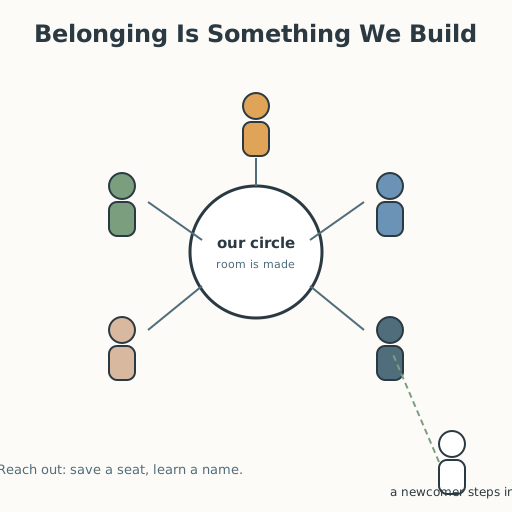
Lesson 3 — Belonging I Strengthen
Summary
Learners analyze who is included and who is left out, then plan one concrete act to strengthen belonging in their school or local community — a welcome they can actually carry out this week. This opens the unit’s second essential question.
Objectives
- Take part in strengthening belonging in their school or local community. (D02.S3.08.02)
Connection
Remember a time you truly belonged: someone saved you a seat, learned to say your name right, or made room for you when the circle was already full. Now remember the opposite — the lunch table where no one shifted, the game where you were picked last. Belonging is not magic; it is made by small, real acts, and it is unevenly made — some people are welcomed again and again, and others wait. Today you choose to be someone who makes room.
Materials
- Belonging plan sheet
- Belonging case cards
Preparation
- Copy the plan sheet and case cards.
- Retrieval: from Unit 3 (Relationships, Empathy & Conflict), recall in-group/out-group dynamics and how identity shapes belonging. Today we turn that into an action, not just an analysis.
Facilitator note
This lesson is written to the learner (“you”). The goal: each learner analyzes who is included and who is left out, and plans one concrete, doable act to strengthen belonging this week. The act must be small enough to actually happen — a saved seat, a learned name, an invitation — not a grand scheme. The critical-thinking lens: noticing that circles form almost by habit is the first step to widening them; in-groups and out-groups can arise from nothing more than a shared label (S-232). The egalitarian lens: the question is never only “are we friendly?” but “who is always left out, and why?” — belonging is shaped by how a person’s identity is received, and inclusive settings treat difference as ordinary rather than deficient (S-235). The ethics lens: welcoming the stranger is treated across cultures as a core duty, not a nicety. The global lens: what “welcome” looks like differs — a shared meal, a spoken greeting, a place made at the fire — but the underlying act of making room recurs everywhere. The technology lens: online spaces can include (a group that welcomes a newcomer in a shared language) or exclude (a chat that ignores or mocks). Keep this safe: no one is required to confess a moment of being excluded; use the case cards as the shared examples. Celebrate collective action — many small welcomes add up to one wider circle (S-233).
Procedure
- Recall (6 min). What did we build last time — and what is the word for feeling you are truly a part of a group? (Belonging.) Say one thing you remember about who is “in” and who is “out” of a circle.
- Meet the cases (10 min). In small groups, take one case card — a scene where someone is left out. Name: who is left out, why, and what one small act could widen the circle? Write or say one answer.
- Widen the circle, not just the welcome (10 min). Discuss: welcoming one person is good, but what habit keeps the circle open for the next person, and the one after? Example: a team that always picks the same friends stays closed even when it is polite. What small change keeps it open?
- Plan your act (12 min). On the plan sheet, fill three spaces:
- One person you will welcome this week (or a group that is often left out).
- One act you will actually do — save a seat, learn a name, say a real hello, invite someone in.
- One habit you will keep so the welcome is not a one-time show.
- Check it is real (7 min). With a partner, test the plan: Can you actually do it this week? Is it small enough to happen? Revise if needed.
- Close (5 min). You did not just talk about belonging; you wrote the first move. Do it, and bring the story next time. Next: we look at how communities care — and the difference between charity and solidarity.
Differentiation
- Support: Give sentence starters (“I will welcome ___ by ___”). Choose one act instead of three spaces.
- Non-visual / tactile path: Build the web aloud and by touch — each learner names one person in the circle and how they are connected (“I am connected to ___ because ___”), passing a length of string, vine, or held hands so each thread is felt rather than seen.
- Extension: Identify a systemic gap (a place, rule, or habit that shuts people out) and plan one way to change it, not just soften it.
Assessment
- Formative (observation): Can the learner name who is left out in one case and commit to one concrete, doable act?
- Artifact: The belonging plan sheet, kept in the portfolio and revisited after the act is done.
Home connection
Ask someone at home: “When did someone make room for you, and how did it change how you felt?” Bring one sentence of their answer to the next lesson.
Resources
- On in-group/out-group habits and how they form: Tajfel, minimal-group and social identity work (S-232).
- On inclusion as treating difference as ordinary rather than deficient: UNESCO, inclusion in education (S-235).
- On cooperative structures helping groups include and thrive: Johnson & Johnson, social interdependence theory (S-233).
- On social awareness and relationship skills as teachable competencies: CASEL (S-001).