Lesson 04 — Systems of Care and Solidarity (Not Charity)
Learners analyze how a **system of care** works — who gives, who receives, who decides — and what makes it fair or unfair, then **distinguish charity from mutual aid and solidarity**, choosing to stand *with* others rather than only give from above.
Objectives
Objectives
- D02.S4.08.01 Analyze how systems of care and mutual aid operate and what makes them fair or unfair.
- D02.S4.08.02 Distinguish charity from mutual aid and solidarity, and explain the difference.
Essential question
How do I act with solidarity rather than charity, as I carry this year into high school?
Key vocabulary
Materials
Standard materials
- Care-system analysis sheet · 1 per learner A one-page sheet with three questions — who gives, who receives, who decides — for analyzing one real system of care
- Care case cards · 1 set per group Short descriptions of real care arrangements from around the world — a food bank, a community garden, a harambee (Kenya), a gotong royong (Indonesia), a mink'a/minga (the Andes), a barn raising (North America), a disaster relief kitchen run by neighbors
Low-tech / no-cost
- A shared board or large paper Draw the three questions together on one big sheet; no printed sheets needed
- Voice and story Share a remembered act of neighborly care aloud as a group instead of using cards
Enriched / lab & device
- A shared document or slideshow · 1 per group Research one real mutual-aid or care system online and present who gives, receives, and decides
- A guest or recorded story · 1 A community member (or recording) describes a real system of care and how it works
Works in different contexts
- large-group Analyze two cases as a whole class on the board, then learners choose one to analyze in pairs
- multi-age Younger learners sort "gives / receives / decides" with pictures; older learners write the analysis and explain the fair/unfair question
- self-directed A learner analyzes one real care system near them with the three questions and self-checks that all three are answered
- level-grouped Learners ready to extend compare two systems and argue which is fairer and why, using evidence
- outdoor-only Study a real local arrangement outdoors — a shared well, a market, a harvest — and ask who gives, who receives, and who decides
Lesson 4 — Systems of Care and Solidarity (Not Charity)
Summary
Learners analyze how a system of care works — who gives, who receives, who decides — and what makes it fair or unfair, then distinguish charity from mutual aid and solidarity, choosing to stand with others rather than only give from above.
Objectives
- Analyze how systems of care and mutual aid operate, and what makes them fair or unfair. (D02.S4.08.01)
- Distinguish charity from mutual aid and solidarity, and explain the difference. (D02.S4.08.02)
Connection
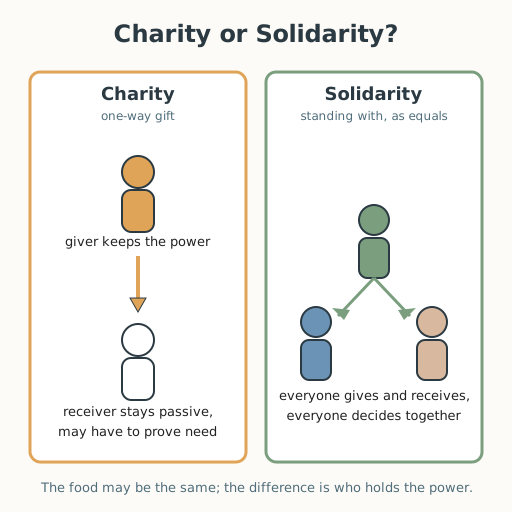
When someone is hungry, one neighbor might hand them a meal — a one-way gift. Or neighbors might share what they grow, cook together, and decide together how everyone gets fed. The food may be the same; the difference is the power and the dignity. In charity, one person gives and the other only receives; in solidarity, people meet one another’s needs as equals, sharing the giving and the deciding. Today you learn to tell them apart — and to notice which one a real community is actually practicing.
Materials
- Care-system analysis sheet
- Care case cards
Preparation
- Copy the analysis sheet and case cards.
- Retrieval: from Unit 3, recall the idea of mutual aid and the charity-versus-solidarity distinction. Today we make that distinction precise and apply it to real systems of care.
Facilitator note
This lesson is written to the learner (“you”). The goal: each learner analyzes one real system of care with three questions — who gives, who receives, who decides — and can explain the difference between charity and mutual aid/solidarity. Hold the distinction carefully and non-morally: charity is not “bad,” and a hungry person fed by a gift is still fed; the point is that sharing power is different from sharing only goods (S-345). The egalitarian lens is the heart here: the difference is who holds power — in charity the giver keeps the power and the receiver stays passive and often must prove need; in mutual aid and solidarity people decide together as equals (S-345). The global lens: mutual aid is a widespread, documented human practice — harambee in Kenya, gotong royong in Indonesia, mink’a/minga in the Andes, barn raising in North America — each a named tradition in one place, not a universal claim about “all people” (S-164); the term itself was popularized by Kropotkin (S-163). The ethics lens: what does a system of care do to a person’s dignity — does it lift people or keep them dependent? The technology lens: digital tools can organize mutual aid fast (neighbors coordinating help in a crisis) and can be used to surveil who “deserves” help. The environment lens: many systems of care are also systems of land care — a shared garden, a managed watershed, a disaster kitchen — caring for people and place at once. Keep it concrete and hopeful: learners leave with the tools to notice power, not with despair about it.
Procedure
- Recall (6 min). What did you plan last time — and what is the word for people helping one another as equals, not from above? (Mutual aid / solidarity.) Say what you remember about the difference between a gift and standing together.
- Name the three questions (8 min). Every system of care answers three questions, whether it says so or not: Who gives? Who receives? Who decides? Write them where everyone can see. These three questions are your analysis tool.
- Worked example (8 min). Analyze one case together. A food bank: who gives (donors), who receives (people who need food, often after proving need), who decides (the people who run it, not the people who use it). Is it fair? It meets a real need — and the receivers hold little power. Now a community garden: who gives (everyone who plants and waters), who receives (everyone who eats), who decides (everyone, together). Notice the difference.
- Analyze one case (12 min). In pairs, take one care case card (or hear it read aloud) — some come from named traditions in one place each (harambee in Kenya, gotong royong in Indonesia, mink’a/minga in the Andes, barn raising in North America). Run the three questions, then decide: what makes this system fair, and what makes it unfair? Write one sentence for each.
- Charity, mutual aid, solidarity (12 min). Sort what you found. Charity = one-way, the giver keeps the power. Mutual aid = needs met together, as equals. Solidarity = standing with others over time, sharing the risk and the deciding. Which one does your case most look like — and what would shift it toward solidarity?
- Peer check (5 min). Trade analyses. Give one piece of evidence for your reading and ask one question of your partner’s.
- Close (4 min). You now have a tool for noticing who holds the power in every act of care. Next and last: we gather the whole year — every whole person, the caring community, and the living Earth — and look ahead.
Differentiation
- Support: Analyze only the worked example, using the three questions with a partner; write one sentence for each question.
- Non-visual / tactile path: Act the difference out — one person stands above and hands down (charity, one-way), then everyone stands in a circle passing an object two ways while deciding together (solidarity). Say the three questions aloud instead of writing them.
- Extension: Compare two systems of care and argue, with evidence, which is fairer and why — then name one way the less-fair one could shift toward solidarity.
Assessment
- Formative (self/peer): Can the learner answer all three questions for one system and explain, in one sentence, how solidarity differs from charity?
- Artifact: The care-system analysis sheet, kept in the portfolio as the unit’s belonging-and-solidarity reflection.
Home connection
Ask someone at home about a time neighbors helped one another as equals — who gave, who received, and who decided? Bring one sentence of their answer to the final lesson.
Resources
- On the charity-versus-mutual-aid distinction as a matter of who holds power: Spade (2020), Mutual Aid: Building Solidarity During This Crisis (and the Next) (S-345).
- On mutual aid as a widespread, documented human practice: Kropotkin (1902), Mutual Aid: A Factor of Evolution (S-163).
- On named communal-work traditions — harambee, gotong royong, mink’a/minga, barn raising: communal work traditions, cross-checked (S-164).
- On cooperative structures as the research base for groups that share fairly: Slavin, cooperative learning (S-147).