Lesson 05 — All of Us: Celebration, the Caring Community & Looking Ahead
Learners gather the year into a **portfolio and celebration**: the whole-self map, the choice-and-consequences note, and the belonging-and-solidarity reflection, then name one thing they will **carry forward** into high school and celebrate each whole person, the caring community, and the living Earth.
Objectives
Objectives
- D01.S2.08.01 Explain how multiple and intersecting identities, such as culture, gender, ability, and language, shape a whole self.
- D01.S3.08.01 Manage impulses deliberately, choosing a response rather than reacting in emotionally charged moments.
- D01.S3.08.02 Explain the difference between short-term and long-term consequences and weigh them in a decision.
- D02.S3.08.02 Take part in strengthening belonging in their school or local community.
- D02.S4.08.01 Analyze how systems of care and mutual aid operate and what makes them fair or unfair.
- D02.S4.08.02 Distinguish charity from mutual aid and solidarity, and explain the difference.
Essential question
How do I gather the whole year — who I am becoming and who I stand with — and carry it into high school?
Key vocabulary
Materials
Standard materials
- Capstone gathering sheet · 1 per learner A one-page sheet with spaces for the three closing artifacts — the whole-self map, the choice note, and the belonging-and-solidarity reflection — plus one "I will carry forward" line
- Each learner's assembled portfolio · 1 per learner The unit's three artifacts gathered from Lessons 1, 2, and 4, plus the belonging act from Lesson 3
Low-tech / no-cost
- A shared board or large paper Build one class "carry forward" wall together; no printed sheets needed
- Voice, memory, and movement Recall the artifacts aloud and mark the celebration with song, clap, or a shared walk instead of printed sheets
Enriched / lab & device
- A digital portfolio or slideshow · 1 per learner Assemble the three artifacts digitally and present one to the group
- A recorded voice-note or short video · 1 per learner Record the "I will carry forward" line to keep and revisit in high school
Works in different contexts
- large-group Celebrate as one circle — each learner shares one artifact or one line, and the class adds each thread to a shared "carry forward" wall
- multi-age Older learners present to younger ones and invite them to add their own hopes; younger learners draw what they will carry forward
- self-directed A learner assembles the three artifacts alone, writes the carry-forward line, and self-checks each is complete before sharing with one trusted person
- level-grouped Learners ready to extend write a short letter to their Grade-9 self, naming one value and one skill they intend to carry forward
- outdoor-only Hold the celebration outdoors, naming the living Earth as part of the community you care for, and mark the moment with a shared walk or a planted seed
Lesson 5 — All of Us: Celebration, the Caring Community & Looking Ahead
Summary
Learners gather the year into a portfolio and celebration: the whole-self map, the choice-and-consequences note, and the belonging-and-solidarity reflection, then name one thing they will carry forward into high school and celebrate each whole person, the caring community, and the living Earth. This is the unit’s and the year’s closing capstone.
Objectives
- Gather the whole year: explain how intersecting identities shape a whole self (D01.S2.08.01), choose rather than react (D01.S3.08.01) and weigh consequences (D01.S3.08.02), strengthen belonging (D02.S3.08.02), and analyze systems of care and stand in solidarity rather than charity (D02.S4.08.01, D02.S4.08.02).
Connection
A celebration is not a party bolted onto the end; it is how a community marks what it has become together. You have spent a year becoming — naming feelings, weighing choices, making room for others, standing with them rather than over them. Today you do not learn a new thing; you gather the things you already built, see them as one, and choose what you will carry into what comes next.
Materials
- Capstone gathering sheet
- Each learner’s assembled portfolio
Preparation
- Gather the three unit artifacts (whole-self map, choice note, belonging-and-solidarity reflection) and a note of the belonging act from Lesson 3.
- Retrieval: this whole lesson is a retrieval and synthesis pass — the payoff of spacing across the year (S-039). Have each learner’s full portfolio on hand.
Facilitator note
This lesson is written to the learner (“you”). It is the closing celebration and synthesis. The goal: each learner assembles the three closing artifacts, states what they learned from each, and names one thing they will carry forward into Grade 9. The three artifacts are: (1) the whole-self map — intersecting identities shaping a whole self; (2) the choice-and-consequences note — pause, weigh now vs. later, choose; (3) the belonging-and-solidarity reflection — who gives, receives, decides, and how to stand with rather than above. Keep assessment mastery, not ranking: a learner missing an artifact simply completes it now — “not yet” is information, never a verdict. Looking ahead is framed as purpose and possibility, not pressure: naming one thing you want to carry forward is a step toward purpose, which grows by trying, not by being certain (S-400); identity remains a growing story, never a finished fact (S-155). The four lenses, gathered: the ethics lens asks what you will choose for others’ sake; the egalitarian lens asks who you will stand with; the global lens remembers that this year’s questions are asked, in different forms, by young people everywhere; the technology & environment lens asks how your choices touch people and the living Earth through the tools you use. Celebrate the collective — each learner’s thread is part of one class web (S-233). End with hope, not a test.
Procedure
- Recall, don’t peek (8 min). Without looking, list from memory what this unit built: the whole-self map, the choice note, the belonging plan, the care-system analysis. What did each one teach you? (Recalling is the learning.)
- Assemble your gathering (12 min). On the capstone sheet, set out your three artifacts and write one sentence for each: what it shows about who you are becoming and who you stand with. Complete anything that is missing.
- Name what you carry forward (10 min). Write one line: “I will carry ___ forward into high school.” Make it real — a value, a skill, a habit — not a slogan. Then read it once, to yourself, slowly — or say it aloud slowly.
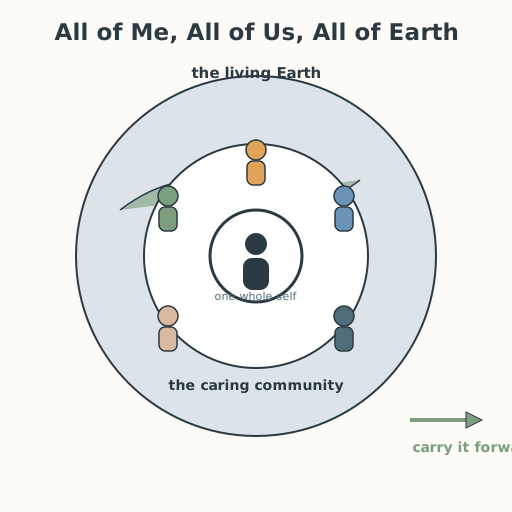
- Celebrate the web (15 min). In a circle, each person shares one artifact or one carry-forward line. Listen to every voice. Notice: the whole is more than the parts — each of you is a whole self, and together you are a caring community, standing on a living Earth.
- Mark the moment (7 min). Together, do one small thing that marks the year — a shared song, a clap that builds, a circle that closes, a seed planted, a name written on the “carry forward” wall. Whatever fits your place and your people.
- Close (3 min). Look around. You did not memorize a year; you became someone. Carry it forward.
Differentiation
- Support: Work from the three artifacts one at a time, with a partner; write one carry-forward line from a starter (“I will keep…”).
- Non-visual / no-writing path: Mark the celebration with voice and movement — name each artifact aloud, speak your carry-forward line, and join the shared song, clap, circle, or walk. A partner or the facilitator can scribe the gathering sheet from your words if a written copy is needed for the portfolio.
- Extension: Write a short letter to your Grade-9 self, naming one value and one skill you intend to carry forward — and one question you hope to answer there.
Assessment
- Summative (portfolio): The completed capstone gathering sheet with all three artifacts and the carry-forward line, kept in the year-end portfolio.
- Self/peer: Learners self-check each artifact is present and give one specific “I saw ___ in your work” to a partner.
- Mastery, not ranking: A learner missing an artifact completes it in the moment; the gathering is finished when it is finished, not before.
Home connection
Show someone at home your gathering sheet and read your carry-forward line aloud. Teaching your family what you learned is the surest sign you have learned it.
Resources
- On purpose as something that grows by trying and reflecting, not by being certain at once: Damon (2008), The Path to Purpose (S-400).
- On identity as a lifelong, developing story: Erikson, Childhood and Society (S-155).
- On cooperative structures and celebrating the collective: Johnson & Johnson, social interdependence theory (S-233).
- On retrieval practice and spacing: Dunlosky et al. (2013) (S-039).