Lesson 01 — Feelings, Identity & Purpose: Where We've Been, Where We're Going
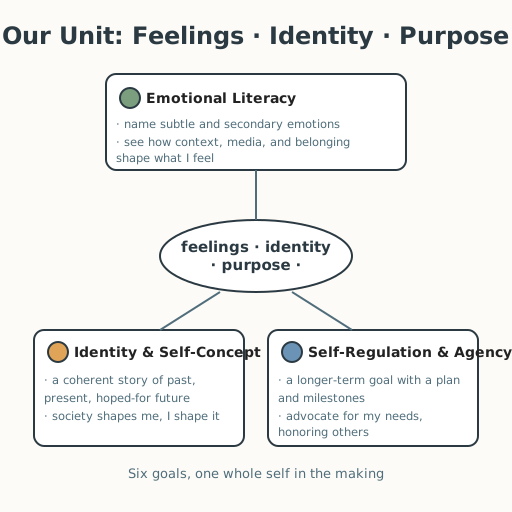
Learners recall four Grade-8 ideas about the self — separating event, thought, and feeling; intersecting identities; inner worth versus outside approval; and short- versus long-term consequences — and preview this unit's three strands and six goals. They meet the unit's organizing idea: a whole self is built from **feelings**, **identity**, and **purpose**, and it is always in the making.
Objectives
Objectives
- D01.S1.09.01 Use a broad emotional vocabulary to articulate subtle and secondary emotions in complex social situations.
- D01.S2.09.01 Construct a coherent personal narrative that connects their past, present, and hoped-for future.
- D01.S3.09.01 Set a longer-term goal with a realistic plan and milestones, and adjust it as needed.
Essential question
How do feelings, identity, and purpose grow together into one whole self — and where is this unit taking us?
Key vocabulary
Materials
Standard materials
- Unit map sheet · 1 per learner A one-page map of the unit's three strands and six goals, to mark and return to across the unit
- Recall cards · 1 set per group Cards recalling four Grade-8 ideas — event/thought/feeling, intersecting identities, self-esteem vs. approval, and short- vs. long-term consequences
Low-tech / no-cost
- A shared board or large paper Draw the three strands and six goals together; no printed map needed
- Voice and memory Recall the Grade-8 ideas aloud as a group instead of using cards
Enriched / lab & device
- A digital slideshow of the three strands · 1 One image or diagram per strand (emotional literacy, identity, agency) to preview each
- A wonder box (physical or shared document) · 1 A place to collect every learner's questions about the unit to revisit at the close
Works in different contexts
- large-group Do the recall round as a whole group with hands raised and ideas recorded on the board, then small groups sort the recall cards
- multi-age Younger learners match each recall idea to a picture; older learners state the idea in one sentence and connect it to the new unit
- self-directed A learner reads the unit map, writes three sentences recalling the Grade-8 ideas, and lists one question per strand
- level-grouped Learners ready to extend write a fifth Grade-8 idea not on the cards and explain why it matters here
- outdoor-only Take the map outdoors and point to a real social scene nearby (a field, a market, a bus stop) and ask what feelings, identities, and purposes are at play there
Lesson 1 — Feelings, Identity & Purpose: Where We’ve Been, Where We’re Going
Summary
Learners recall four Grade-8 ideas about the self — separating event, thought, and feeling; intersecting identities; inner worth versus outside approval; and short- versus long-term consequences — and preview this unit’s three strands and six goals. They meet the unit’s organizing idea: a whole self is built from feelings, identity, and purpose, and it is always in the making.
Objectives
- Begin to name the unit’s first goal: using a broad emotional vocabulary to articulate subtle and secondary emotions. (D01.S1.09.01)
- Begin to name the unit’s fourth goal: constructing a coherent personal narrative linking past, present, and hoped-for future. (D01.S2.09.01)
- Begin to name the unit’s fifth goal: setting a longer-term goal with a realistic plan and milestones. (D01.S3.09.01)
Connection
Think of a moment recently when you felt something you could not quite name — a mix that was not simply happy or sad, but something sharper and smaller, like a prick of envy at a friend’s good news followed by a flush of guilt at feeling envious at all. Think of the story you tell about who you are when someone asks, and of the things you are hoping to become. Feelings, identity, and purpose are not three separate subjects; they are the one life you are already living. This unit helps you see it clearly and, a little more, steer it.
Materials
- Unit map sheet
- Recall cards
Preparation
- Copy the unit map sheet and recall cards.
- Retrieval: from Grade 8, recall (a) separating the event, the thought, and the feeling; (b) intersecting identities (culture, gender, ability, language); (c) inner worth versus outside approval; and (d) short-term versus long-term consequences. Today we link those to the new unit.
Facilitator note
This lesson is written to the learner (“you”). It is the unit’s opening and retrieval pass, so the goals are modest: (1) recall four Grade-8 ideas — a feeling can be pulled apart into event, thought, and feeling (S-332); a self is made of intersecting identities (D01.S2.08.01); self-esteem can come from inner worth or from outside approval (S-222); and choices have short- and long-term consequences (D01.S3.08.02); (2) preview the unit’s three strands — emotional literacy, identity and self-concept, self-regulation and agency — and its six goals; (3) plant the organizing idea: a whole self is built from feelings, identity, and purpose, and it is always in the making. Do not try to teach the six goals today; just name and locate them. The social-emotional lens: naming the self precisely is a skill that supports regulation and care (S-001). The global lens: every culture gives its young people ways of answering “who am I?”, and the answers differ by place and time. The ethics lens: the distinction between how things are and how things ought to be runs through the whole unit — a feeling is a fact about you, while what you do with it is a choice (philosophy §5). Keep every question open: identity is held as a story in the making, never a label or a verdict (philosophy §11). Spacing note (S-039): this recall pass is what makes the unit’s ideas stick later.
Procedure
- Recall (10 min). In a small group, look at four recall cards: event / thought / feeling, intersecting identities, inner worth vs. outside approval, short- vs. long-term consequences. For each, say in one sentence what you remember from Grade 8.
- Connect the four (5 min). What do all four have in common? (Each is about knowing yourself — noticing what is going on inside you and choosing what to do with it.)
- Meet the map (10 min). Look at the unit map. Three strands: emotional literacy, identity & self-concept, self-regulation & agency. Six goals — two per strand. Read each goal aloud once; don’t worry about understanding them yet.
- Plant the big idea (10 min). The unit’s idea in one breath: a whole self is built from feelings (what moves inside me), identity (the story of who I am), and purpose (what I choose to become). Say it back in your own words.
- Wonder (10 min). Write one question about each strand in the wonder box. Which question do you most want answered by the end of the unit?
- Close (5 min). Today we remembered what we know and saw the road ahead. Next: a richer feeling vocabulary.
Differentiation
- Support: Give sentence starters for the recall round (“A feeling can be pulled apart into…”).
- Extension: Add a fifth Grade-8 idea of your own and say why it will matter in this unit.
Assessment
- Formative (observation): Can the learner recall each Grade-8 idea in one sentence and name the unit’s three strands and six goals?
- Artifact: The completed unit map (or the learner’s written recall), kept in the portfolio.
Home connection
Ask someone at home: what is one thing you once believed about yourself, then changed your mind about as you grew? Bring the story (no names needed) to the next lesson.
Resources
- On the event-thought-feeling split and primary vs. secondary disturbance: Albert Ellis Institute, REBT, https://albertellis.org/rebt-cbt-therapy/ (S-332).
- On self-compassion versus comparison-based self-esteem: Neff (2003), https://doi.org/10.1080/15298860309032 (S-222).
- On the payoff of spaced retrieval: Dunlosky et al. (2013), https://doi.org/10.1177/1529100612453266 (S-039).
- On explicit instruction and worked examples: Kirschner, Sweller & Clark (2006), https://doi.org/10.1207/s15326985ep4102_1 (S-011).