Lesson 02 — A Richer Feeling Vocabulary: Subtle and Secondary Emotions
Learners build a **broad emotional vocabulary** by distinguishing **basic emotions**, **subtle emotions** (fine-grained states such as envy, nostalgia, awe, and resentment), and **secondary emotions** (feelings about feelings, such as shame about jealousy). They learn that naming a feeling precisely — **emotional granularity** — is itself a skill that supports understanding and regulation.
Objectives
Objectives
- D01.S1.09.01 Use a broad emotional vocabulary to articulate subtle and secondary emotions in complex social situations.
Essential question
What is the difference between a basic emotion, a subtle emotion, and a secondary emotion — and why does having more words for feelings matter?
Key vocabulary
Materials
Standard materials
- Emotion word bank sheet · 1 per learner A grid of feeling words grouped into basic, subtle, and secondary, with blank spaces to add words
- Feeling vocabulary wheel (printed or shown) · 1 per group The concentric wheel showing basic, subtle, and secondary emotions
Low-tech / no-cost
- Paper and pencil Draw your own feeling wheel by hand; no printed sheets needed
- Voice and memory Build the word bank aloud as a group, one feeling per learner
Enriched / lab & device
- A shared digital word wall or spreadsheet · 1 A living feeling-vocabulary list every learner can add to across the unit
- A device to look up feeling words in a second language · 1 per group Compare how another language names a feeling that has no exact translation in yours
Works in different contexts
- large-group Build one big word bank on the board together, then each learner chooses and defines three words
- multi-age Younger learners match each word to a face or a situation; older learners define the word and give a real example
- self-directed A learner fills the word bank alone, then checks each word by writing a one-sentence example for it
- level-grouped Learners ready to extend collect feeling words from another language and share which resist translation
- outdoor-only Name the feelings in a real scene outdoors — a shared meal, a game, a quiet walk — and sort them into basic, subtle, and secondary
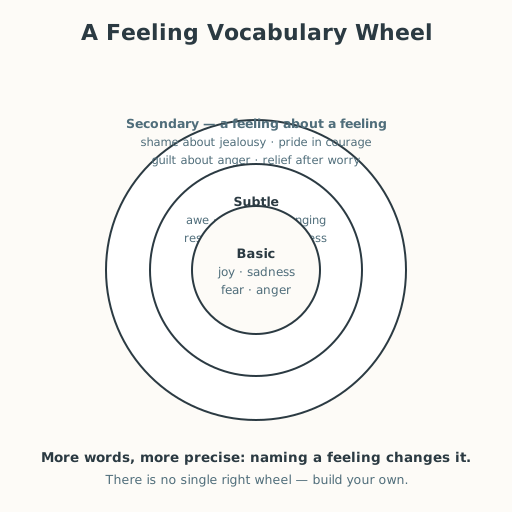
Lesson 2 — A Richer Feeling Vocabulary: Subtle and Secondary Emotions
Summary
Learners build a broad emotional vocabulary by distinguishing basic emotions, subtle emotions (fine-grained states such as envy, nostalgia, awe, and resentment), and secondary emotions (feelings about feelings, such as shame about jealousy). They learn that naming a feeling precisely — emotional granularity — is itself a skill that supports understanding and regulation.
Objectives
- Distinguish basic, subtle, and secondary emotions and place feeling words into each group. (D01.S1.09.01)
- Use a broad emotional vocabulary to name a subtle or secondary emotion from your own life. (D01.S1.09.01)
Connection
A friend shares amazing news, and you notice a small, sharp feeling that is not simple happiness for them — but it is not exactly anger either. It is envy, and then a second feeling: a flush of guilt or shame about the envy. Notice how the second feeling sits on top of the first, like a reaction to a reaction. English calls that first one a subtle emotion and the second a secondary emotion — a feeling about a feeling. The more words you have for these layers, the more clearly you can see yourself, and the more choice you have about what to do next.
Materials
- Emotion word bank sheet
- Feeling vocabulary wheel
Preparation
- Copy the emotion word bank sheet and the feeling vocabulary wheel.
- Retrieval: from Lesson 1, recall the unit’s three strands. Today we begin the first — emotional literacy.
Facilitator note
This lesson is written to the learner (“you”). It is the first skill lesson of the unit, so the method is explicit instruction with worked examples, then guided practice (S-011), not free-form discovery. Model each category yourself first, then have learners sort and generate words with a partner before working alone. The key distinctions to teach: (1) basic emotions are broad, early-developing states — joy, sadness, fear, anger (and, in some models, trust, disgust, anticipation, surprise; Plutchik, S-402); (2) subtle emotions are finer-grained and often more socially complex — envy, gratitude, nostalgia, awe, resentment, tenderness, longing; (3) secondary emotions are feelings about feelings — shame about jealousy, guilt about anger, pride in courage, relief after worry. The core claim to carry: having a richer feeling vocabulary — emotional granularity — lets a person name their experience more precisely and is associated with better emotion regulation (Barrett, S-401). This is a description of how emotions work, offered as one well-supported scientific account, not a creed, and not a therapy; keep it that way (philosophy §5, §11). The global lens: languages differ in which feelings have names — a feeling word in one language may have no exact translation in another, which is a reminder that our vocabularies shape (without fully deciding) what we notice. The critical-thinking lens: no single “wheel” of emotions is settled fact; wheels are models, and learners should feel free to build their own. Never rank feelings as “good” or “bad” — name them neutrally and honor them all (egalitarian spirit: every self is a whole in the making, never a label).
Procedure
- Recall (5 min). Without looking, name the unit’s three strands from Lesson 1. Which one are we beginning today?
- Worked example — basic and subtle (10 min). Watch and listen as your facilitator models the two layers with a real example: “basic” anger at being cut in line, then the “subtle” feeling underneath — maybe resentment that this keeps happening, or hurt. What makes the second word more precise?
- Introduce secondary emotions (10 min). Now the third layer: a feeling about a feeling. Model it: “I felt envy — and then I felt ashamed of feeling envious.” The shame is the secondary emotion. In pairs, generate two more examples of a feeling about a feeling.
- Sort and add (15 min). With a partner, sort the words on your word bank sheet into basic, subtle, and secondary. Add at least three new words of your own to each ring. If a word is hard to place, say why.
- Apply it to you (10 min). Choose one subtle or secondary emotion you have felt recently. Write one sentence naming it precisely (“I felt ___ when ___, and then I felt ___ about that”).
- Close (5 min). Today you grew your feeling vocabulary. Next: we use it to read a complex moment.
Differentiation
- Support: Provide a starter list and sentence frames (“I felt ___ when ___…”).
- Extension: Collect feeling words from another language and share one that has no exact translation in yours, explaining what it captures.
Assessment
- Formative (observation): Can the learner sort feeling words into basic, subtle, and secondary, and name a subtle or secondary emotion from their own life?
- Artifact: The completed emotion word bank (or the learner’s “I felt ___ when ___” sentence), kept in the portfolio.
Home connection
Ask someone at home: is there a feeling you know but struggle to name? What do you call it? Add the word to your word bank.
Resources
- On emotional granularity and constructed emotion: Barrett (2017), How Emotions Are Made, https://lisafeldmanbarrett.com/books/how-emotions-are-made/ (S-401).
- On basic emotions and their combinations/intensities: Plutchik (1980), Emotion: A Psychoevolutionary Synthesis (S-402).
- On primary vs. secondary emotional disturbance: Albert Ellis Institute, REBT, https://albertellis.org/rebt-cbt-therapy/ (S-332).
- On explicit instruction and worked examples: Kirschner, Sweller & Clark (2006), https://doi.org/10.1207/s15326985ep4102_1 (S-011).