Lesson 03 — Reading a Complex Moment: Naming the Layers of Feeling
Learners apply their growing emotional vocabulary to **complex social situations**. Using a **layered frame — event, thought, subtle feeling, secondary feeling** — they read realistic scenarios and their own experience, naming what is happening at each layer. This is the unit's first skill in *reading a moment* rather than reacting to it.
Objectives
Objectives
- D01.S1.09.01 Use a broad emotional vocabulary to articulate subtle and secondary emotions in complex social situations.
Essential question
How do I read a complex social situation and name the subtle and secondary emotions at play in it — mine and others'?
Key vocabulary
Materials
Standard materials
- Case cards · 1 set per group Four short, realistic social scenarios (e.g., a friend is praised and you are not; a group inside joke you are outside of) for learners to analyze layer by layer
- Layers-of-feeling sheet · 1 per learner The event → thought → subtle feeling → secondary feeling frame, with space to write
Low-tech / no-cost
- Paper and pencil Write out the four layers freehand; no printed sheets needed
- Voice and body Act out or tell a scenario aloud instead of using cards
Enriched / lab & device
- A shared document for collaborative analysis · 1 Groups annotate the same scenario in different colors, one layer each
- Short film or clip depicting a layered social moment · 1 Learners name the subtle and secondary emotions of the characters they watch
Works in different contexts
- large-group Analyze one scenario together on the board, then groups analyze the remaining three
- multi-age Younger learners name the basic event and one feeling; older learners name all four layers for the same scene
- self-directed A learner works through the case cards alone, writing all four layers for each, then self-checks against a worked example
- level-grouped Learners ready to extend write their own scenario and analyze it, then swap with a partner to compare readings
- outdoor-only Observe a real, low-stakes social moment outdoors (a game, a queue, a shared task) and name the layers at play, with care and no gossip
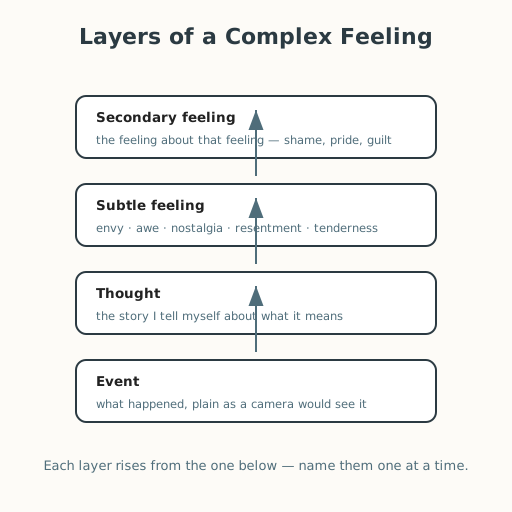
Lesson 3 — Reading a Complex Moment: Naming the Layers of Feeling
Summary
Learners apply their growing emotional vocabulary to complex social situations. Using a layered frame — event, thought, subtle feeling, secondary feeling — they read realistic scenarios and their own experience, naming what is happening at each layer. This is the unit’s first skill in reading a moment rather than reacting to it.
Objectives
- Name the event, thought, subtle feeling, and secondary feeling in a complex social situation. (D01.S1.09.01)
- Use precise emotional vocabulary to articulate a subtle or secondary emotion of your own in a complex moment. (D01.S1.09.01)
Connection
A group of friends laughs at an inside joke you were not there for. In an instant, several things happen at once: the event (they laughed, you stood outside it), a thought (“I don’t belong with them”), a subtle feeling (a small ache of loneliness, maybe a flicker of hurt), and then a secondary feeling (embarrassment at caring so much, or anger at yourself for being sensitive). None of that is simple “sad.” A complex moment is made of layers. Today you learn to read them one at a time — and reading a moment is the first step toward choosing, not just reacting.
Materials
- Case cards
- Layers-of-feeling sheet
Preparation
- Copy the case cards and layers-of-feeling sheet.
- Retrieval: from Lesson 2, recall the difference between a subtle and a secondary emotion. Today we use those words to read a whole situation.
Facilitator note
This lesson is written to the learner (“you”). It is a guided-practice lesson building on Lesson 2’s vocabulary (S-011). Model one case card fully — naming all four layers aloud — before learners work in pairs; then have them practice two cards together and one independently. The four-layer frame is: event (what a camera would record, without interpretation), thought (the story the person tells about what it means), subtle feeling (the fine-grained emotion — envy, hurt, tenderness, relief), secondary feeling (the feeling about the feeling — shame, pride, guilt). This frame is adapted descriptively from the event-thought-feeling / ABC account (S-332); it is a self-awareness tool, not a diagnosis or therapy, and the facilitator should say so. Keep the room safe: scenarios are invented and low-stakes; no learner is ever required to reveal anything personal, and names are never used for real people. The social-emotional lens: naming a moment precisely is the ground of emotional maturity and of caring well for others (S-001). The ethics lens: the same event can be read more than one way, so we hold our reading of another person’s feelings as a guess, offered with humility, never as a verdict on them. The global lens: which feelings are named, shown, or hidden in a moment differs across cultures — invite learners to notice that without ranking any way as better. Mastery, not ranking: a learner who can name only two layers today names all four tomorrow; “not yet” is a map, not a grade (S-007).
Procedure
- Recall (5 min). From Lesson 2, what is the difference between a subtle emotion and a secondary emotion? Say one of each.
- Worked example (10 min). Watch and listen as your facilitator reads one case card and names all four layers aloud: the event, the thought, the subtle feeling, the secondary feeling. Notice how the layers rise one from another.
- Guided practice (15 min). In pairs, take two more case cards. For each, name the four layers together. Where you disagree, say why — there is often more than one honest reading.
- Independent practice (15 min). Choose a real-but-safe moment from your own week (or invent one). On your sheet, name the four layers for it. You may keep it private.
- Share a reading (7 min). With your pair, share only the layers of the invented cases, not personal ones — how did your readings differ, and why?
- Close (3 min). You can now read a moment instead of just reacting to it. Next: what shapes the feeling in the first place — context, belonging, and media.
Differentiation
- Support: Provide a bank of feeling words and sentence starters for each layer (“The event was…; the thought might be…”).
- Extension: Write your own scenario and analyze it; swap with a partner and compare your readings of the same moment.
Assessment
- Formative (observation): Can the learner name all four layers in a case scenario, using precise vocabulary for the subtle and secondary feelings?
- Artifact: The completed layers-of-feeling sheet for one scenario, kept in the portfolio.
Home connection
Choose a scene from a film or story you share with someone at home and, together, name the layers of feeling a character is moving through. Bring one new feeling word you found.
Resources
- On the event-thought-feeling / ABC account of emotional consequence: Albert Ellis Institute, REBT, https://albertellis.org/rebt-cbt-therapy/ (S-332).
- On emotional granularity and its link to regulation: Barrett (2017), How Emotions Are Made, https://lisafeldmanbarrett.com/books/how-emotions-are-made/ (S-401).
- On self-awareness as a core SEL competency: CASEL, https://casel.org/fundamentals-of-sel/ (S-001).
- On explicit instruction and worked examples: Kirschner, Sweller & Clark (2006), https://doi.org/10.1207/s15326985ep4102_1 (S-011).