Lesson 04 — Shaped by Where I Stand: Context, Belonging, and Emotion
Learners analyze how **social context** and **group belonging** shape what they feel — how the same event can feel different depending on where they stand and who is watching. They distinguish what a situation amplifies from what is genuinely theirs, and practice noticing the pull without being ruled by it.
Objectives
Objectives
- D01.S1.09.02 Analyze how emotions are shaped by social context, media, and group belonging.
Essential question
How are my emotions shaped by social context and group belonging — and how do I keep what is truly mine?
Key vocabulary
Materials
Standard materials
- Context cards · 1 set per group Cards describing the same event (e.g., being praised; making a mistake) in different social settings and groups, to compare how the feeling shifts
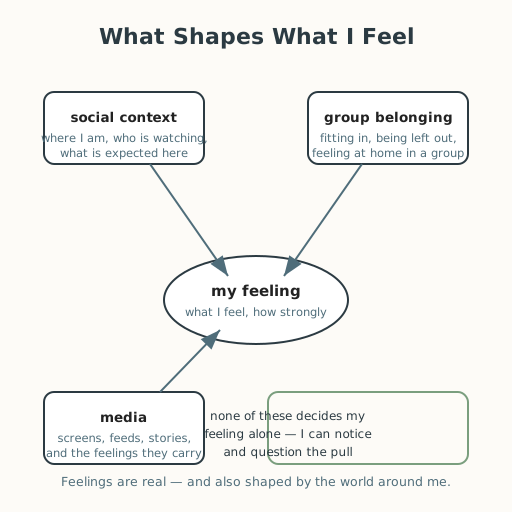
- Shapers-of-emotion sheet · 1 per learner A three-arrow diagram — social context, group belonging, media — with space to write how each shaped a real feeling
Low-tech / no-cost
- Paper and pencil Draw the three arrows and write your own examples; no printed sheets needed
- Voice and role-play Act out the same event in two different settings and notice how the feeling changes
Enriched / lab & device
- A shared document for the group comparison · 1 Learners log how the same event felt in different groups they belong to
- A short documentary clip about group life in another culture · 1 Learners notice which feelings that group encourages, hides, or values
Works in different contexts
- large-group Sort the context cards as a whole class, then small groups discuss one real example each
- multi-age Younger learners match each setting to a likely feeling; older learners explain *why* the feeling shifts and what stays theirs
- self-directed A learner writes the same event in three different settings of their own life and names the feeling in each
- level-grouped Learners ready to extend compare how two different groups they belong to would react to the same event and why
- outdoor-only Observe how being in a crowd versus being alone outdoors changes the feeling of the same event (a win, a stumble, a joke)
Lesson 4 — Shaped by Where I Stand: Context, Belonging, and Emotion
Summary
Learners analyze how social context and group belonging shape what they feel — how the same event can feel different depending on where they stand and who is watching. They distinguish what a situation amplifies from what is genuinely theirs, and practice noticing the pull without being ruled by it.
Objectives
- Analyze how social context and group belonging shape what and how strongly a person feels. (D01.S1.09.02)
- Distinguish the part of a feeling that comes from the situation from the part that is your own. (D01.S1.09.02)
Connection
The same news — say, a mistake you made — can feel completely different depending on where you are. Made it in front of a group you trust, it might feel like a small, almost funny thing, and they help you fix it. Made it in front of people you are trying to impress, the very same slip can feel like a weight on your chest. The event did not change; the context did. Add to that the pull of belonging — how much we want to be inside a group, and how much it stings to be outside — and you can see that feelings are real but never happen in a vacuum. Today you learn to see the situation’s part in what you feel.
Materials
- Context cards
- Shapers-of-emotion sheet
Preparation
- Copy the context cards and shapers-of-emotion sheet.
- Retrieval: from Lessons 2–3, recall the four-layer frame. Today we ask where the feeling comes from — the situation’s part.
Facilitator note
This lesson is written to the learner (“you”). It shifts from naming a feeling to analyzing its causes — the second emotional-literacy goal (D01.S1.09.02). The core ideas to teach: (1) social context — the same event evokes different feelings in different settings (a mistake among friends versus among strangers); (2) group belonging — people are deeply sensitive to being inside or outside a group, and this shapes emotion strongly (Tajfel’s minimal-group work showed how readily people favor their in-group; S-232); (3) display rules — cultures and groups differ in which feelings are shown, hidden, or valued (Ekman & Friesen’s account of nonverbal display; S-160). Hold these as descriptive observations, not as “you are a slave to your group.” The critical point for agency: noticing the pull of context is what lets a person choose a response instead of being carried by it — a feeling can be real and partly situational at the same time. The global lens is central here: invite learners to compare, without ranking, how different cultures and groups shape emotional life — which feelings are welcomed in a funeral, a celebration, a classroom, a market. The egalitarian lens: belonging is not equally available to everyone — some people are excluded from groups by prejudice or circumstance, and that exclusion is itself a source of feeling that society, not the individual, created. Be careful and kind: no learner should be asked to confess feelings of exclusion; keep examples invented or optional. Never claim a learner’s feeling is “not real” because it is shaped by context — the lesson is that context adds to feeling, not that feeling is fake.
Procedure
- Recall (5 min). From Lesson 3, name the four layers of a feeling. Today we ask where the layers come from.
- Worked example (10 min). Listen as your facilitator tells the same event — a mistake made in public — in two settings: among trusted friends, and among strangers you want to impress. Name the different feelings in each. What changed: the event or the context?
- Sort and compare (15 min). In pairs, sort the context cards: the same event across different settings and groups. For each, name the feeling and then say what part the context is playing.
- Mine and the situation’s (15 min). On your sheet, take one real feeling you had this week. Separate the arrows: what did social context add? What did belonging add? What is still genuinely yours underneath? You may keep this private.
- Discuss the pull (7 min). With your pair: once you notice a feeling is partly situational, what choices open up that did not exist before?
- Close (3 min). Feelings are real — and shaped by where you stand. Next: the screen in between, how media shapes feeling.
Differentiation
- Support: Provide sentence frames (“The context added…; underneath, my own part was…”).
- Extension: Compare two groups you belong to and how each would receive the same event, and explain the difference.
Assessment
- Formative (observation): Can the learner name how context and belonging shaped a feeling, and distinguish the situational part from the part that is their own?
- Artifact: The completed shapers-of-emotion sheet, kept in the portfolio.
Home connection
Ask someone at home: is there a feeling you only feel in certain places or with certain people? How does the place change it? Share one example with the class next time.
Resources
- On in-group favoritism and minimal groups: Tajfel, minimal group paradigm (S-232).
- On nonverbal behavior and display rules: Ekman & Friesen, The Repertoire of Nonverbal Behavior (S-160).
- On social awareness as a core SEL competency: CASEL, https://casel.org/fundamentals-of-sel/ (S-001).
- On explicit instruction and worked examples: Kirschner, Sweller & Clark (2006), https://doi.org/10.1207/s15326985ep4102_1 (S-011).