Lesson 05 — The Screen in Between: How Media Shapes What I Feel
Learners analyze how **media — feeds, ads, and headlines — shapes emotion**, focusing on **social comparison**, the **curated highlight reel**, and **emotional contagion**. They learn that a feed is a window, not a mirror, and design a small **digital boundary** of their own, holding media as neither a villain nor a master.
Objectives
Objectives
- D01.S1.09.02 Analyze how emotions are shaped by social context, media, and group belonging.
Essential question
How do screens, feeds, and media shape what I feel about myself and others — and how do I keep my own measure?
Key vocabulary
Materials
Standard materials
- Media examples · 1 set per group A small, age-appropriate collection of feed screenshots, ads, and headlines (with faces and names removed) to analyze for how they shape feeling
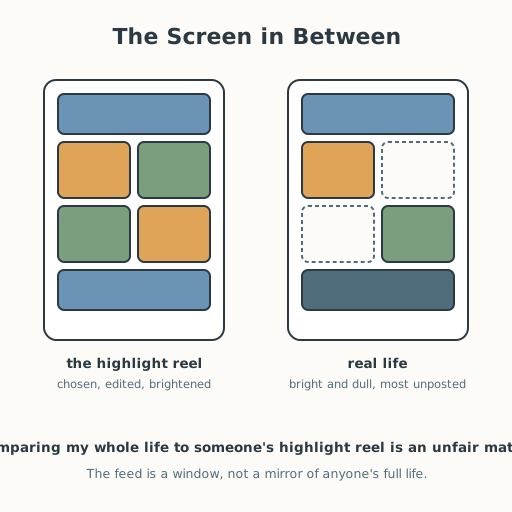
- Screen-in-between sheet · 1 per learner A two-panel frame — the highlight reel versus a fuller real life — with space to write what each makes you feel
Low-tech / no-cost
- Paper and pencil Draw the two panels and write your own examples; no devices or printed sheets needed
- Voice and memory Describe a feed or ad you remember, and analyze how it made you feel, without any device
Enriched / lab & device
- A device to examine a live feed critically · 1 per group Learners apply the analysis to a real feed, naming what is curated and what is missing
- A screen-time or wellbeing tool demonstration · 1 Show how a device setting can create a digital boundary (time limits, muted notifications)
Works in different contexts
- large-group Analyze one media example together on the board, then groups analyze the rest
- multi-age Younger learners point to what is edited or missing; older learners explain the comparison and design a boundary
- self-directed A learner analyzes a feed or ad they choose, names the feelings it stirs, and writes one digital boundary for themselves
- level-grouped Learners ready to extend trace one feeling to its source in the feed and explain the mechanism (comparison, contagion, curation)
- outdoor-only Contrast a screen image of a place or body with the real, fuller version outdoors — what does the screen leave out?
Lesson 5 — The Screen in Between: How Media Shapes What I Feel
Summary
Learners analyze how media — feeds, ads, and headlines — shapes emotion, focusing on social comparison, the curated highlight reel, and emotional contagion. They learn that a feed is a window, not a mirror, and design a small digital boundary of their own, holding media as neither a villain nor a master.
Objectives
- Analyze how media shapes what and how strongly a person feels about themselves and others. (D01.S1.09.02)
- Design one small digital boundary that protects your own emotional measure. (D01.S1.09.02)
Connection
You scroll for five minutes and come away feeling, somehow, a little less — less interesting, less accomplished, less happy — without quite knowing why. What you saw was not anyone’s whole life; it was a highlight reel: the best angle, the best moment, chosen and edited and posted. Comparing your messy, full, unedited life to a stack of highlight reels is a match no one can win. That quiet “less” you feel is real — and it is also, in part, made by the screen. Today you learn to see the machine behind the feeling, so you can keep your own measure.
Materials
- Media examples
- Screen-in-between sheet
Preparation
- Copy the media examples and screen-in-between sheet.
- Retrieval: from Lesson 4, recall how context and belonging shape feeling. Today we zoom in on one shaper — media.
Facilitator note
This lesson is written to the learner (“you”). It completes the second emotional-literacy goal (D01.S1.09.02) by focusing on media. The core ideas: (1) curation — feeds are chosen, edited, and filtered, so they show a highlight reel, not a full life; (2) social comparison — people naturally compare themselves to others, and curated content skews that comparison upward (Festinger, S-221; Common Sense Media’s research on media and adolescent development, S-226); (3) emotional contagion — the feelings shown in media can spread to the viewer; (4) the balanced picture — digital media can also connect, teach, and lift, and adolescence is a time when digital habits are being formed (WHO adolescent mental-health framing, S-311). The stance is neither demonizing nor worshipping media (philosophy §4, technology lens): the lesson’s goal is noticing the pull and choosing, not quitting screens. The egalitarian lens: the same feed is not equally harmful to everyone — those already excluded or under pressure can feel the comparison more sharply, and the platforms’ incentives (keep you scrolling) fall unevenly. The social-emotional lens: a boundary is self-care, not weakness. Keep it concrete and agency-filled: the lesson ends with a doable boundary, never despair. Be sensitive: do not pressure learners to disclose their own screen habits or feelings; make all sharing optional and invented examples welcome. Evidence is distinguished from values: that feeds are curated is a fact; that one should limit them is a value the learner weighs for themselves (philosophy §5).
Procedure
- Recall (5 min). From Lesson 4, name one thing that shapes feeling besides the event itself. Today: the screen.
- Worked example (10 min). Look at one media example together. Name what is shown, what is left out, and what feeling each is designed to stir. Where does comparison sneak in?
- Analyze in pairs (15 min). Take two more media examples. For each: what is curated? What is missing? What feeling does it aim to create — and how? Use the words comparison, highlight reel, contagion.
- Two panels (10 min). On your sheet, draw or write the highlight reel on one side and a fuller, realer life on the other. What does the screen leave out?
- Design a boundary (10 min). Write one small, doable digital boundary for yourself — a time limit, a muted notification, a feed you follow or unfollow, a moment you put the phone away. Make it specific enough to actually do.
- Close (5 min). A feed is a window, not a mirror. Next: we turn to the story of who you are.
Differentiation
- Support: Provide sentence frames (“The feed shows…; it leaves out…; it makes me feel…”).
- Extension: Trace one feeling to its exact source in a feed and explain the mechanism — was it comparison, contagion, or curation?
Assessment
- Formative (observation): Can the learner name how a media example shapes feeling, and write one specific, doable digital boundary?
- Artifact: The completed screen-in-between sheet (with the boundary), kept in the portfolio.
Home connection
With someone at home, compare one image you both saw on a screen with the fuller, realer version of the same thing. What did the screen leave out?
Resources
- On social comparison processes: Festinger (1954), A Theory of Social Comparison Processes (S-221).
- On media and adolescent development: Common Sense Media Research Program (S-226).
- On adolescent mental health and formative digital habits: WHO, Mental health of adolescents, https://www.who.int/news-room/fact-sheets/detail/adolescent-mental-health (S-311).
- On explicit instruction and worked examples: Kirschner, Sweller & Clark (2006), https://doi.org/10.1207/s15326985ep4102_1 (S-011).