Lesson 06 — My Story, Still Being Written: Past, Present, and Hoped-For Future
Learners construct a **coherent personal narrative** linking their **past, present, and hoped-for future** into one connected story. Using a past–present–future line and a worked example, they find a single thread — a value, a theme, a turning point — that runs through all three, and tell their story as one still being written.
Objectives
Objectives
- D01.S2.09.01 Construct a coherent personal narrative that connects their past, present, and hoped-for future.
Essential question
What coherent story links my past, my present, and my hoped-for future — and how do I tell it as one connected life?
Key vocabulary
Materials
Standard materials
- Story-line sheet · 1 per learner A past–present–future line with space to note people, places, and turning points at each stage
- Worked-example narrative · 1 to share A short, model personal narrative (invented, not a real learner's) showing how one thread runs through past, present, and future
Low-tech / no-cost
- Paper and pencil Draw the story line and write the narrative freehand; no printed sheets needed
- Voice and memory Tell the story aloud to a partner instead of writing it, then sketch the line
Enriched / lab & device
- A digital timeline or slideshow tool · 1 per learner Build the narrative as a visual timeline with images, text, and audio
- A voice recorder · 1 per pair Record the spoken narrative, then listen back to find the connecting thread
Works in different contexts
- large-group Share only invented or optional examples whole-class; personal narratives are written individually and shared in small, trusted groups
- multi-age Younger learners draw three pictures (past, present, future); older learners write the connecting thread in words
- self-directed A learner writes the narrative alone using the worked example as a model, then self-checks that past, present, and future are linked
- level-grouped Learners ready to extend identify a single theme running through all three stages and state it in one sentence
- outdoor-only Take the story line outdoors and anchor each stage to a real place that matters — a tree, a street, a field — as memory aids
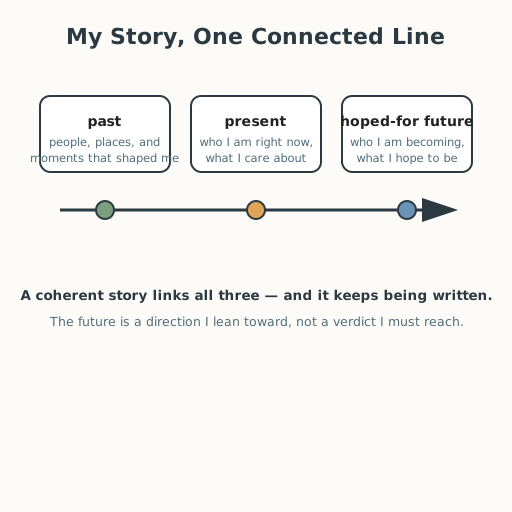
Lesson 6 — My Story, Still Being Written: Past, Present, and Hoped-For Future
Summary
Learners construct a coherent personal narrative linking their past, present, and hoped-for future into one connected story. Using a past–present–future line and a worked example, they find a single thread — a value, a theme, a turning point — that runs through all three, and tell their story as one still being written.
Objectives
- Construct a coherent personal narrative that connects your past, present, and hoped-for future. (D01.S2.09.01)
- Name the thread that links the three stages into one story. (D01.S2.09.01)
Connection
If someone asked you right now, “So, who are you?”, what would you say? Not your name — the story under the name: where you come from, what matters to you, where you are headed. A scattered list of facts is not an identity; a story is. And a story has a thread — one thing that shows up in the past, is alive in the present, and reaches toward the future. Maybe it is curiosity, or loyalty, or the pull of a certain place or craft. Today you find your thread and tell your story as one connected life — not a finished book, but a story still being written.
Materials
- Story-line sheet
- Worked-example narrative
Preparation
- Copy the story-line sheet and the worked-example narrative.
- Retrieval: from Lesson 1, recall the unit’s second strand — identity and self-concept. Today we begin it.
Facilitator note
This lesson is written to the learner (“you”). It is a skill lesson: building a coherent narrative is taught with a worked example, then guided practice (S-011), not left to blank-page discovery. The psychological idea behind it is narrative identity — people make sense of who they are by constructing an evolving story of the self that links the reconstructed past, the felt present, and the imagined future, and this story gives life unity and purpose (McAdams, S-404). The linked notion of possible selves — the selves a person imagines becoming, hoping to become, or fearing to become — sits between the present self and future motivation (Markus & Nurius, S-399). Hold these as descriptive accounts, not a required genre or a verdict: a learner’s story may be fragmented, uncertain, or multiple — that is human, and it is fine. The ethics lens: a narrative is an interpretation, and the same life can be honestly told more than one way; teach learners to tell their own story with honesty and kindness to themselves, not to build a flattering myth. The global lens: cultures differ in how a life story is told — some center ancestors and lineage, some center place, some center individual achievement — and no one form is the right one. Safety is paramount: this can be tender material. Every sharing is optional; personal narratives are shared only in small, trusted groups, never demanded aloud; a learner who has experienced harm or loss may write only what feels safe, or write about a character instead. Connect difficulty to agency and hope, never to shame (philosophy §12). The future is a direction, not a deadline — “I don’t know yet” is a complete and honest answer.
Procedure
- Recall (5 min). Name the unit’s three strands. Today we begin identity and self-concept.
- Worked example (10 min). Listen as your facilitator tells a short, invented narrative that runs one thread through a past, a present, and a hoped-for future. Notice how the same value shows up in all three.
- Map your line (15 min). On your story-line sheet, note the people, places, and turning points of your past; what matters to you now; and who you hope to become. Keep it to what feels safe to write.
- Find the thread (10 min). Look across your three columns. What appears in more than one — a value, a curiosity, a loyalty, a place, a craft? Write it in one sentence.
- Tell the story (15 min). Write or speak a short narrative that carries that thread from past, through present, toward the future. It does not need to be long; it needs to be yours and connected.
- Close (5 min). You did not write a finished book; you found the thread of a story still being written. Next: how the world shapes who you are.
Differentiation
- Support: Use the worked example’s frame (“In the past I…; now I…; I hope to…; the thread is…”).
- Extension: Identify a single theme that runs through all three stages and state it as a title for your story.
Assessment
- Formative (portfolio): The personal narrative (or story line) linking past, present, and hoped-for future, with a named thread — kept in the portfolio. Sharing is optional; the artifact itself is the evidence.
- Self: The learner checks: does one thread appear in all three stages?
Home connection
Ask someone at home to tell you one short story from their own past — and ask them what it taught them that still matters now. Notice the thread.
Resources
- On narrative identity and life stories: McAdams (2001), The Psychology of Life Stories, https://doi.org/10.1037/1089-2680.5.2.100 (S-404).
- On possible selves: Markus & Nurius (1986), Possible Selves, https://doi.org/10.1037/0003-066X.41.9.954 (S-399).
- On identity as a lifelong process: Erikson, Childhood and Society (S-155).
- On explicit instruction and worked examples: Kirschner, Sweller & Clark (2006), https://doi.org/10.1207/s15326985ep4102_1 (S-011).