Lesson 08 — Authoring My Choices: How I Shape the World Back
Learners analyze how **identity shapes choices** — how a person's values, beliefs, and belonging lead to what they do — and how those choices, repeated, shape the world and feed back into the self. They trace one of their own values into a real choice and its effects, seeing themselves as **authors, not just receivers**, of their lives.
Objectives
Objectives
- D01.S2.09.02 Analyze how a person's identity is shaped by their society and, in turn, shapes their choices.
Essential question
How does my identity shape my choices — and how do my choices, repeated, shape the world and the person I am becoming?
Key vocabulary
Materials
Standard materials
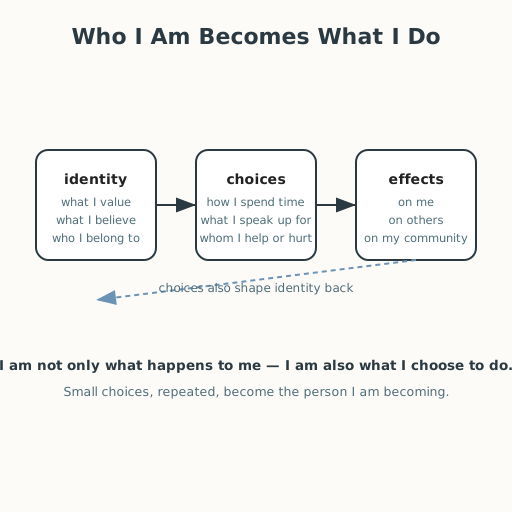
- Identity-to-choice sheet · 1 per learner A three-box flow — identity, choices, effects — with a feedback arrow, and space to trace one value into a real choice and its effects
- Choice scenario cards · 1 set per group Short scenarios where a character's identity (values, beliefs, belonging) leads to a choice with effects on self and others
Low-tech / no-cost
- Paper and pencil Draw the three boxes and trace a value into a choice freehand; no printed sheets needed
- Voice and role-play Act out a scenario and its effects instead of using cards
Enriched / lab & device
- A shared document for a class map of values and choices · 1 Learners connect their values to real choices, building a collective picture of agency
- A short reading or film of a person acting on their values · 1 Learners trace how the character's identity shaped a choice and its ripple
Works in different contexts
- large-group Trace one scenario together on the board, then groups trace the rest and share one each
- multi-age Younger learners match a value to a choice; older learners trace the effects on self, others, and community
- self-directed A learner traces one of their own values into a real choice and its effects, then reflects on the feedback loop
- level-grouped Learners ready to extend analyze how a repeated small choice became a habit that now shapes their identity back
- outdoor-only Choose a real, small choice available outdoors (helping, sharing space, caring for a place) and trace its effects
Lesson 8 — Authoring My Choices: How I Shape the World Back
Summary
Learners analyze how identity shapes choices — how a person’s values, beliefs, and belonging lead to what they do — and how those choices, repeated, shape the world and feed back into the self. They trace one of their own values into a real choice and its effects, seeing themselves as authors, not just receivers, of their lives.
Objectives
- Analyze how a person’s identity shapes their choices and, in turn, their effects on the world. (D01.S2.09.02)
- Trace one of your own values into a real choice and name its effects on yourself, others, and your community. (D01.S2.09.02)
Connection
Last lesson you saw how the world made you. Now turn the arrow around. A person who values loyalty will make different choices than one who values freedom — in who they defend, what they keep secret, what they give up. A person who feels they belong to a place will act toward that place differently than one who feels like a visitor. Your identity is not just a mirror reflecting the world; it is a hand that moves things. Small choices, repeated, become the person you are becoming and the world you are helping to build. Today you learn to see yourself as an author, not only a receiver.
Materials
- Identity-to-choice sheet
- Choice scenario cards
Preparation
- Copy the identity-to-choice sheet and choice scenario cards.
- Retrieval: from Lesson 7, recall one influence you were given and one you chose. Today we follow the chosen parts into action.
Facilitator note
This lesson is written to the learner (“you”). It completes the fourth goal (D01.S2.09.02) by flipping the arrow: identity shapes choices, and choices shape the world and, in a feedback loop, the self. The core ideas: (1) values → choices — what a person values and believes steers what they do (who they defend, how they spend time, whom they help or hurt); (2) effects — choices have consequences for the self, for others, and for the community; (3) the feedback loop — small choices, repeated, harden into habits, and habits become identity (what a person does comes to be part of who they are). These are taught with a worked example and guided practice (S-011). The ethics lens is central: a choice’s rightness is judged by its effects on others, not only by how it feels — and the same choice can look different from another person’s side. The egalitarian lens: agency is not equally distributed — not everyone has the same freedom to act on their values, because of money, safety, or prejudice — so we honor effort without blaming those with fewer choices. The community lens: a person’s choices ripple through the people around them, so authorship is also responsibility. Keep the balance honest: this is about agency, not blame — a learner is the author of their choices but not of everything that happens to them. Emphasize hope and the possibility of change: a habit can be re-authored. No learner is judged for the choices they trace; invented examples are always welcome.
Procedure
- Recall (5 min). From Lesson 7, name one part of your identity you were given and one you have begun to choose.
- Worked example (10 min). Watch as your facilitator traces an invented person’s value — say, loyalty — into a real choice and its effects on the self, on others, and on the community. Notice the arrow: value → choice → effects.
- Trace the scenarios (15 min). In pairs, take the choice scenario cards. For each, name the character’s value or belief, the choice it led to, and the effects on self, others, and community.
- Trace your own (15 min). On your sheet, choose one value you actually hold. Trace it into a real choice you have made or could make, and name its effects. (Keep it private if you prefer.)
- See the loop (7 min). With your pair: how does a small choice, repeated, become part of who you are? Name one habit you can see forming — for better or worse.
- Close (3 min). You are not only what happens to you; you are also what you choose to do. Next: aim that authorship at a goal worth reaching.
Differentiation
- Support: Provide sentence frames (“I value…; so I chose…; the effects were…”).
- Extension: Analyze how one repeated small choice became a habit that now shapes your identity back — and whether you want to keep it.
Assessment
- Formative (observation): Can the learner trace a value into a choice and name its effects on self, others, and community?
- Artifact: The completed identity-to-choice sheet, kept in the portfolio.
Home connection
Ask someone at home: what is one value you hold that shows up in a choice you make every day? How does that choice ripple outward?
Resources
- On identity status, exploration, and commitment: Marcia (1966), Development and Validation of Ego-Identity Status, https://doi.org/10.1037/h0023281 (S-403).
- On possible selves as a bridge from present self to future action: Markus & Nurius (1986), Possible Selves, https://doi.org/10.1037/0003-066X.41.9.954 (S-399).
- On responsible decision-making as a core SEL competency: CASEL, https://casel.org/fundamentals-of-sel/ (S-001).
- On explicit instruction and worked examples: Kirschner, Sweller & Clark (2006), https://doi.org/10.1207/s15326985ep4102_1 (S-011).