Lesson 07 — Made in a Society: How the World Shapes Me
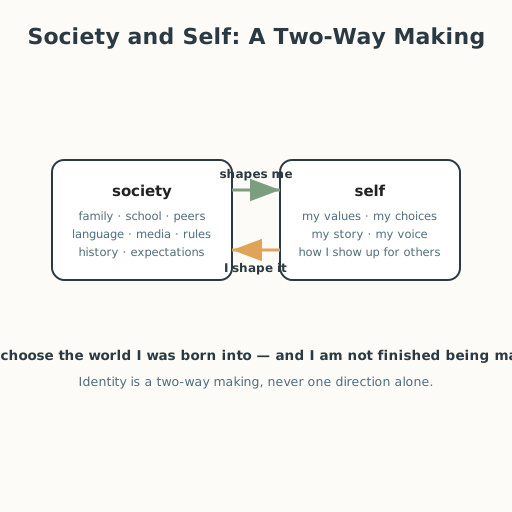
Learners analyze how **society shapes identity** — through family, school, peers, media, language, rules, and history — and sort these influences into those they were **given** and those they have **chosen**. They see identity as a **two-way making**: society shapes the self, and the self in turn shapes society, beginning with which given parts to keep and which to question.
Objectives
Objectives
- D01.S2.09.02 Analyze how a person's identity is shaped by their society and, in turn, shapes their choices.
Essential question
How is my identity shaped by my society — its family, school, peers, media, rules, and history — and which parts did I never choose?
Key vocabulary
Materials
Standard materials
- Society-and-self sheet · 1 per learner A two-way diagram — society shapes me, I shape it — with space to list influences and mark which were chosen and which were given
- Influence cards · 1 set per group Cards naming influences — family, school, peers, media, language, rules, history, expectations — to sort as given or chosen
Low-tech / no-cost
- Paper and pencil Draw the two-way diagram and list influences freehand; no printed sheets needed
- Voice and memory Name influences aloud and sort them as a group discussion
Enriched / lab & device
- A shared document for mapping influences · 1 Learners build a class map of the many forces that shape identity, then mark their own
- A short reading or film about identity in another society · 1 Learners analyze how that society shapes its members' sense of self
Works in different contexts
- large-group Build one big influence map on the board together, then each learner marks their own given-versus-chosen items
- multi-age Younger learners sort influences as given or chosen; older learners also name *how* an influence works and which to keep or question
- self-directed A learner lists their influences, marks given versus chosen, and writes one paragraph on how society shaped them
- level-grouped Learners ready to extend analyze one influence in depth — how it reached them and how it still operates
- outdoor-only Walk through a real social space (a street, a market, a place of gathering) and list the unspoken rules and expectations it teaches
Lesson 7 — Made in a Society: How the World Shapes Me
Summary
Learners analyze how society shapes identity — through family, school, peers, media, language, rules, and history — and sort these influences into those they were given and those they have chosen. They see identity as a two-way making: society shapes the self, and the self in turn shapes society, beginning with which given parts to keep and which to question.
Objectives
- Analyze how society — family, school, peers, media, language, rules, and history — shapes a person’s identity. (D01.S2.09.02)
- Distinguish the parts of your identity that were given to you from those you have begun to choose. (D01.S2.09.02)
Connection
You did not choose the language you first spoke, the family you were born into, the place, the school, the rules about how a person should act that surrounded you before you could question them. Those things were given to you — and they have quietly shaped what you value, fear, and want. Society is not a backdrop to your life; it is one of its authors. And yet the writing is two-way: as you grow, you begin to look back at what you were handed and decide what to keep, what to question, and what to change. Today you take stock of the first direction — how the world made you — so that next time you can see the second: how you make the world back.
Materials
- Society-and-self sheet
- Influence cards
Preparation
- Copy the society-and-self sheet and influence cards.
- Retrieval: from Lesson 6, recall your narrative thread. Today we ask where that thread came from — the society that helped weave it.
Facilitator note
This lesson is written to the learner (“you”). It opens the fourth goal (D01.S2.09.02), analyzing how society shapes identity. The core ideas: (1) socialization — identity is formed inside society, through family, school, peers, media, language, rules, and history; (2) given versus chosen — some parts of identity are handed to a person at birth (language, family, place, group memberships, expectations), and some are chosen or still being chosen; (3) identity as a two-way making — society shapes the self, and the self shapes society back, partly by deciding what to keep, question, or change. For the developmental frame, Erikson’s account of identity as a lifelong process (S-155) and Marcia’s identity statuses — that exploration (“moratorium”) is a normal and healthy part of forming identity before commitment (S-403) — support teaching that uncertainty and open exploration are not failure; they are the work itself. The global lens is central: identity is shaped differently in every society, and no single society’s way is the default or the best — invite learners to compare, never rank. The egalitarian lens: some people are given identities that are not equally valued by their society — identities that are stereotyped, excluded, or denied — and that inequality is something society built, not something the person deserves (see stereotype threat, S-284). The ethics lens: noticing what you were given is the first step toward deciding, with care for yourself and others, what to do with it. Safety: do not require learners to disclose painful parts of their given identities; invented examples and optional sharing are the norm. Emphasize agency and hope: what is given is real, but it is not a cage.
Procedure
- Recall (5 min). From Lesson 6, what thread runs through your story? Today: where did that thread come from?
- Worked example (10 min). Watch as your facilitator sorts three influence cards for an invented person — language, family, a peer group — into given and chosen, and says how each one shapes that person.
- Sort the cards (15 min). In pairs, sort the full set of influence cards into given and chosen. For two of them, say how the influence works — what it teaches, values, or forbids.
- Map your own (15 min). On your sheet, list influences on your own identity. Mark each as given or chosen. Which given one do you want to keep? Which one do you want to question? (Keep it private if you prefer.)
- Discuss the two-way street (7 min). With your pair: society shapes you — but where do you begin to shape it back? Name one small way.
- Close (3 min). You are made in a society — and you are not finished being made. Next: how your identity shapes your choices.
Differentiation
- Support: Provide sentence frames (“I was given…; I chose…; I want to keep/question…”).
- Extension: Analyze one influence in depth — how it reached you and how it still operates today.
Assessment
- Formative (observation): Can the learner name how society shaped their identity and distinguish given from chosen parts?
- Artifact: The completed society-and-self sheet, kept in the portfolio.
Home connection
Ask someone at home: what is one thing about you that came from your family or your place, that you never chose? What do they think of it?
Resources
- On identity as a lifelong, developing process: Erikson, Childhood and Society (S-155).
- On identity status and exploration: Marcia (1966), Development and Validation of Ego-Identity Status, https://doi.org/10.1037/h0023281 (S-403).
- On stereotype threat — how a devalued identity can weigh on a person: Steele & Aronson (1995), https://doi.org/10.1037/0022-3514.69.5.797 (S-284).
- On social awareness as a core SEL competency: CASEL, https://casel.org/fundamentals-of-sel/ (S-001).