Lesson 03 — Media, Peers, and the Messages My Body Hears
Learners **evaluate body-image messages** from media and peers using four decode questions — who made it, what does it want, what is left out, how does it make me feel about my body. They separate a message's *claim* from its *value*, name retouching and comparison culture, and practice responding to a peer comment with a steady, body-respecting answer.
Objectives
Objectives
- D03.S1.09.02 Evaluate body-image messages from media and peers and articulate a body-positive or body-neutral view of their own body.
Essential question
How do media images and peer comments shape how I feel about my body, and how do I evaluate those messages instead of absorbing them?
Key vocabulary
Materials
Standard materials
- Media-message analysis sheet · 1 per learner A template with the four decode questions (who made it, what does it want, what is left out, how does it make me feel about my body)
- Ad or social-post examples · 3–4 for the group Sample fitness/fashion/wellness ads or posts, printed or projected, chosen to be non-shaming and to spark analysis, not distress
Low-tech / no-cost
- A shared board or large paper Decode one message together aloud; no printed ads needed
- Memory and voice Learners recall an ad or post they have seen and analyze it from memory
Enriched / lab & device
- A device or screen · 1 per pair Look up a real ad or post and run the decode questions on it live
- A before/after retouching example · 1 for the group A short clip or image showing how images are altered, if available
Works in different contexts
- large-group Decode one message as a whole class, then pairs analyze a second example and share one finding each
- multi-age Younger learners answer "what does it want?" and "how does it make me feel?"; older learners add "who made it" and "what is left out"
- self-directed A learner picks one ad or post, runs all four decode questions in writing, and writes one sentence separating the message's claim from its value
- level-grouped Learners ready to extend analyze how a message uses composition, lighting, or symbolism (linking to D07 media analysis) to sell a body ideal
- outdoor-only Analyze a message seen on a billboard, shop window, or product package; the decode questions work without any screen
Lesson 3 — Media, Peers, and the Messages My Body Hears
Summary
Learners evaluate body-image messages from media and peers using four decode questions — who made it, what does it want, what is left out, how does it make me feel about my body. They separate a message’s claim from its value, name retouching and comparison culture, and practice a steady response to a peer comment.
Objectives
- Evaluate body-image messages from media and peers and articulate a body-positive or body-neutral view of their own body. (D03.S1.09.02)
Connection
You have seen the image a hundred times: a single, narrow kind of body, smooth and edited, posing with a product as if the product made the body. And you have heard the comment — “you look different,” “that’s for people who are fit,” or a silent glance at a phone held up for comparison. These messages feel personal, but they are not really about you: they are made by someone for a purpose, and they leave most bodies out on purpose. Learning to decode a message — to ask who made it, what it wants, and what it left out — turns you from a person the message happens to into a person who reads it and chooses.
Materials
- Media-message analysis sheet
- Ad or social-post examples
Preparation
- Copy the analysis sheet and gather the sample messages.
- Retrieval: from earlier media-literacy work (D07 and D10), recall the habit of asking where information comes from and what the source wants (S-063, S-217).
Facilitator note
This lesson is written to the learner (“you”). The skill to land: decode a body-image message with four questions — (1) Who made it? (2) What does it want me to think, feel, or buy? (3) What is left out — which bodies, which realities? (4) How does it make me feel about my own body? — then separate the message’s factual claim from its value message. This is a skill, so model the decode on one example before learners try it themselves (S-011). Keep the emotional temperature safe: choose sample messages that are analyzable without being cruel, and never show a learner an image chosen to make them feel bad. The critical-thinking lens: decoding is the same source-checking habit as fact-checking a claim (S-063, S-217). The ethics lens: a message that profits from making people feel their bodies are wrong is a question of values, not evidence. The egalitarian lens: the “ideal” body is historically and culturally specific — it changes by decade and by place — so no single body type is the truth (S-401, S-407). The global lens: different cultures have prized very different bodies, and beauty standards are local, shifting, and often imported with power attached. The technology lens: retouching and filters now make the “ideal” literally impossible to match — even the person in the image does not look like the image. Be explicit that the point is never to shame anyone’s appearance, choices, or culture, and never to rank bodies; the point is to loosen a message’s grip. Remind learners that if a message ever hurts, they can step away, and that media influence on how adolescents see themselves is real and worth taking seriously (S-311). Body image is sensitive; hold it with care and route distress toward a trusted adult.
Procedure
- Recall (5 min). What do we already ask about any piece of media — where it comes from and what it wants? Today we aim that same skill at messages about our bodies.
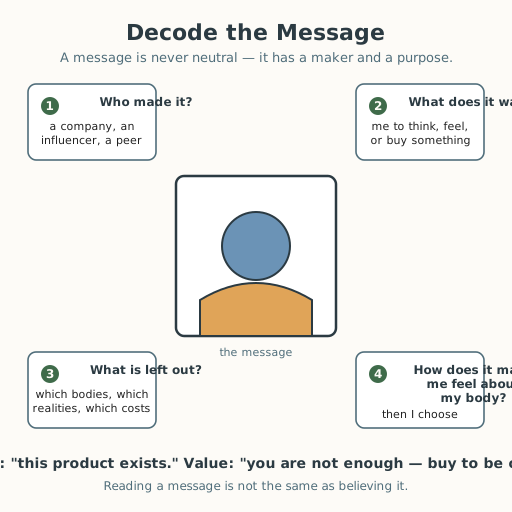
- Meet the four decode questions (8 min). Write them where all can see: (1) Who made it? (2) What does it want me to think, feel, or buy? (3) What is left out? (4) How does it make me feel about my body? A message is never neutral; it has a maker and a purpose.
- Model the decode (12 min). Take one sample ad or post. Run all four questions out loud. Notice the techniques: retouching (skin smoothed, proportions altered), lighting and composition that make one body look like the norm, and comparison culture (the feeling that you should measure yourself against the image). Then separate the claim (“this product exists”) from the value (“you are not good enough as you are; buy this to be acceptable”).
- Decode in pairs (15 min). Choose a second message. Fill in the analysis sheet with all four questions and write one sentence naming the claim and the value separately.
- Practice the peer response (10 min). A partner says a common comment — “you look different lately,” “that’s a workout for thin people,” “you’d be prettier if…”. Practice a steady, non-aggressive answer that returns the power to you, such as: “My body is not here to be evaluated” or “I decide what my body means.” Swap roles.
- Close (5 min). One sentence each: “A message I used to absorb is ___; now I read it as ___.” Reading a message is not the same as believing it.
Differentiation
- Support: Provide two of the four questions answered and ask learners to complete the rest; give sentence starters for the claim/value split.
- Extension: Find a second message that pushes the opposite value (body acceptance) and analyze it with the same four questions — showing the tool cuts both ways.
Assessment
- Formative (observation): Can the learner run all four decode questions and separate claim from value?
- Portfolio artifact: The completed analysis sheet, kept in the portfolio.
Home connection
Find one body-image message you see this week (an ad, a post, a package). Run the four questions on it in one or two sentences and bring your notes to the next lesson.
Resources
- On decoding media messages: NAMLE, “Key Questions to Ask When Analyzing Media Messages,” (S-151); and UNESCO, Media and Information Literacy, https://www.unesco.org/en/media-information-literacy (S-217).
- On media influence and adolescent self-perception: WHO, “Mental health of adolescents,” https://www.who.int/news-room/fact-sheets/detail/adolescent-mental-health (S-311).
- On body image and positive body image: Tylka & Wood-Barcalow (2015), “What is and what is not positive body image?” Body Image (S-407).
- On media and tech impact on young people: Common Sense Media Research Program (S-226).
- On explicit instruction and worked examples: Kirschner, Sweller & Clark (2006) (S-011).