Lesson 04 — A Body-Positive or Body-Neutral View of Myself
Learners **articulate a body-positive or body-neutral view of their own body**. They distinguish three resting places — body positivity, body neutrality, and body acceptance — and the shared idea underneath them all: *appearance is not your worth, and your body's value is not up for a vote.* They draft a short personal statement that is genuinely theirs, not borrowed from media or peers.
Objectives
Objectives
- D03.S1.09.02 Evaluate body-image messages from media and peers and articulate a body-positive or body-neutral view of their own body.
Essential question
How do I hold a steady, body-positive or body-neutral view of my own body — one that is mine, not borrowed from media or peers?
Key vocabulary
Materials
Standard materials
- Body-view statement template · 1 per learner A scaffold with sentence frames for writing a personal body-positive or body-neutral statement
- Notebook or journal · 1 per learner For drafting the personal statement
Low-tech / no-cost
- Voice and a partner Speak the statement aloud first, then write it; no printed template needed
- A shared board or large paper Build the three views (positivity / neutrality / acceptance) as one class chart
Enriched / lab & device
- A short audio or video of people with varied bodies speaking about body acceptance · 1 for the group Optional; model how different people hold a steady view in their own words
- A word processor or note app · 1 per learner Draft, revise, and keep the statement digitally
Works in different contexts
- large-group Introduce the three views to the whole group, then learners draft privately and optionally share one line each; never require sharing personal statements aloud
- multi-age Younger learners complete one sentence ("My body is good at ___"); older learners write the full statement with a reason
- self-directed A learner studies the three views, drafts a statement from the frames, and self-checks that it is theirs (not borrowed) and kind
- level-grouped Learners ready to extend add a "when a hard day comes" line — a sentence to return to on days the view wobbles
- outdoor-only Draft the statement while moving gently outside; movement can loosen words that sitting cannot
Lesson 4 — A Body-Positive or Body-Neutral View of Myself
Summary
Learners articulate a body-positive or body-neutral view of their own body. They distinguish three resting places — body positivity, body neutrality, and body acceptance — and the shared idea underneath them all: appearance is not your worth, and your body’s value is not up for a vote. They draft a short personal statement that is genuinely theirs, not borrowed from media or peers.
Objectives
- Evaluate body-image messages from media and peers and articulate a body-positive or body-neutral view of their own body. (D03.S1.09.02)
Connection
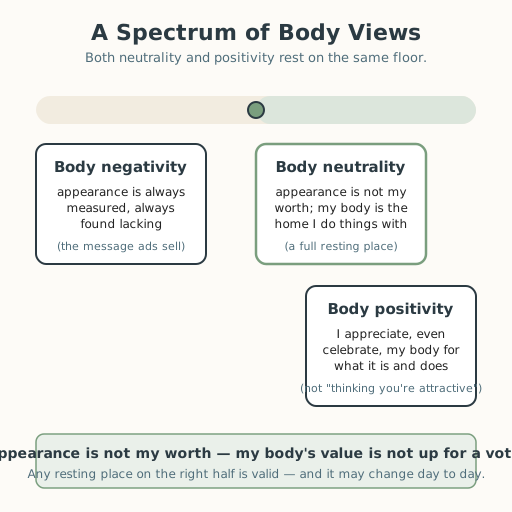
You do not have to love every part of your body every day to live at peace with it. Some people find power in loving their body loudly — that is body positivity. Others find peace by simply not making their appearance the center of their worth — that is body neutrality: your body is not the most important or most interesting thing about you. Both are real resting places, and both rest on the same floor: appearance is not your worth. Today you find your own words for the view you already half-hold, so the message you carry is yours — not the one the ads sold you.
Materials
- Body-view statement template
- Notebook or journal
Preparation
- Copy the statement template.
- Retrieval: from Lesson 3, recall the four decode questions and the claim/value split.
Facilitator note
This lesson is written to the learner (“you”). The concept to land: body positivity and body neutrality are two different, valid ways to hold a steady view of one’s own body — positivity says “I love and celebrate my body,” neutrality says “my body’s appearance is not what makes me valuable” — and both rest on body acceptance: appearance is not your worth, and your body’s value is not up for a vote. This is a values and identity lesson more than a skill, so use inquiry and reflection, but still model the statement before learners draft (S-011). Treat the research carefully and honestly: positive body image is a real, studied construct — it is not the same as “thinking you are attractive,” and it is measured by things like appreciating your body’s function, filtering body-image information, and kindness toward your body (S-407). The ethics lens: how we speak to and about our own bodies is a practice of respect that we model for others. The egalitarian lens: the “ideal” body is historically and culturally specific, so no one body type is closer to some true standard — and every body, including bodies with disabilities, illness, or assistive devices, is a full and legitimate body (S-407, S-411). The global lens: cultures worldwide have carried many standards of beauty; the modern, media-driven, single standard is one recent and powerful story, not a law of nature. Hold the room safely: sharing is always optional, never required; a learner who is not ready to say “positive” things about their body can rest at neutral — that is complete, not a lesser version. Never ask anyone to rank or evaluate a peer’s body. If body image is a point of real pain for a learner, connect them to a trusted adult or the help-seeking paths named later in the year.
Procedure
- Recall (5 min). From Lesson 3: what is the difference between a message’s claim and its value? Today we write a message of our own — to ourselves — and make sure it is really ours.
- Meet the three views (10 min). Read them on the spectrum: Body negativity — appearance is constantly measured and found lacking (the message the ads want you to carry). Body neutrality — my appearance is not the measure of my worth; my body is the home I do things with, not a project to fix. Body positivity — I can appreciate, even celebrate, my body for what it is and what it does. Both of the last two are healthy resting places; neither is “more correct.” You may rest differently on different days.
- Model the statement (8 min). Worked example (neutral): “My body is not here to be evaluated. It carries me through my day — it lets me think, move, laugh, and care for the people I love. That is what makes it mine, and that is enough.” Worked example (positive): “I appreciate my body for what it does for me — my legs that carry me, my hands that make things, my voice that speaks up. I do not need to match an image to be whole.” Notice: neither sentence mentions weight, shape, or comparison.
- Draft yours (15 min). Use the frames to write your own two-to-four sentence statement. Aim for: (a) what your body does or makes possible, (b) a line that is yours (a true memory or fact of your life), and (c) no appearance-ranking. Rest at neutral if positivity does not feel true today.
- Self-check and peer-check (8 min). Read it to yourself. Ask: Is it mine, or is it a borrowed slogan? Is it kind? Would it hold on a hard day? If you wish, share with a partner and help each other replace any appearance-ranking with a function line.
- Close (9 min). Write one line you can say to yourself on a hard day, and underline it. You do not have to love every part of your body to live at peace with it.
Differentiation
- Support: Use the single-sentence frame “My body is good at ___ and that is enough” and fill the blank with a real thing the learner’s body does.
- Extension: Write a second statement as if you were saying it to a friend who is struggling — then notice what you would offer them that you might withhold from yourself.
Assessment
- Formative (observation/self): Does the statement name function over form, avoid appearance-ranking, and sound genuinely the learner’s own?
- Portfolio artifact: The personal body-view statement, kept in the portfolio (shared only if the learner chooses).
Home connection
Put your underlined line somewhere you will see it this week — a note, a phone lock screen, a page in your journal. Notice one moment it helped and be ready to say it from memory.
Resources
- On positive body image and body acceptance: Tylka & Wood-Barcalow (2015), “What is and what is not positive body image?” Body Image (S-407).
- On body image and self-worth: National Eating Disorders Association, “Body Image,” https://www.nationaleatingdisorders.org/body-image-0 (S-411).
- On explicit instruction and worked examples: Kirschner, Sweller & Clark (2006) (S-011).