Lesson 05 — Setting and Tracking a Movement Goal
Learners **set a personal movement goal and plan to track it over time**. The goal is specific, measurable, and realistic; it is built on *function, feeling, or skill* — never weight or appearance. They build a simple tracking log, test the first step, and commit to a check-in, framing the whole thing as ownership, not punishment.
Objectives
Objectives
- D03.S2.09.01 Set a personal movement or fitness goal and track progress toward it over time.
Essential question
How do I set a personal movement goal that is specific, realistic, and mine — and track it over time without turning it into a punishment?
Key vocabulary
Materials
Standard materials
- Movement-goal planner · 1 per learner A one-page planner with spaces for the goal, a reason, a start point, small steps, and a tracking table
- Tracking log template · 1 per learner A simple table to record what was done and how it felt, over several weeks
Low-tech / no-cost
- Paper and pencil Draw the planner and tracking table by hand; the body itself is the only equipment required
- Voice and a partner Talk the goal through aloud before writing; a partner checks it is specific and realistic
Enriched / lab & device
- A fitness tracker, phone app, or stopwatch · 1 per pair Optional tool for counting, timing, or recording — used only if it helps, never to rank bodies
- A simple movement space or outdoors · 1 shared Try the first small step of the goal right now to feel it is realistic
Works in different contexts
- large-group Model one goal to the whole group, then learners draft individually; use a gallery of goals (function, feeling, skill, consistency) rather than any competitive ranking
- multi-age Younger learners set a one-week goal; older learners set a four-week goal with a check-in point and a recovery note
- self-directed A learner drafts the goal and tracking plan alone, self-checks each part (specific, measurable, realistic), and schedules the first check-in
- level-grouped Learners ready to extend add a plan for *recovery* and for what to do when a week is missed — the sign of a sustainable goal
- outdoor-only Choose goals that need only the outdoors — walking, cycling, gardening, dancing, carrying, stretching — and track by feel and time, not distance
Lesson 5 — Setting and Tracking a Movement Goal
Summary
Learners set a personal movement goal and plan to track it over time. The goal is specific, measurable, and realistic; it is built on function, feeling, or skill — never weight or appearance. They build a simple tracking log, test the first step, and commit to a check-in, framing the whole thing as ownership, not punishment.
Objectives
- Set a personal movement or fitness goal and track progress toward it over time. (D03.S2.09.01)
Connection
Think of a goal as something you own, not something you owe. A good movement goal sounds like “I want to be able to carry the groceries up the hill without stopping” or “I want to dance without getting winded” or “I want to sit at my desk without my back aching” — not “I should fix my body.” The difference matters: a goal built on what your body can do and feel invites you in, while a goal built on shame pushes you away. Today you set a goal you would actually keep, and you build the tiny tracking habit that keeps it real.
Materials
- Movement-goal planner
- Tracking log template
Preparation
- Copy the planner and tracking log.
- Retrieval: from Lesson 1, recall the body–mind loop — movement is one of the ways you can deliberately shift your own body state.
Facilitator note
This lesson is written to the learner (“you”). The skill to land: a good movement goal is (1) specific and measurable, (2) realistic — a small step you can actually do this week, (3) built on function, feeling, or skill rather than weight or appearance, and (4) tracked simply, with a planned check-in and a kind response when a week is missed. This is a skill, so use a worked example first, then guided practice (S-011). The critical lens here is ethical and egalitarian: hold the line firmly that goals must never target weight, body size, or appearance — the curriculum is weight-neutral by design, and a “goal” to shrink a body is not wellness, it is harm (S-407). The egalitarian lens: a movement goal must fit any body and ability — walking, rolling, swimming, gardening, dancing, stretching, carrying, cycling — and the UNESCO charter holds that physical activity is a right for all, practiced inclusively without discrimination (S-342). The global lens: movement traditions worldwide (dance, games, martial arts such as tai chi, capoeira, and kalaripayattu, manual work) all count as movement; the goal is health and joy, not any single sport. The technology lens: trackers and apps can help record, but they can also distort a healthy relationship with movement by making it about numbers and comparison — use them only if they help, and never to rank bodies (see Grade 10’s fuller treatment). Emphasize mastery, not ranking: a missed week is information, not a verdict — the learner simply restarts, smaller. Model a goal that is genuinely small, so no learner is set up to fail.
Procedure
- Recall (5 min). From Lesson 1: how does movement shift body state — and therefore mood and thinking? Today we turn that into a plan we own.
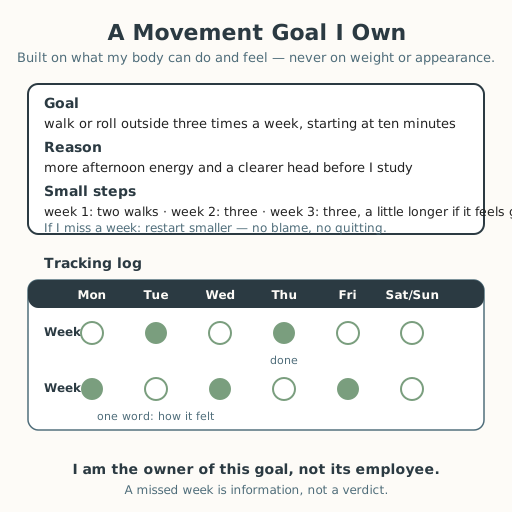
- Meet a good goal (10 min). A good movement goal is specific (“walk or roll outside three times a week” — not “move more”), measurable (you can say yes or no), realistic (a small step you can do this week), and built on function, feeling, or skill — never on weight or appearance. It also names a reason that is yours.
- Study the worked example (10 min). Worked example: Goal: walk or roll outside three times a week, starting at ten minutes. Reason: I want more energy in the afternoon and a clearer head before studying. Start point: one ten-minute walk this week. Small steps: week 1 — two walks; week 2 — three; week 3 — three, a little faster or longer if it feels good. Tracking: mark each day done and write one word for how it felt. If I miss a week: I restart smaller — no blame, no quitting.
- Draft yours (15 min). Fill the planner: goal, reason, start point, small steps, and a tracking table. Make it yours — your body, your life, your joy.
- Test the first step (8 min). Do the first small step right now if you can — ten minutes of walking, stretching, or whatever you chose. Notice how it feels; adjust the goal if it was too big or too small.
- Peer-check (5 min). Swap planners with a partner. Check: is it specific and measurable? Realistic? Built on function/feeling/skill, with no weight or appearance language? Fix what needs fixing.
- Close (2 min). One sentence: “I am the owner of this goal, not its employee.” Set a check-in day.
Differentiation
- Support: Give a pre-written goal with blanks (“___ times a week, starting at ___ minutes, because ___”) and ask the learner to fill it in.
- Extension: Add a recovery line to the plan — rest days, and what to do if you feel sore or tired — the mark of a sustainable goal.
Assessment
- Formative (observation/self): Is the goal specific, measurable, realistic, and function/feeling/skill-based, with a tracking plan and a check-in?
- Portfolio artifact: The completed planner, kept in the portfolio; the tracking log is filled in over the following weeks and revisited in the unit capstone.
Home connection
Start the tracking log today. At your check-in, write one honest sentence: what worked, what did not, and one small change. Bring the log back to the capstone lesson.
Resources
- On physical activity and how it supports health: WHO, “Physical activity,” fact sheet, https://www.who.int/news-room/fact-sheets/detail/physical-activity (S-341).
- On movement as a right for all, practiced inclusively: UNESCO, International Charter of Physical Education, Physical Activity and Sport (S-342).
- On positive body image and why goals must not target appearance: Tylka & Wood-Barcalow (2015), Body Image (S-407).
- On explicit instruction and worked examples: Kirschner, Sweller & Clark (2006) (S-011).