Lesson 06 — Movement, Mind, and Learning
Learners **analyze how movement affects mental health and learning**, naming the basic mechanisms — endorphins, dopamine and serotonin, BDNF and focus, circulation and sleep — and then *test it on themselves* with a short movement break and a before/after focus trial. They separate what the evidence supports from what it does not.
Objectives
Objectives
- D03.S2.09.02 Analyze how movement affects mental health and learning, describing the basic mechanism such as endorphins and focus.
Essential question
How does movement shape my mental health and my learning — and what is actually happening in my brain and body when it does?
Key vocabulary
Materials
Standard materials
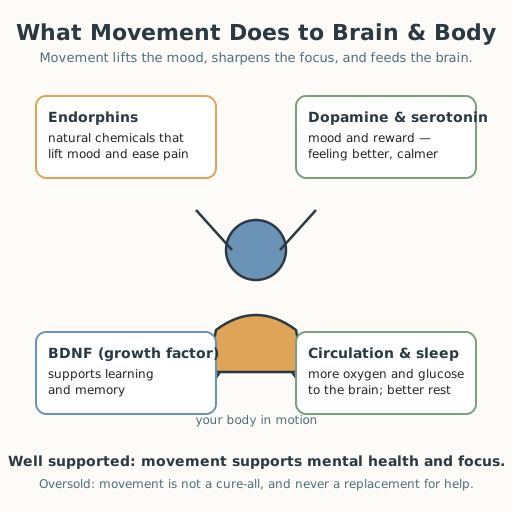
- Movement-and-mind diagram · 1 per learner A one-page diagram of what movement does in the brain and body (endorphins, dopamine/serotonin, BDNF and focus, circulation, sleep)
- Notebook or journal · 1 per learner For the mechanism notes and the "before/after focus" trial
Low-tech / no-cost
- Voice and the body Run the movement trial with the body alone; explain the mechanisms aloud with the diagram drawn on a board
- A shared board or large paper Build the "what movement does" map together
Enriched / lab & device
- A short movement break (walk, dance, stretch) plus a timer · 1 for the group Run a real 5-minute movement break and compare focus before and after
- A video or article on exercise and brain health · 1 for the group Optional; deepen the mechanism with a reputable explainer
Works in different contexts
- large-group Run the movement break as one whole group, then learners record their own before/after; discuss mechanisms together
- multi-age Younger learners name the mood change; older learners name the mechanism (endorphins, focus, BDNF) behind it
- self-directed A learner studies the diagram, runs a timed before/after focus trial alone, and writes one mechanism in their own words
- level-grouped Learners ready to extend distinguish the short-term mood lift from the longer-term brain changes, and note how sleep and recovery fit in
- outdoor-only Run the movement break outside; notice how the setting adds to the effect, and keep the trial safe and accessible to all bodies
Lesson 6 — Movement, Mind, and Learning
Summary
Learners analyze how movement affects mental health and learning, naming the basic mechanisms — endorphins, dopamine and serotonin, BDNF and focus, circulation and sleep — and then test it on themselves with a short movement break and a before/after focus trial. They separate what the evidence supports from what it does not.
Objectives
- Analyze how movement affects mental health and learning, describing the basic mechanism such as endorphins and focus. (D03.S2.09.02)
Connection
You have felt it: after sitting still too long, your mind goes foggy; after a walk or a game or a dance, the same problem suddenly looks solvable. That is not a mood trick — it is chemistry and blood flow doing real work. Movement tells your brain to make chemicals that lift mood and sharpen focus, and it sends more oxygen and glucose where thinking happens. Understanding the mechanism matters because it turns “exercise is good for you” from a slogan into something you can use on purpose: a ten-minute break before studying is not wasted time — it is study strategy.
Materials
- Movement-and-mind diagram
- Notebook or journal
Preparation
- Copy the movement-and-mind diagram.
- Retrieval: from Lesson 5, recall your movement goal; today we learn why that goal pays off in the brain, not just the body.
Facilitator note
This lesson is written to the learner (“you”). The concept to land: movement supports mental health and learning through real mechanisms — (1) endorphins and other mood chemicals (dopamine, serotonin) lift mood and reduce feelings of stress; (2) growth factors like BDNF support brain health, learning, and memory; (3) better circulation delivers oxygen and glucose to the brain, aiding focus; and (4) regular movement improves sleep, which consolidates learning. This is a concept with a skill (tracing cause to effect), so teach the mechanisms explicitly with a worked example, then let learners run a real trial (S-011). Keep the science honest and hedged: the strongest, best-replicated claims are that regular physical activity supports mental health and that a single bout can acutely improve mood and alertness (S-341, S-409); the endorphin story is real but one mechanism among several, and no single chemical is the whole story (S-408). The critical-thinking lens: separate “well supported” (movement supports mental health and focus) from “oversold” (movement as a cure-all, or a substitute for help when someone is struggling — see the help-seeking work later in the year). The ethics lens: use movement to support yourself, never to punish yourself; the moment movement becomes penance for eating or existing, it has stopped being wellness. The egalitarian lens: the mechanisms work across all bodies and abilities — seated movement, stretching, rolling, and adapted activity produce the same kinds of benefit, so no one is excluded (S-342). The global lens: every culture has long linked movement to wellbeing — through dance, games, martial arts such as yoga, tai chi, capoeira, and wrestling traditions, and manual work — long before gyms and apps existed. Emphasize that the trial is self-comparison (you before vs. you after), never a competition, and that learners who cannot or should not move today can still learn the mechanism and apply it another day.
Procedure
- Recall (5 min). What is your movement goal from Lesson 5? Today we learn the why behind it — what movement actually does to the brain and body.
- Meet the mechanisms (12 min). Study the diagram. Movement triggers endorphins (natural chemicals that lift mood and ease pain), dopamine and serotonin (mood and reward), BDNF (a growth factor that supports learning and memory), and better circulation (more oxygen and glucose to the brain), and over time it improves sleep, which is when learning is cemented. Plain version: movement lifts the mood, sharpens the focus, and feeds the brain.
- Separate evidence from hype (8 min). Well supported: regular movement supports mental health; one session can lift mood and alertness (S-341, S-409). Oversold: movement is not a cure for everything, and it is not a replacement for help when someone is struggling. Saying “just exercise” to a person in real distress is not evidence — it is dismissal.
- Run the trial (12 min). Do a short, accessible movement break — five minutes of walking, dancing, or stretching. Before: rate your focus and mood 1–5 and note them. After: rate again. Then try a small thinking task (a list, a puzzle, a paragraph) and notice any difference.
- Record and analyze (12 min). In your journal: your before/after numbers, one sentence on what changed, and one mechanism from the diagram that might explain it. Write the caveat line too: “This was one short trial with just me — it shows a possibility, not proof.”
- Close (6 min). One sentence each: “I can use movement as a tool for my mind by…” (a break before studying, a walk to clear a bad mood, a stretch to reset). Movement is not a chore — it is a lever you can pull on your own mind.
Differentiation
- Support: Give the before/after scale pre-printed and ask learners to circle a number and copy one mechanism sentence; provide a fill-in (“Movement helps my mind by ___”).
- Extension: Design a small personal experiment to test the effect over a week (e.g., a movement break before study on three days, none on three) and predict the result.
Assessment
- Formative (observation/self): Can the learner name at least two mechanisms and describe a before/after change in their own words, with the honesty that one trial is not proof?
- Portfolio artifact: The before/after notes and mechanism sentence, kept in the portfolio.
Home connection
This week, use a movement break once before a task that needs focus. Note one honest observation — did it help, and what did you notice? Bring it to the capstone lesson.
Resources
- On physical activity and mental health: WHO, “Physical activity,” fact sheet (S-341).
- On the mechanisms linking exercise and mental health (endorphins, monoamines, BDNF): Mikkelsen et al. (2017), “Exercise and mental health,” Maturitas (S-408).
- On movement as a right for all bodies: UNESCO, International Charter of Physical Education, Physical Activity and Sport (S-342).
- On explicit instruction and worked examples: Kirschner, Sweller & Clark (2006) (S-011).