Lesson 03 — Trust and Honest Talk About Feelings
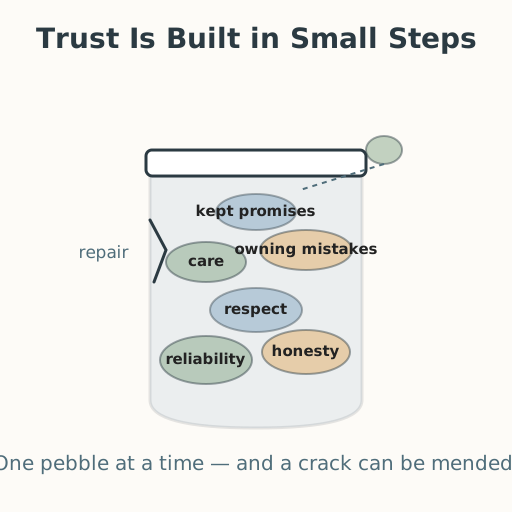
Learners name the small behaviors that **build trust** (reliability, honesty, respect, care, owning mistakes) and practice **honest talk about feelings** with I-statements, including how to begin **repairing** a relationship after a rupture.
Objectives
Objectives
- D02.S1.09.02 Practice healthy relationship skills, including consent, trust, and honest talk about feelings.
Essential question
How is trust built and repaired, and how do I talk honestly about my feelings in a relationship?
Key vocabulary
Materials
Standard materials
- Trust-builder sheet · 1 per learner A sheet listing trust-building behaviors (reliability, honesty, respect, care, owning mistakes) with space to sort examples
- I-statement worked example · 1 per learner The "I feel ___, when ___, because I need ___" sentence frame, with a fully worked example
Low-tech / no-cost
- A shared board or large paper Build the trust list and the sentence frame together
- Voice and a partner Practice I-statements aloud in pairs
Enriched / lab & device
- A shared document or journaling app · 1 per learner Write a longer honest-feelings reflection to keep in the portfolio
Works in different contexts
- large-group Build the trust list once together, then pairs practice I-statements on one scenario each
- multi-age Younger learners sort one trust example each; older learners also write a repair sentence after a rupture
- self-directed A learner sorts the examples, writes three I-statements about real situations, and self-checks the frame
- level-grouped Learners ready to extend name a rupture they have experienced and draft a repair conversation
- outdoor-only Run the I-statement practice while walking; the skill needs no equipment
Lesson 3 — Trust and Honest Talk About Feelings
Summary
Learners name the small behaviors that build trust (reliability, honesty, respect, care, owning mistakes) and practice honest talk about feelings with I-statements, including how to begin repairing a relationship after a rupture.
Objectives
- Practice healthy relationship skills, including consent, trust, and honest talk about feelings. (D02.S1.09.02)
Connection
Think of a person you trust without thinking about it — a friend who keeps your secrets, a sibling who shows up, an adult who believes you. Now think of how that trust was built: not in one grand gesture, but in a hundred small moments — kept promises, told truths, respected feelings, owned mistakes. Trust is not automatic and not free; it is built slowly and can be cracked quickly. And when it cracks, honest talk is how it begins to mend. Today you learn both halves — building it and repairing it.
Materials
- Trust-builder sheet
- I-statement worked example
Preparation
- Copy the trust-builder sheet and worked example.
- Retrieval: from Grade 3, recall using “I” statements to say how you feel without blaming (D02.S1.03.02); from Grade 8, recall how tone and body language change meaning.
Facilitator note
This lesson is written to the learner (“you”). The ideas to land: (1) trust is built by small, repeated behaviors — reliability (doing what you said), honesty (telling the truth, kindly), respect (honoring boundaries and differences), care (showing up for the other), and owning mistakes (admitting and repairing them); (2) a rupture — a hurt or a breach — is normal in close relationships, and trust is rebuilt through repair, not silence; (3) honest talk about feelings uses the I-statement — “I feel ___ when ___, because I need ___” — which owns your feeling without blaming. Model the I-statement frame fully, then guided practice (S-011). The ethics lens: honesty is a form of care, not a weapon; repair is a duty we owe people we love. The egalitarian lens: trust should be mutual, not one-way — in healthy relationships, both people can speak and both are heard, across differences of age, gender, or status. The global lens: how openly feelings are spoken varies across cultures and families — some name feelings directly, some show them through action; neither is “better,” and honest talk can happen in many registers. The technology lens: in text, tone vanishes, so honest talk about feelings needs extra care and sometimes a spoken follow-up. Keep this gentle and normalizing — every close relationship has ruptures.
Procedure
- Recall (5 min). From Grade 3: what is an “I” statement, and why does it help? Today we put it to work in trust and repair.
- Meet trust (10 min). Trust is built by small, repeated behaviors. Sort the examples on your sheet into the five builders: reliability, honesty, respect, care, owning mistakes. Which builds trust, and which cracks it?
- Meet the I-statement (8 min). Honest talk about feelings uses one frame: “I feel ___ when ___, because I need ___.” It owns your feeling and names your need — without blaming the other person.
- Study the worked example (8 min). Blaming: “You always cancel on me and it’s so rude.” Honest: “I feel hurt and a little anxious when plans get canceled at the last minute, because I need to be able to count on our time together.” Say why the second one is easier to hear and to act on.
- Practice in pairs (12 min). Use the frame on three real-feeling situations: a friend forgot something important to you; someone said something that stung; a group left you out of a plan. Switch roles and give each other feedback.
- Meet repair (6 min). When trust cracks, repair begins with an honest I-statement, a real apology, and an agreed next step. Draft one repair sentence for a rupture you imagined.
- Close (3 min). Share one trust-builder you want to practice this week.
Differentiation
- Support: Provide the I-statement frame as a fill-in, with feeling and need words listed to choose from.
- Extension: Draft a full repair conversation — honest I-statement, apology that names the harm, and an agreed next step.
- Non-speaking / AAC / Deaf / hard of hearing: An I-statement can be written, signed, or pointed to (using the feeling and need word bank) — never only spoken. Honest talk is about honesty, not about using a voice; trust-building and repair are practiced in whatever mode the learner owns.
Assessment
- Formative (observation): Can the learner sort trust-building behaviors and form an honest I-statement?
- Peer check: Partner confirms the I-statement names a feeling and a need without blaming.
- Portfolio artifact: The completed trust-builder sheet and one I-statement, kept in the portfolio.
Home connection
Notice one small moment this week when someone kept a promise or told the truth — and name it aloud: “I noticed you… and it builds my trust.” Try one honest I-statement at home if a feeling needs saying.
Resources
- On relationship skills and social awareness as SEL competencies: CASEL, “Fundamentals of Social and Emotional Learning,” https://casel.org/fundamentals-of-sel/ (S-001).
- On needs-based, honest communication: Marshall B. Rosenberg, Nonviolent Communication (2003) (S-148).
- On explicit instruction and worked examples for skills: Kirschner, Sweller & Clark (2006), https://doi.org/10.1207/s15326985ep4102_1 (S-011).