Lesson 04 — Empathic Inquiry: Understanding Before Responding
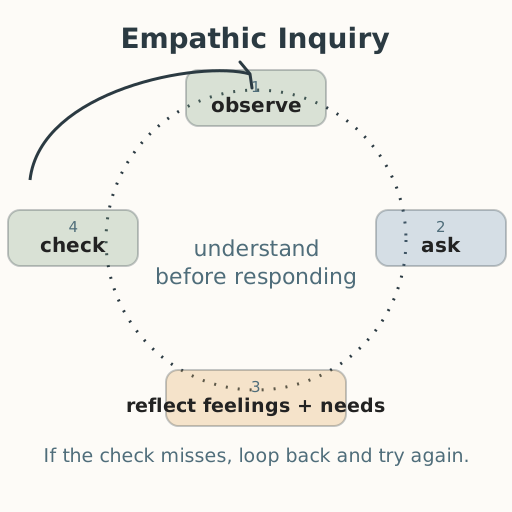
Learners practice **empathic inquiry** — a four-step loop of **observe, ask, reflect feelings and needs, and check** — to understand another person before responding, resisting the urge to fix, judge, or argue first.
Objectives
Objectives
- D02.S2.09.01 Use empathic inquiry to understand another's feelings and needs before responding.
Essential question
How do I understand another person's feelings and needs before I respond — especially when my first impulse is to fix, judge, or argue?
Key vocabulary
Materials
Standard materials
- Empathic-inquiry loop card · 1 per learner A four-step loop — observe, ask, reflect feelings and needs, check — with a worked example printed on the back
- Listening scenarios · 1 set per group Short situations where a person is upset, worried, or excited, to practice the loop on
Low-tech / no-cost
- Voice and a partner The whole loop runs with listening and speaking alone
- A shared board or large paper Draw the loop together and record feeling and need words as a class bank
Enriched / lab & device
- A recording tool · 1 per pair Record a practice conversation and listen back to notice where the loop was followed or skipped
Works in different contexts
- large-group Model the loop once to the whole group, then pairs practice one scenario each
- multi-age Younger learners practice the observe and ask steps; older learners complete all four including the check
- self-directed A learner studies the worked example, then writes a reflective empathic response to a situation they have witnessed
- level-grouped Learners ready to extend practice resisting the "fix it" impulse and naming their own feelings while listening
- outdoor-only Practice the loop while walking or seated outside; the skill needs no equipment
Lesson 4 — Empathic Inquiry: Understanding Before Responding
Summary
Learners practice empathic inquiry — a four-step loop of observe, ask, reflect feelings and needs, and check — to understand another person before responding, resisting the urge to fix, judge, or argue first.
Objectives
- Use empathic inquiry to understand another’s feelings and needs before responding. (D02.S2.09.01)
Connection
Someone you know is upset — a friend who just failed something they studied for, a sibling who was left out, a classmate who seems angry for no reason. Your first impulse is often to fix it (“you should just…”), to minimize it (“it’s not a big deal”), or to argue (“you’re overreacting”). But people rarely feel helped by being fixed before they are heard. There is a different first move, practiced by counselors, mediators, and good friends everywhere: understand first, respond second. Today you learn the loop.
Materials
- Empathic-inquiry loop card
- Listening scenarios
Preparation
- Copy the loop card and scenario set.
- Retrieval: from Grade 6, recall the difference between empathy (feeling with) and sympathy (feeling for) (D02.S2.06.01); from Grade 8, recall how bias and stereotypes can block empathy.
Facilitator note
This lesson is written to the learner (“you”). The skill to land: empathic inquiry is a four-step loop — (1) observe: notice the person’s face, voice, body, and situation; (2) ask: an open question that invites them to say more (“what’s that been like for you?”); (3) reflect: name the feeling and the need you hear (“you sound frustrated because you wanted this to go differently”); (4) check: confirm you got it right (“is that close?”), and loop back if not. This is a skill; use a worked example first, then guided practice (S-011). The ethics lens: understanding someone is not endorsing them — and it is the honest starting point before any judgment or advice. The egalitarian lens: whose feelings get listened to, and whose get talked over, is often about power; empathic inquiry is a way of making room for quieter voices. The global lens: deep listening is honored in traditions across cultures — from the talking circle to the mediator’s questions — though its forms differ. The technology lens: in text there is no face or voice to observe, so the “ask” and “check” steps matter even more, and a kind check can prevent a misread. Emphasize that reflecting is a guess offered humbly, not a verdict.
Procedure
- Recall (5 min). From Grade 6: what is the difference between feeling with someone and feeling for someone? Today we build the skill of the first one.
- Meet the loop (10 min). Empathic inquiry has four steps: observe (notice their face, voice, body, and situation), ask (an open question), reflect (name the feeling and need you hear), and check (confirm, and loop back if you missed).
- Study the worked example (10 min). Scenario: a friend says, “I can’t believe I practiced all week and still didn’t get the part.” Observe: voice flat, shoulders low. Ask: “What was that like for you?” Reflect: “You sound disappointed — like you put in all that work and wanted it to pay off.” Check: “Is that close?” Trace each step and say why this is different from “you should just try again.”
- Practice in pairs (15 min). Use the scenarios. Person A shares something that is bothering them (real or from the set). Person B runs the loop — and does not fix, judge, or argue. Then switch roles.
- Peer-check (5 min). Ask your partner: did I observe and ask before I reflected? Did I check my guess? Did I resist the urge to fix it? Adjust what was missing.
- Close (5 min). Share one step you found hard. Understanding first is a skill, and it gets easier with practice.
Differentiation
- Support: Provide a bank of feeling and need words and open-question stems (“what’s it been like…?”, “how did that land for you?”).
- Extension: While listening, also notice your own inner reaction (the urge to fix or judge) and name it silently — then return to the loop.
- Deaf / hard of hearing: “Observe” means seeing — sign, gesture, and visible expression — not hearing a voice; reflect and check can be signed, written, or pointed to the feeling and need bank.
- Neurodivergent / non-speaking / AAC: Reading a face is not required. When it is hard, the “ask” and “check” steps carry the load — ask how the person feels rather than guessing from expression, and always check your guess. Reflection may be written, signed, or pointed, never only spoken.
Assessment
- Formative (observation): Can the learner run the loop — observe, ask, reflect, check — before responding?
- Peer check: Partner confirms the listener reflected feelings and needs and checked the guess.
- Portfolio artifact: The completed loop card with one worked example, kept in the portfolio.
Home connection
This week, when someone shares a difficulty, try not to fix it for one full minute — just ask one question and reflect what you hear. Notice what changes.
Resources
- On empathic concern versus personal distress: Batson, Fultz & Schoenrade (1987) (S-230).
- On empathy and perspective-taking as routes to prosocial behavior: Decety & Cowell (2014) (S-231).
- On needs-based listening and reflection: Marshall B. Rosenberg, Nonviolent Communication (2003) (S-148).
- On explicit instruction and worked examples for skills: Kirschner, Sweller & Clark (2006), https://doi.org/10.1207/s15326985ep4102_1 (S-011).