Lesson 05 — Empathy Across Distance, Media, and Technology
Learners examine how **empathy is narrowed or widened** by distance, numbers, media, and technology — the identifiable-victim effect, psychic numbing, framing, and compassion fatigue — and choose one practical counter-move for their own media habits.
Objectives
Objectives
- D02.S2.09.02 Examine how empathy can be limited or expanded by distance, media, and technology.
Essential question
How is empathy narrowed or widened by distance, numbers, media, and technology — and what can I do about it?
Key vocabulary
Materials
Standard materials
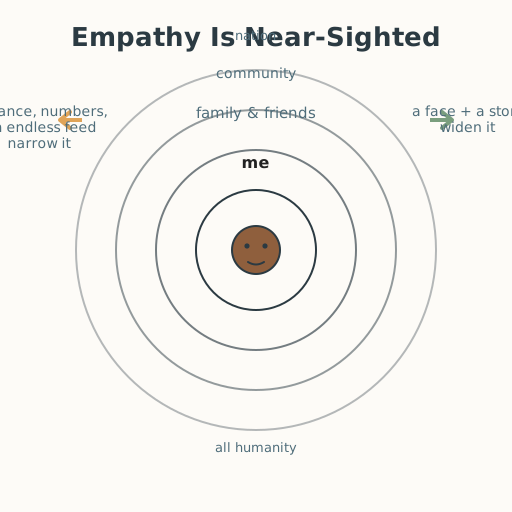
- Empathy-radius diagram · 1 per learner A diagram showing near and far circles of concern, with arrows for what widens (a face, a story, a shared place) and narrows (distance, a crowd, an endless feed)
- Media-framing examples · 1 set per group Two contrasting ways the same faraway event is described — one with a named person and one as a statistic — to compare
Low-tech / no-cost
- A shared board or large paper Draw the empathy-radius diagram together and add examples
- Voice and discussion The whole analysis can run as talk, with no paper or device needed
Enriched / lab & device
- Two short news or social-media items · 2 Real examples of faraway suffering framed as a person versus a number, to analyze side by side
Works in different contexts
- large-group Teach the diagram once together, then small groups compare the framing examples and report one finding
- multi-age Younger learners sort what widens and narrows empathy; older learners also analyze who controls the framing
- self-directed A learner studies the diagram, then analyzes two real news items they find and writes how framing shaped their feeling
- level-grouped Learners ready to extend research the identifiable-victim effect and propose a counter-move for their own media habits
- outdoor-only Discuss while walking; use a real, faraway place you can imagine together as the example
Lesson 5 — Empathy Across Distance, Media, and Technology
Summary
Learners examine how empathy is narrowed or widened by distance, numbers, media, and technology — the identifiable-victim effect, psychic numbing, framing, and compassion fatigue — and choose one practical counter-move for their own media habits.
Objectives
- Examine how empathy can be limited or expanded by distance, media, and technology. (D02.S2.09.02)
Connection
Here is a strange, ordinary fact: one child’s face on a screen can move us to tears, while a headline about a million people affected by a flood scrolls past and barely registers. It is not that we are bad people; it is that empathy is a near-sighted tool. It works best up close, on one named person with a story. Distance, numbers, and an endless feed all dim it. Understanding this — and how media and technology steer it — is the first step to choosing where your care actually goes. Today you take that step.
Materials
- Empathy-radius diagram
- Media-framing examples
Preparation
- Copy the diagram and framing examples.
- Retrieval: from Grade 8, recall how stereotypes can block empathy (D02.S2.08.02); from Grade 7, recall how online and offline communities differ.
Facilitator note
This lesson is written to the learner (“you”). The ideas to land: (1) empathy is naturally “parochial” — it runs strongest toward people near us, who look like us, and toward single identifiable victims, not crowds; this is the “identifiable victim effect” (S-414); (2) as the number of victims grows, feeling can actually numb — “psychic numbing” — one death is a tragedy, a million is a statistic; (3) media and technology can widen empathy (a single story, a face, a shared place can make a faraway person real) or narrow it (endless feeds, dehumanizing frames, and echo chambers that only show us “us”); (4) sustained exposure to others’ suffering can produce “compassion fatigue” — not because we are cold, but because we are tired; (5) because we know this, we can choose counter-moves. This is a concept, so use inquiry and discussion more than drill (philosophy §13). The critical-thinking lens: the same event can be framed as a person or a number, and the frame changes how we feel — so ask who chose the frame. The egalitarian lens: whose suffering is shown as a face and whose is shown as a statistic is often about power and proximity, not about whose suffering matters more. The global lens: media from different places frame faraway crises differently, and a global citizen learns to notice the frame. The technology lens is the heart here: feeds and platforms shape what we see, and therefore what we feel (S-226). Hold this honestly but not hopelessly — end with agency, the counter-move the learner can choose.
Procedure
- Recall (5 min). From Grade 8: how can a stereotype block empathy? Today we widen the lens — how does distance and media shape what we feel?
- Meet the near-sightedness (12 min). Empathy runs strongest up close. Study the diagram: near circles (me, my people) feel strongest; far circles (strangers, millions) feel faint. Two effects explain it: the identifiable victim effect — one named person with a face and story moves us far more than a crowd — and psychic numbing — as the number grows, feeling flattens (S-414).
- Meet the media lens (12 min). Media and technology can widen empathy — one story, one face can make a faraway person real — or narrow it — a dehumanizing frame, a statistic, or an echo chamber that shows only “us” (S-226). Compare the two framing examples: the same event told as one named person versus as a number. How does each make you feel, and why?
- Name the tiredness (5 min). Constant exposure to others’ suffering can bring compassion fatigue — not coldness, but exhaustion. It is a signal to rest and to choose, not a reason to give up.
- Choose a counter-move (12 min). Pick one: seek one name and story when a big number goes numb; vary your feed to include voices unlike your own; take a break when compassion fatigue hits; or check who framed a story and why. Write your counter-move and when you will use it.
- Close (4 min). Empathy is near-sighted — but knowing that lets us aim it on purpose.
Differentiation
- Support: Sort a list of items into “widens empathy” and “narrows empathy” using the diagram.
- Extension: Research the identifiable-victim effect or psychic numbing, and design one change to a real feed or news habit that would counter it.
Assessment
- Formative (observation): Can the learner explain how distance, numbers, and media shape empathy, and name a counter-move?
- Portfolio artifact: The annotated empathy-radius diagram and the written counter-move, kept in the portfolio.
Home connection
For one day, notice when a big number goes numb or a face moves you. Try your counter-move once, and note what changed.
Resources
- On the identifiable victim effect and psychic numbing: Slovic (2007), “If I Look at the Mass I Will Never Act” (S-414).
- On the limits of empathy and the case for reasoned compassion: Paul Bloom (2016), Against Empathy (S-413).
- On media and technology shaping adolescent social and emotional life: Common Sense Media, Research Program, https://www.commonsensemedia.org/research (S-226).