Lesson 06 — Forms of Community Across Cultures
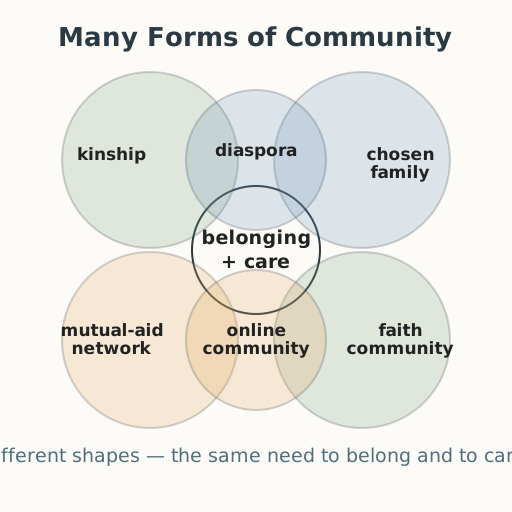
Learners compare **forms of community** across cultures — kinship, chosen family, mutual-aid networks, faith communities, diaspora, and online communities — identifying what people join, share, and give in each, and what all of them have in common: belonging and care.
Objectives
Objectives
- D02.S3.09.01 Compare forms of community across cultures, including chosen families and mutual-aid networks.
Essential question
What forms does community take across cultures — kinship, chosen family, mutual-aid networks, faith, diaspora, and online — and what do they share?
Key vocabulary
Materials
Standard materials
- Forms-of-community chart · 1 per learner A comparison chart with rows for kinship, chosen family, mutual-aid network, faith community, diaspora, and online community — and columns for how people join, what they share, and how they care for each other
- Community example cards · 1 set per group Short, real descriptions of each form, drawn from different regions, to sort and discuss
Low-tech / no-cost
- A shared board or large paper Build the comparison chart together
- Voice and discussion Learners describe communities they know firsthand as examples
Enriched / lab & device
- Short documentary clips or interviews · 2–3 Real stories of chosen families, mutual-aid networks, or diaspora communities to watch and discuss
Works in different contexts
- large-group Build the chart together, then small groups each take one form and report what makes it a community
- multi-age Younger learners name one community they belong to and what people share; older learners complete the full comparison
- self-directed A learner fills the chart using the example cards and their own experience, then writes what all the forms share
- level-grouped Learners ready to extend compare how a chosen family and a kinship family meet the same needs differently
- outdoor-only Discuss while walking or seated outside, using the communities learners can see or remember around them
Lesson 6 — Forms of Community Across Cultures
Summary
Learners compare forms of community across cultures — kinship, chosen family, mutual-aid networks, faith communities, diaspora, and online communities — identifying what people join, share, and give in each, and what all of them have in common: belonging and care.
Objectives
- Compare forms of community across cultures, including chosen families and mutual-aid networks. (D02.S3.09.01)
Connection
Ask yourself how many “we’s” you belong to. Your family is one — but maybe not the only one. There may be the friends who feel like family, the people you worship or celebrate with, the neighbors who help when someone is sick, the online group that shares your language or hobby, the relatives scattered across countries who still call. Community is not one shape; it is many, and different cultures have built strikingly different ones. Today you map the variety — and find what they all share.
Materials
- Forms-of-community chart
- Community example cards
Preparation
- Copy the chart and example cards.
- Retrieval: from Grade 7, recall how online and offline communities differ (D02.S3.07.01); from Grade 8, recall how power and resources are shared in a community and who is left out.
Facilitator note
This lesson is written to the learner (“you”). The ideas to land: community takes many forms — (1) kinship (family by birth or marriage), (2) chosen family (people who become family by choice, not blood), (3) mutual-aid networks (people who meet one another’s needs together, as equals), (4) faith and spiritual communities, (5) diaspora (a people scattered across countries who keep a shared identity and care across distance), and (6) online communities. What all forms share: people belong to something, share something (stories, resources, identity, care), and give to one another. This is a concept, so use inquiry and comparison (philosophy §13). The global/anthropological lens is the heart here: communities differ across cultures and times — the communal-work traditions of harambee in Kenya, gotong royong in Indonesia, mink’a in the Andes, and barn-raising in North America are all named forms of mutual aid (S-164); the term “mutual aid” was popularized by Kropotkin (S-163); and mutual aid as solidarity — not charity — is articulated by Dean Spade (S-345). The egalitarian lens: there is no single “real” family or “real” community — a chosen family is as real as a birth family, and honoring that is honoring people’s lives. The ethics lens: communities carry obligations — to care for members and to ask who is left out. The technology lens: online community is real belonging, not a lesser copy, even though it works differently. Approach other cultures’ communities as living traditions to honor with respectful questions, never as specimens.
Procedure
- Recall (5 min). From Grade 7: how is belonging online different from belonging offline? Today we look at the many shapes belonging takes.
- Meet the forms (12 min). Read the six forms on the chart: kinship, chosen family, mutual-aid network, faith community, diaspora, online community. For each, use the example cards to answer: how do people join? what do they share? how do they care for one another?
- Compare (15 min). Fill the chart. Then compare: how does a chosen family meet the same needs a kinship family does? How is a mutual-aid network different from a charity — and why does that difference matter (S-345)?
- Find the shared center (10 min). Across all six forms, name what they share: people belong to something, share something, and give to one another. Write your own list of the communities you belong to, and mark which form each is.
- Close (8 min). Share one community of yours that does not fit a single box. That overlap is not a problem; it is how belonging really works.
Differentiation
- Support: Provide the chart partially filled; learners add their own example under each form.
- Extension: Compare two forms in depth — a kinship family and a chosen family — and write where each is stronger or weaker at meeting the needs of belonging, support, and care.
Assessment
- Formative (observation): Can the learner describe several forms of community and what they share?
- Portfolio artifact: The completed forms-of-community chart with the learner’s own communities marked, kept in the portfolio.
Home connection
Ask an older person in your family or neighborhood: “What communities have you belonged to in your life?” Add what they name to your chart.
Resources
- On communal-work (mutual-aid) traditions across cultures: harambee, gotong royong, mink’a/minga, barn raising, https://en.wikipedia.org/wiki/Communal_work (S-164).
- On mutual aid as a widespread human practice: Peter Kropotkin (1902), Mutual Aid: A Factor of Evolution (S-163).
- On mutual aid as solidarity, distinct from charity: Dean Spade (2020), Mutual Aid (S-345).