Lesson 02 — Reading Visual Media: Composition & Symbolism
Learners use a composition checklist — rule of thirds, leading line, framing, color, scale, and gaze — plus a search for symbols, to analyze one advertisement, one news photograph, and one social-media post. They practice separating **observation** (what I see) from **judgment** (what I value) and asking who benefits from an image and who is left out.
Objectives
Objectives
- D07.S1.09.02 Analyze how visual media such as advertising, news, and social media uses composition and symbolism to influence viewers.
Essential question
How do advertising, news, and social media use composition and symbolism to influence what I notice, feel, and believe?
Key vocabulary
Materials
Standard materials
- Three images per group — one advertisement, one news photograph, one social-media post · 1 set per group Printed or on screen; choose images with visible composition and at least one symbol
- A composition checklist sheet · 1 per learner Rule of thirds, leading line, framing, color, scale, gaze — a tool for looking
Low-tech / no-cost
- A shared advertisement or poster in the room, or a magazine page Any real printed image works; no screen needed
- A hand-drawn grid Draw two vertical and two horizontal lines on clear plastic or tracing paper to lay over an image
- A spoken or partner description of each image For learners who are blind or have low vision — the checklist becomes a listening-and-asking tool, not a looking tool
Enriched / lab & device
- A classroom screen for a close look at one image together · 1 To annotate an ad together before small-group work
- A reverse-image search or source look-up · 1 To trace where a viral image actually came from (ties to D10 media verification)
Works in different contexts
- large-group Analyze one image as a whole group with the checklist on the board, then groups analyze their own image
- multi-age Younger learners find one thing the maker wants them to notice; older learners explain how composition and a symbol each work to do it
- self-directed A learner completes the three-image analysis alone using the checklist and writes one paragraph per image
- level-grouped Learners ready to extend add the "who benefits?" question and trace the image's origin
- outdoor-only Analyze a real sign, billboard, or market stall display — composition and symbolism are everywhere a message is
Lesson 2 — Reading Visual Media: Composition & Symbolism
Summary
Learners use a composition checklist — rule of thirds, leading line, framing, color, scale, and gaze — and hunt for symbols to analyze one advertisement, one news photograph, and one social-media post. They practice the critical habit of separating observation (what is actually there) from judgment (what it makes me feel or believe) and asking who benefits and who is left out. Persuasion is not automatically bad; this lesson equips learners to tell honest persuasion from manipulation.
Objectives
- Analyze how visual media — advertising, news, and social media — use composition and symbolism to influence viewers. (D07.S1.09.02)
Connection
Before you read a word of a page, you have already read its images. The bright button you are meant to tap, the photo that makes a story feel urgent, the smiling face beside a product — none of these are accidents. Someone placed them, framed them, and colored them so your eye would land exactly where they want. You already feel the pull of composition and symbolism every day; today you learn the names for the moves, so you can decide for yourself whether to go along.
Materials
- Three images per group: one advertisement, one news photograph, one social-media post
- A composition checklist sheet
Preparation
- Select or print the three images; pick ones with clear composition and at least one obvious symbol.
- Retrieval: from Grade 8, recall the critique habit — observation is different from judgment. Today we turn that into a checklist and apply it to media that is trying to influence us.
Facilitator note
This lesson builds media literacy, not cynicism. The goal is that a learner can name the tools of visual persuasion (composition, symbolism) and ask what they are for — not that they distrust every image. Use the worked example: analyze the first image together, out loud, with the checklist, before learners work in groups (S-011). The critical-thinking lens is the core: evidence is what I can point to; judgment is what I value. The ethics lens: persuasion and manipulation both use the same tools — the difference is honesty about what is being asked and who gains. The egalitarian lens: always ask who is shown, who is missing, and why that matters — advertising has a long history of leaving whole groups out or casting them in narrow roles. The technology lens: composition tools are now in everyone’s pocket; the same grid a designer uses is on your phone camera. Keep sources honest: the Center for Media Literacy’s core questions (who created this, what techniques attract attention, what is omitted, who benefits) frame the analysis (S-442).
Procedure
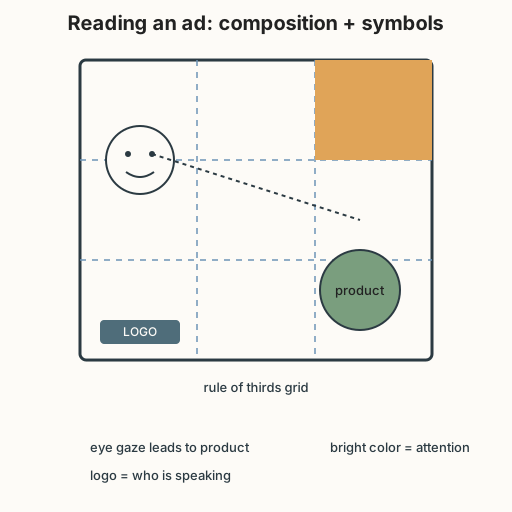
- Meet the checklist (5 min). Look at the annotated diagram. The moves: rule of thirds (the four sweet spots where lines cross), leading line (a real or implied line that pulls the eye), framing (what is inside and outside the edges), color (bright draws the eye), and gaze (where a pictured person looks). A symbol is an object or color that stands for something more — a crown for power, a dove for peace, a green leaf for “natural.”
- Worked example: one ad, together (10 min). As a group, find in one advertisement: the focal point, one leading line, one symbol, and one thing the maker wants you to feel. Say each as an observation (“the product is at a rule-of-thirds crossing”) before any judgment (“this makes me want it”).
- Analyze in groups (20 min). In your group, run the checklist over the news photograph and the social-media post. For each, write: one composition move, one symbol, what it makes you notice, and what it makes you feel.
- Ask who benefits (10 min). For each image: who made it, who is shown, who is missing, and who gains if you are persuaded? Say which answers are evidence and which are your values.
- Close (10 min). Share one finding. How will you look at the next ad or post differently?
Differentiation
- Support: Provide sentence starters (“The eye goes first to ___ because ___.”).
- Extension: Trace one image to its source and add the question “does the source match the message?” — the bridge to Grade 9 media verification.
- Access (blind / low vision): Analyze each image through a spoken description — a partner or the facilitator describes placement, color, and symbol aloud, and the learner names the composition move and the symbol from what they hear. The checklist works entirely by listening and asking.
Assessment
- Formative (observation + artifact): Does the learner name at least one composition move and one symbol for each image, and keep observation separate from judgment?
- Peer-check: Trade findings with a partner; can your partner see the move you described?
Home connection
For one day, notice every image that tries to get your attention — signs, screens, packaging. Pick one and ask at dinner: what is it trying to make you do, and how?
Resources
- Center for Media Literacy — the five core questions for reading media: https://www.medialit.org/ (S-442).
- On explicit instruction and worked examples: Kirschner, Sweller & Clark (2006), https://doi.org/10.1207/s15326985ep4102_1 (S-011).