Lesson 04 — Music as Identity, Community & Resistance
Learners listen to music from more than one culture — reggae from Jamaica and nueva canción from Chile, with an optional local tradition — and analyze how each builds **identity** (who we are), **community** (belonging and participation), or **resistance** (protest, solidarity, survival). They separate what they *hear* from what they *value*, and honor these as living traditions, not museum pieces.
Objectives
Objectives
- D07.S2.09.02 Analyze how music can build identity, community, or resistance, using examples from more than one culture.
Essential question
How can music build identity, community, or resistance — and how do different cultures do it differently?
Key vocabulary
Materials
Standard materials
- Two or three short listening excerpts with brief context notes · 1 set per group Reggae from Jamaica and nueva canción from Chile are strong, well-documented examples; add a local or learner-chosen tradition as a third
- A listening organizer (identity / community / resistance columns) · 1 per learner A place to record what each song does and the evidence heard
Low-tech / no-cost
- Sung or clapped examples from learners' own traditions No recordings needed — learners bring a song or rhythm that matters to their family or community
- A chalkboard or large paper organizer Draw the three columns together and fill them as a group
Enriched / lab & device
- Access to a streaming or video source with lyrics and subtitles · 1 To hear the songs and read their words, with translation where needed
- A guest musician or community elder · 1 To share a living tradition of music-as-resistance or music-as-identity first-hand
Works in different contexts
- large-group Listen once together and fill the organizer on the board, then groups discuss one song each
- multi-age Younger learners identify what a song is *for* (gathering, mourning, marching); older learners cite the musical evidence for how it works
- self-directed A learner listens to the two examples and completes the organizer, then writes one paragraph comparing them
- level-grouped Learners ready to extend add a third tradition of their choosing and analyze its function with evidence
- outdoor-only Use call-and-response and work songs as living examples — sing or clap a rhythm together and feel how it unifies a group
Lesson 4 — Music as Identity, Community & Resistance
Summary
Learners listen to music from more than one culture — reggae from Jamaica and nueva canción from Chile, with an optional third tradition from the learners’ own world — and analyze how each builds identity (a shared sense of who we are), community (belonging, gathering, participation), or resistance (protest, solidarity, survival under pressure). They practice separating what they hear from what they value, and they treat every tradition as living heritage to honor with respectful questions — never as a specimen.
Objectives
- Analyze how music can build identity, community, or resistance, using examples from more than one culture. (D07.S2.09.02)
Connection
Think of the song your family sings at a wedding, a funeral, a festival, or a march. It is not just decoration: it gathers people into one rhythm, reminds them who they are, and, when times are hard, keeps their courage alive. A song can hold a memory that no textbook does — a name, a wrong, a hope. Across the world, people who had little else have still had a song, and the song carried what the people needed to survive and to resist. Today you listen to how that works.
Materials
- Two or three short listening excerpts with brief context notes
- A listening organizer with three columns: identity / community / resistance
Preparation
- Choose and queue the excerpts; have a line or two of context for each (who made it, when, and why).
- Retrieval: from Grade 8, recall the critique habit — observation is different from judgment. Today we apply it to music that does something in the world.
Facilitator note
This lesson is about respectful listening, not ranking. The worked example models the analysis on one song before learners analyze the others (S-011). Two well-documented examples carry the global lens: reggae “originated within a cultural space that was home to marginalized groups” in western Kingston and is recognized as “a voice for all” on questions of “injustice, resistance, love and humanity” (UNESCO, S-450; also Britannica, S-445); nueva canción is the Latin American movement that fused folk forms with protest and social change during the 1960s–80s, when musicians faced censorship and violence for singing (Britannica, S-449). Both are living traditions — people still make them today — so speak of them as present, not past. The ethics lens: resistance music often emerges from real harm (apartheid, dictatorship, slavery, colonial rule); name the harm honestly but keep hope and agency attached. The egalitarian lens: ask whose song gets recorded, celebrated, and remembered, and whose is forgotten. The community lens: call-and-response and group singing are participatory — the community is not the audience; it is the instrument. If a learner brings a tradition of their own, honor it first and let them teach it.
Procedure
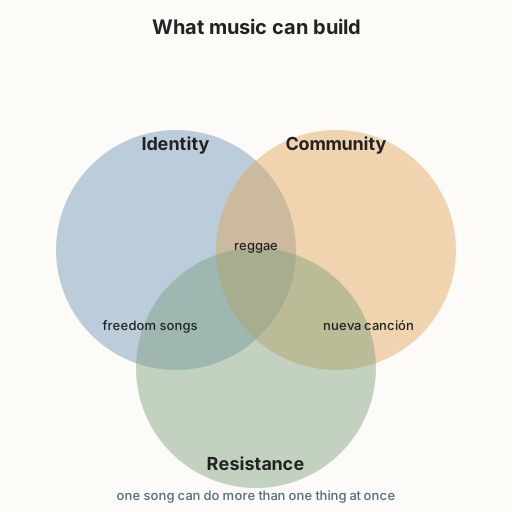
- Meet the organizer (5 min). Look at the three circles. One song can build identity (we know who we are), community (we gather and belong), and resistance (we refuse and endure) — often at the same time.
- Worked example: reggae (15 min). Listen to a reggae excerpt with its context. Together, fill the organizer: what you hear (offbeat guitar, bass line, Rastafari references) and what it does (gives voice to the marginalized, praises, comments on injustice). Say each as an observation before any judgment.
- Analyze: nueva canción (15 min). Listen to a nueva canción excerpt. In pairs, fill the organizer: how does it build identity (folk roots, local instruments, Spanish words of home), and how is it resistance (singing what is forbidden, keeping memory alive under dictatorship)?
- Compare (10 min). What do the two traditions share? What is different because their places, histories, and instruments differ?
- Close (10 min). If you brought a tradition, share it. Otherwise, name one song you already know that builds identity, community, or resistance — and how.
Differentiation
- Support: Provide sentence starters (“This song gathers people because ___.”).
- Extension: Add a third tradition and analyze its function with the same evidence discipline, then name what makes it distinct.
- Access (Deaf / hard of hearing): Meet each song through its words and written rhythm — read the lyrics (with translation), follow a rhythm chart or notation, or feel the pulse on a speaker’s vibration — and cite lyric and rhythm as evidence exactly as a listener would cite what they hear.
Assessment
- Formative (observation + artifact): Does the learner cite heard evidence (rhythm, instrument, call-and-response, lyric) for each function, across at least two cultures, and keep observation separate from judgment?
- Peer-check: Can your partner hear the evidence you pointed to?
Home connection
Ask someone at home for one song that mattered in a hard time or a celebration. What did it help them feel or do?
Resources
- UNESCO — “Reggae music of Jamaica” (inscribed 2018), on reggae as the voice of the marginalized and a vehicle for social commentary: https://ich.unesco.org/en/RL/reggae-music-of-jamaica-01398 (S-450).
- Encyclopaedia Britannica — “Reggae” and “Nueva canción” (protest songs and social change): https://www.britannica.com/art/reggae (S-445); https://www.britannica.com/art/nueva-cancion (S-449).
- On explicit instruction and worked examples: Kirschner, Sweller & Clark (2006), https://doi.org/10.1207/s15326985ep4102_1 (S-011).