Lesson 05 — Performing Identity: The Moving Body Asks a Question
Learners choose a personal question ("Where do I come from?", "What do I carry?", "What am I becoming?"), then devise a short movement phrase — a sequence of gestures and positions with a beginning, middle, and end — that explores it. They perform for a partner or small group with consent, revise once, and reflect in writing on what the body revealed that words alone could not.
Objectives
Objectives
- D07.S3.09.01 Create a performance that uses the moving body to explore identity or a personal question, and reflect on the process.
Essential question
How can I use my moving body to explore a question about who I am?
Key vocabulary
Materials
Standard materials
- Open floor space and comfortable clothing · 1 per learner Enough room to move without touching unless invited
- A movement journal or paper · 1 per learner For drafting a movement phrase and writing the reflection
Low-tech / no-cost
- Voice and body only No props, music, or space beyond the body itself — movement is the whole medium
- A shared open area outdoors Use the ground, a wall, a tree, or a shadow as a partner in the phrase
Enriched / lab & device
- A recording device to film the performance · 1 per learner or pair To watch back and revise, as Grade 8 did with recordings
- Music or a soundscape of the learner's choosing · 1 To underscore the phrase, if the learner wants it
Works in different contexts
- large-group Learners devise and rehearse in pairs, then share in small circles rather than one large stage
- multi-age Younger learners build a three-move phrase; older learners build five moves and name what each move explores
- self-directed A learner devises, performs for themselves (or films), and writes the reflection alone
- level-grouped Learners ready to extend add a second question and a contrasting tempo or level to answer it
- outdoor-only Use the place itself — reach toward a branch, gather toward the ground, rise with the slope — so the environment enters the phrase
Lesson 5 — Performing Identity: The Moving Body Asks a Question
Summary
Learners choose a personal question — “Where do I come from?”, “What do I carry?”, “What am I becoming?” — then devise a short movement phrase: a sequence of gestures and positions with a clear beginning, middle, and end. They perform for a partner or small group with consent, revise once, and reflect in writing on what the body revealed that words alone could not. The lesson builds on Grade 8’s devised pieces and treats the body with dignity: every body moves differently, and every body is enough.
Objectives
- Create a performance that uses the moving body to explore identity or a personal question, and reflect on the process. (D07.S3.09.01)
Connection
Long before you had words for who you are, your body already knew. The way you stand when you are proud, the way your shoulders fold when you are tired, the way you move through your own home without thinking — these are a language you have been speaking all your life. Some questions about the self do not fit into sentences, so people everywhere have turned to the moving body to ask them: a dancer reaching, a runner at the starting line, a person bowing in greeting. Today you let your body ask a question and see what answer comes.
Materials
- Open floor space and comfortable clothing
- A movement journal or paper
Preparation
- Clear a safe space; agree on norms of consent (no one touches anyone without asking, anyone may pass or watch instead of perform).
- Retrieval: from Grade 8, recall that a devised piece is shaped through rehearsal — it changes as you work. Today we devise a short phrase and revise it once.
Facilitator note
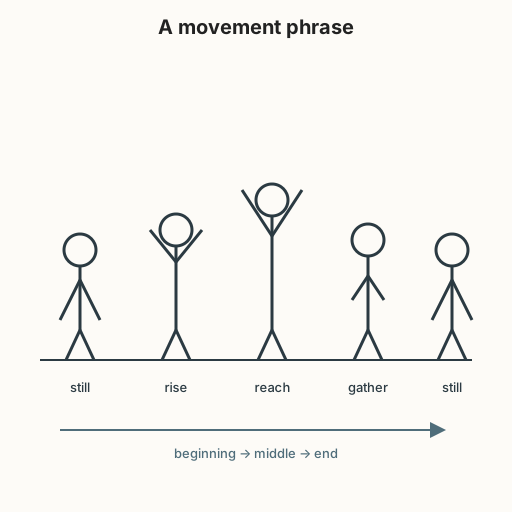
This is a vulnerable lesson; safety comes first. Set clear norms: participation is by invitation, anyone may watch instead of perform, and bodies are never commented on — only the movement choices. The social-emotional and physical lenses carry the lesson: identity is felt in the body, and moving is thinking. The ethics lens: consent is the foundation — no one touches, films, or shares another’s body without permission, and a learner’s “pass” is always honored. The global lens: many traditions use gesture as meaning — a mudra, a bow, a greeting gesture — and learners may draw on any they know respectfully, as a question rather than a costume; if a gesture belongs to a tradition not their own, they should ask before borrowing its meaning. Keep the worked example brief: model a three-move phrase (still → rise → reach) so novices see what a phrase is, then let them make it their own (S-011). Feedback is descriptive (“I saw you rise slowly, then reach”), never a verdict on the person. Honor the wide range of bodies and abilities; stillness, a seated gesture, or a hand moving are as complete as a leap.
Procedure
- Choose a question (5 min). Pick one personal question to explore with your body — “Where do I come from?”, “What do I carry?”, or “What am I becoming?”.
- Warm the instrument (5 min). Stand and find stillness. Notice your posture, your breath, your weight. This is your body — your instrument — and it is enough exactly as it is.
- Devise a phrase (20 min). Look at the movement-phrase diagram: a phrase has a beginning (still), a middle (rise, reach, or gather), and an end (still again). Build five moves that explore your question — slow or fast, high or low, large or small. Repeat the phrase until it feels like yours, then revise once: change one move and notice what it does.
- Perform with consent (15 min). Show your phrase to a partner or a small circle. Ask first, and invite descriptive feedback: what did they see, and what did it make them feel?
- Reflect (10 min). Write three sentences: what your phrase explored, one thing your body “said” that words could not, and what you discovered in the process.
Differentiation
- Support: Provide a three-move scaffold (still → reach → still) to build from.
- Extension: Add a second question and answer it with a contrasting tempo or level, then name the contrast.
- Access (motor): A phrase can be one seated gesture, a hand, a breath, or stillness itself — the beginning–middle–end shape is what matters, not the size or speed of the movement.
Assessment
- Formative (performance + reflection): Does the phrase have a clear beginning, middle, and end, explore the chosen question, and show one revision? Does the reflection name what the body revealed that words did not?
- Self-check: Can you say what each of your five moves means to you?
Home connection
Notice how someone at home moves when they are happy, tired, or welcoming. What does their body say without words?
Resources
- On explicit instruction and worked examples for new skills: Kirschner, Sweller & Clark (2006), https://doi.org/10.1207/s15326985ep4102_1 (S-011).