Lesson 06 — Dance, Drama & Ritual: Building Community & Carrying Memory
Learners analyze how dance, drama, and ritual build **community** and carry **memory** across cultures, using the Māori haka, Mexico's Indigenous Day of the Dead festivity, and the West African griot tradition. They separate what they *observe* from what they *value*, and they treat each as a living tradition — a way people still gather and remember today — never as a museum specimen.
Objectives
Objectives
- D07.S3.09.02 Analyze how dance, drama, and ritual build community or carry memory across cultures.
Essential question
How do dance, drama, and ritual build community or carry memory across cultures?
Key vocabulary
Materials
Standard materials
- Two or three short case-study notes with images (haka, Day of the Dead, griot tradition) · 1 set per group Well-documented examples of movement/ritual as community and memory (S-447, S-448, S-446)
- An analysis organizer (community / memory columns) · 1 per learner To record what each tradition does and the evidence observed
Low-tech / no-cost
- A shared telling or reading of the case studies No images needed — describe each tradition and let learners picture it
- A chalkboard or large paper organizer Draw the two columns together and fill them as a group
Enriched / lab & device
- Short video excerpts of each tradition (with respectful sourcing) · 1 set To see and hear the movement; choose recordings made by or with the community
- A guest practitioner or community elder · 1 To share a living ritual or dance tradition first-hand
Works in different contexts
- large-group Introduce the three case studies together, then small groups each analyze one and report back
- multi-age Younger learners identify who gathers and what is remembered; older learners explain how the form (movement, call-and-response, repetition) does the work
- self-directed A learner reads the case studies and completes the organizer, then writes one paragraph comparing two traditions
- level-grouped Learners ready to extend add a tradition from their own community and analyze its function with the same evidence discipline
- outdoor-only Use the seasons and the land as the case study — how a harvest, a planting, or a remembrance is marked in movement and song where you are
Lesson 6 — Dance, Drama & Ritual: Building Community & Carrying Memory
Summary
Learners analyze how dance, drama, and ritual build community and carry memory across cultures, using three well-documented examples: the Māori haka, Mexico’s Indigenous Day of the Dead festivity, and the West African griot tradition. They separate what they observe from what they value, and they meet each tradition as a living practice — a way people still gather and remember today — approached with respectful questions, never as a specimen to dissect.
Objectives
- Analyze how dance, drama, and ritual build community or carry memory across cultures. (D07.S3.09.02)
Connection
Think of how your own family marks the big things — a birth, a death, a harvest, a new year. There is usually a way of doing it: the same food, the same song, the same motions, done again each time. That repetition is not empty; it is how memory is kept when no one writes it down, and how a group reminds itself that it is one group. All over the world, people have used the moving body and the spoken word to hold their history and their belonging. Today you look at how three peoples do it.
Materials
- Two or three short case-study notes with images (haka, Day of the Dead, griot tradition)
- An analysis organizer with two columns: community / memory
Preparation
- Prepare the case-study notes; if showing video, choose recordings made by or with the community.
- Retrieval: from Grade 8, recall the critique habit — observation is different from judgment. Today we apply it to traditions that are still alive.
Facilitator note
This lesson is about respect, not spectacle. The worked example models the analysis on one tradition before learners analyze the others (S-011). The global and community lenses carry it. The Māori haka is a living tradition of posture and chant that expresses identity, strength, welcome, and remembrance — explained authoritatively by Te Ara, the Encyclopedia of New Zealand (S-447). Mexico’s Day of the Dead (“Indigenous festivity dedicated to the dead,” inscribed by UNESCO in 2008) commemorates the temporary return of deceased loved ones, linking the living to ancestors and the maize harvest — a fusion of Indigenous and Catholic traditions (S-448). The West African griot (also jeli/jali) is a troubadour-historian who carries genealogies and histories in an oral tradition across generations (S-446). Speak of all three in the present tense — these are living peoples. The ethics lens: rituals can also be sites of belonging and exclusion (who is allowed to perform, who is remembered); name this honestly. The environment lens: many rituals are tied to seasons, harvests, and land — memory and place are one. If a learner brings a tradition of their own, honor it first and let them teach it.
Procedure
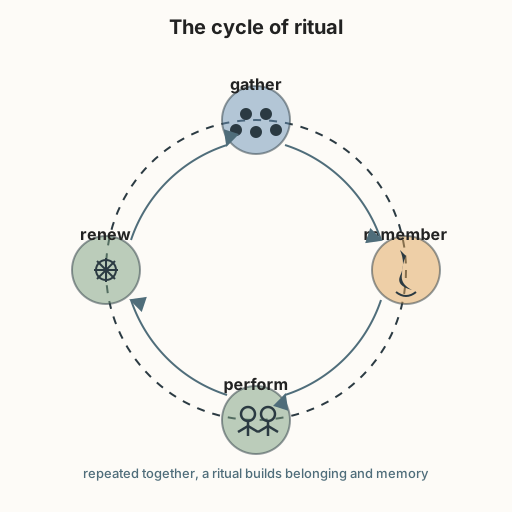
- Meet the organizer (5 min). Look at the ritual cycle: gather → remember → perform → renew. A ritual does at least two things — it builds community (people gather, belong, and participate) and carries memory (it holds what a people must not forget).
- Worked example: the haka (15 min). Read or watch the haka case study. Together, fill the organizer: what you observe (unison posture, chant, stamping, facing the group) and what it does (expresses identity, welcomes, remembers, unifies). Say each as an observation before any judgment.
- Analyze: Day of the Dead and the griot (20 min). In pairs, fill the organizer for each. Day of the Dead: how does it build community (families prepare together, the living and dead meet) and carry memory (altars, offerings, the maize cycle)? The griot: how does the spoken word carry genealogy and history across generations?
- Compare (10 min). What do the three share? What is different because their places, seasons, and histories differ?
- Close (5 min). Name one ritual in your own life — a holiday, a game day, a family habit — and what it builds or remembers.
Differentiation
- Support: Provide sentence starters (“This ritual remembers ___ by ___.”).
- Extension: Add a tradition from your own community and analyze it with the same observation-before-judgment discipline.
- Access: No movement is required — the analysis runs entirely from the case studies and the organizer. When showing video, pair it with a spoken description of the movement, and give a written transcription of any chant so rhythm and words remain evidence for learners who cannot hear them.
Assessment
- Formative (observation + artifact): Does the learner cite observed evidence (movement, chant, object, repetition, call-and-response) for how each tradition builds community or carries memory, and keep observation separate from judgment?
- Peer-check: Can your partner see or hear the evidence you named?
Home connection
Ask someone at home about a ritual or repeated tradition in your family. What does it remember, and who does it gather?
Resources
- Te Ara — The Encyclopedia of New Zealand, on the haka: https://teara.govt.nz/en/haka (S-447).
- UNESCO — “Indigenous festivity dedicated to the dead” (Mexico, inscribed 2008): https://ich.unesco.org/en/RL/indigenous-festivity-dedicated-to-the-dead-00054 (S-448).
- Encyclopaedia Britannica — “Griot” (West African troubadour-historian): https://www.britannica.com/art/griot (S-446).
- On explicit instruction and worked examples: Kirschner, Sweller & Clark (2006), https://doi.org/10.1207/s15326985ep4102_1 (S-011).