Lesson 01 — Accurate Information & a Dignity-First Space
Learners establish a **dignity-first, no-shame space** for the unit and learn the core skill underneath all of it: telling **accurate information** from **misinformation** about the body and health. They build shared ground rules and a three-question source-check they will use all unit.
Objectives
Objectives
- D03.S4.09.01 Explain the basics of sexual and reproductive health, including anatomy, consent, and how to access accurate information and care.
Essential question
How do I find and trust accurate information about my body and health, and how do we hold these questions with dignity and without shame?
Key vocabulary
Materials
Standard materials
- Class ground-rules chart · 1 for the group A shared poster of the agreed norms for health/sexuality discussion, built together
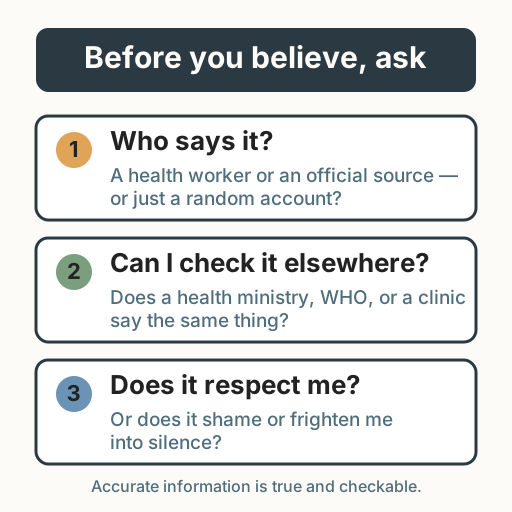
- Accurate-information checklist · 1 per learner A short list of questions to ask of any health claim (who says it, can I check it, does it respect me)
Low-tech / no-cost
- A shared board or large paper Build the ground rules and the source-check questions together aloud; no printed sheets needed
- Voice and a partner Practice the three source-check questions in pairs, speaking rather than writing
Enriched / lab & device
- One device with internet access, per pair · 1 per pair Optional; to practice checking a real health claim against an official source
- Printed copies of a WHO or UNESCO health page · 1 set So learners can see what an authoritative, rights-based health source looks like
Works in different contexts
- large-group Build ground rules with the whole group (raised hands or a shared list), then pairs practice the source-check on one claim and report back
- multi-age Younger learners name one trusted adult and one place to ask; older learners apply the full three-question check to a claim
- self-directed A learner writes their own three questions, tests them on one claim they have heard, and notes the answer
- level-grouped Learners ready to extend add a fourth question — "who benefits from my believing this?" — to the checklist
- outdoor-only Hold the circle outdoors; ground rules and source-check questions can be spoken aloud and remembered, with no paper needed
Lesson 1 — Accurate Information & a Dignity-First Space
Summary
Learners establish a dignity-first, no-shame space for the unit and learn the core skill underneath all of it: telling accurate information from misinformation about the body and health. They build shared ground rules and a three-question source-check they will use all unit.
Objectives
- Explain the basics of sexual and reproductive health — anatomy, consent, and how to access accurate information and care. (D03.S4.09.01)
Connection
Think of the last health question you were too shy — or too unsure — to ask out loud. Maybe it came up in a chat, a video, or a joke you did not quite get. Everyone has questions about their body; the problem is not the question. The problem is that so many of the answers floating around are wrong, and wrong answers about your body can cost you your health and your peace. This unit begins with the skill that unlocks everything else: telling accurate information from misinformation, in a room where no question is shameful and every body is treated with dignity.
Materials
- Class ground-rules chart
- Accurate-information checklist
Preparation
- Copy or draw the source-check questions.
- Retrieval: from Grade 8, recall the difference between a claim and the evidence behind it, and the substance-awareness lesson’s idea that accurate information supports safer choices.
Facilitator note
This lesson is written to the learner (“you”). The concept to land: sexual and reproductive health is a matter of accurate information, consent, and access to care — taught with dignity and never shame — and the first skill is telling accurate information from misinformation. This is a norms-and-skills lesson, so use explicit instruction for the skill (the three-question source-check, modeled as a worked example) and inquiry for the values (S-011). The ethics lens: how we speak about bodies sets the temperature of the room — we speak with dignity, we do not mock, we do not shame. The egalitarian lens is central and non-negotiable: no body and no question is “better” or “worse”; every learner’s body, family, culture, and pace is honored, and no one is ever pressured to share. The global lens: what counts as a trusted source of health information differs around the world — a community health worker in one place, a clinic in another, an official health ministry or WHO page in another — so “accurate” means “from a source that is accountable and checkable,” not “from the nearest screen.” The technology lens: the internet carries both the best and the worst health information ever made, so the skill is to check, not to trust blindly (UNESCO CSE, S-412; WHO, S-261). Model the three questions on one concrete claim (worked example below), then let learners practice. Establish the safety net now: sharing is always optional; a learner may always pass; and if a learner discloses something that suggests harm, you follow your setting’s safeguarding path — believe, do not promise secrecy, and get help (WHO violence-prevention guidance, S-051). Keep claims accurate and cite sources; distinguish evidence from values throughout.
Procedure
- Open and ground rules (10 min). This unit is about your body, your health, and your safety, and it is taught with dignity, never shame. Together, build the room’s norms: we use accurate words; we do not mock anyone’s body or question; sharing is a choice, never a demand; and a question is never “stupid.” Write or say them; they are the floor we stand on all unit.
- Why accurate information matters (8 min). Wrong answers about the body are everywhere — in rumors, jokes, and endless social posts. A wrong answer can lead a person to take a real risk or to miss real care. Accurate information is information that is true and checkable; misinformation is false or misleading information spread whether or not the sharer means harm.
- Meet the three questions (10 min). Worked example: claim — “You cannot get an infection if you are young and healthy.” Ask: (1) Who says it? A random account or a health worker? (2) Can I check it somewhere else? Does an official source — a health ministry, WHO, a clinic — say the same? (3) Does it respect me? Or does it shame or frighten me into silence? For this claim: no one responsible says it, it fails every check, and it is false — infections do not care how young you are. That is the skill.
- Practice (12 min). In pairs, take one health claim you have actually heard (or one from the facilitator’s list) and run it through the three questions. Write or say your verdict: accurate, misleading, or “I need to check.”
- Close (10 min). Write down the three questions and one trusted adult you could ask a health question to without shame. You have just built the tool this whole unit runs on.
Differentiation
- Support: Use the two-question shortcut: “Who says it, and can a trusted adult check it?”
- Extension: Add a fourth question — “Who benefits if I believe this?” — and apply it to one claim that was designed to sell or scare.
Assessment
- Formative (observation/self): Can the learner apply the three questions to a claim and say whether it is accurate, misleading, or needs checking?
- Portfolio artifact: The learner’s written source-check questions and their named trusted adult, kept in the portfolio.
Home connection
Bring the three questions home: the next time a health claim crosses your screen or your conversation, run it through the check and tell one person what you found.
Resources
- On comprehensive sexuality education and the right to accurate information: UNESCO, International Technical Guidance on Sexuality Education (2018) (S-412).
- On adolescent health and development: WHO, “Adolescent health” (S-261).
- On explicit instruction and worked examples: Kirschner, Sweller & Clark (2006) (S-011).