Lesson 02 — Bodies, Parts & Accurate Names
Learners learn the **accurate names and basic jobs of the reproductive parts** — in bodies with a uterus and ovaries and in bodies with testes — and why **knowing the real names** is a health skill and a matter of dignity, not something to whisper or replace with slang.
Objectives
Objectives
- D03.S4.09.01 Explain the basics of sexual and reproductive health, including anatomy, consent, and how to access accurate information and care.
Essential question
What are the accurate names for the parts of the reproductive system, and why does knowing them matter for health and dignity?
Key vocabulary
Materials
Standard materials
- Anatomy diagram sheet · 1 per learner A clean, labeled diagram of the internal and external reproductive organs, to annotate
- Word-bank cards · 1 set per group Cards naming each part with a one-line "what it does," to match to the diagram
Low-tech / no-cost
- A shared board or large paper Draw and label the diagrams together as a class; no printed sheet needed
- Voice and a partner Say the names aloud together and match each part to its job in discussion; a learner who cannot see the diagram can meet every part purely by ear
- Found-object tactile model Outline the organs with string, rope, or a stick drawn in sand, and mark the ovaries and testes with stones or leaves, so a learner who is blind or low-vision can trace each part by touch while it is named aloud
Enriched / lab & device
- An interactive or annotated 3-D anatomy resource · 1 for the group Optional; a labeled digital anatomy tool to rotate and explore
- Colored pencils · 1 set To color-code each structure and its function on the diagram
Works in different contexts
- large-group Model labeling the diagrams once to the whole group, then small groups match part cards to jobs and report one finding each
- multi-age Younger learners name a few major parts and their jobs; older learners explain how the parts work together in a cycle or pathway
- self-directed A learner labels the diagram, matches each part to its job, and writes one sentence on why accurate names matter
- level-grouped Learners ready to extend trace the path of an egg or of sperm from start to finish and explain the journey in their own words
- outdoor-only Draw the diagrams with a stick in sand or dirt, or in chalk on the ground, and label them aloud together
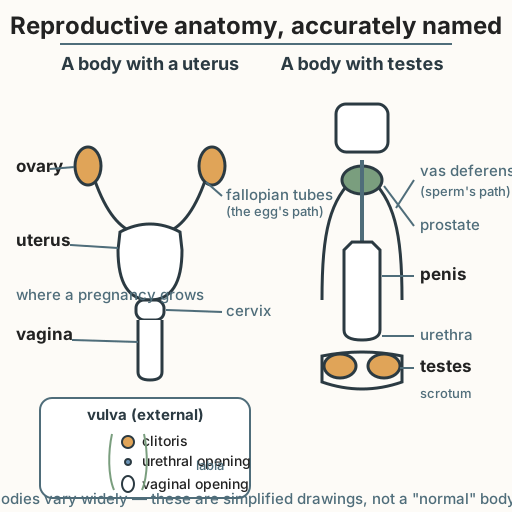
Lesson 2 — Bodies, Parts & Accurate Names
Summary
Learners learn the accurate names and basic jobs of the reproductive parts — in bodies with a uterus and ovaries and in bodies with testes — and why knowing the real names is a health skill and a matter of dignity, not something to whisper or replace with slang.
Objectives
- Explain the basics of sexual and reproductive health, including anatomy. (D03.S4.09.01)
Connection
Every part of your body already has a name — your elbow, your kneecap, your lungs. We say those names plainly, without embarrassment, because we need them to explain where something hurts or how something works. The parts of the reproductive system are just as real and just as nameable, yet many people grow up knowing only whispered slang or no words at all. Knowing the accurate names is not about being “grown-up”; it is about being able to say clearly what you mean, understand your own body, and get the right care. Today you learn the real names and what each part does — with the same calm dignity you would use for any other part of you.
Materials
- Anatomy diagram sheet
- Word-bank cards
Preparation
- Copy the diagram sheet and word-bank cards.
- Retrieval: from Grade 6, recall the basic changes of puberty and that bodies change at different times; from Grade 3, recall the correct names for private body parts.
Facilitator note
This lesson is written to the learner (“you”). The concept to land: every part of the body, including the reproductive system, has an accurate name, and knowing and using those names — without shame or giggling — is a health skill and an act of dignity. This is foundational knowledge, so use explicit instruction and worked examples: model labeling one diagram completely before learners work independently (S-011). Use the accurate terms and say them calmly and matter-of-factly; your own comfort sets the room’s comfort. Key accurate terms to teach — with a uterus and ovaries: vulva (the external parts: clitoris, inner and outer labia, the urethral and vaginal openings), vagina, cervix, uterus, fallopian tubes, ovaries; with testes: penis, scrotum, testes, epididymis, vas deferens, urethra, prostate. Bodies vary, so describe parts by their presence (“people with a uterus”) rather than assuming parts equal gender; a person’s parts do not define who they are. The egalitarian lens: there is no “normal” body — bodies vary in size, shape, and how they are made, including intersex variations and differences of ability — and every one is a full, legitimate body. The ethics lens: accurate names protect people — a person who can name a part can report pain or harm precisely and get care. The global lens: every language has words for these parts, and in many cultures they are named plainly by parents, elders, and healers; the whisper-and-slang habit is one cultural style, not a universal rule. The critical-thinking lens: slang and euphemism are not the problem; the problem is not knowing the real name when it matters. The technology lens: medical imaging — from the labeled diagrams you hold today to ultrasound and other scans — is how we see inside a living body without opening it, and it has made reproductive health safer and more knowable; the same technology can also be turned to judge or police bodies, so we use it to inform, never to shame. Keep it factual and calm, cite the anatomy/reproductive-health authority (WHO adolescent health, S-261; UNESCO CSE, S-412), and remember: a learner may always pass; never require anyone to point at or name anything aloud if they are not ready.
Procedure
- Recall (5 min). From Grade 6: what changes happen to bodies at puberty, and do they happen at the same time for everyone? Today we name the parts those changes involve.
- Meet the diagram (15 min). Worked example, guided together: label the diagram of the body with a uterus and ovaries. Vulva — the external parts (clitoris, inner and outer labia, and the two openings). Vagina — the passage from the vulva to the uterus. Cervix — the neck of the uterus. Uterus — the muscular place where a pregnancy can grow. Fallopian tubes — the two paths an egg travels. Ovaries — where eggs are stored and released. Say each name aloud, once, plainly.
- Meet the second diagram (8 min). Label the body with testes. Penis and scrotum — the external parts. Testes — where sperm are made. Epididymis and vas deferens — the path sperm travel. Prostate and urethra — the glands and the tube urine and semen leave through. Say each name aloud, once, plainly.
- Match and practice (12 min). Match each name to its one-line job. Then, with a partner, say one sentence using an accurate name correctly — e.g., “The ovaries release an egg each cycle.”
- Close (10 min). Write one reason accurate names matter (for your health, for asking for help, for understanding your own body). There is nothing here to be ashamed of — these are just parts of a body, and your body deserves to be named with dignity.
Differentiation
- Support: Focus on the five parts most relevant to understanding health and care, and match each name to its job with a picture cue.
- Extension: Trace the full path of an egg (ovary → fallopian tube → uterus) or of sperm (testes → vas deferens → urethra) and write the journey in one clear sentence.
Assessment
- Formative (observation/peer): Can the learner use the accurate names and match most parts to their jobs without confusion or embarrassment?
- Portfolio artifact: The labeled anatomy diagram, kept in the portfolio (or, for a learner who does not see the diagram or prefers not to keep it: a dictated or recorded verbal labeling of the parts, or a tactile model built from found objects and described aloud — so the knowledge is captured without requiring sight or writing).
Home connection
Notice how calmly your family, community, or health materials name the parts of the body. If a younger child in your life asks, practice answering with the accurate word, said plainly — the same way you would name a knee or a lung.
Resources
- On adolescent development and reproductive health: WHO, “Adolescent health” (S-261).
- On accurate anatomy within comprehensive sexuality education: UNESCO, International Technical Guidance on Sexuality Education (2018) (S-412).
- On explicit instruction and worked examples: Kirschner, Sweller & Clark (2006) (S-011).