Lesson 08 — Seeking Help: A Plan That Works
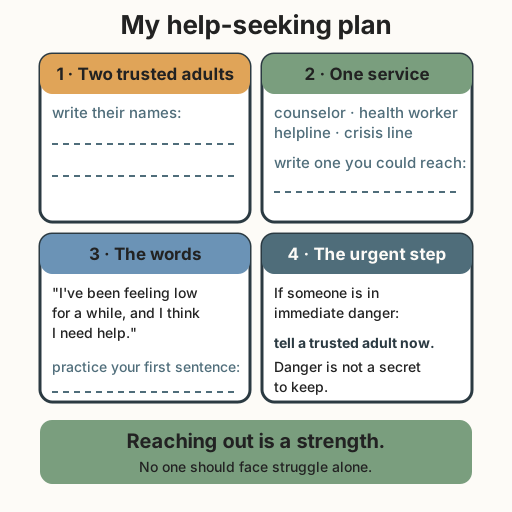
Learners build a **personal help-seeking plan**: two trusted adults, one service they could reach, practiced words for asking, and the urgent step — **if someone is in immediate danger, tell a trusted adult now or contact emergency services.** The lesson's spine: **reaching out is a strength, and no one should face struggle alone.**
Objectives
Objectives
- D03.S4.09.02 Recognize signs of mental health struggles in themselves or others and describe how and where to seek help.
Essential question
How and where do I seek help for mental health — for myself or for someone I care about — and why is reaching out a strength, not a weakness?
Key vocabulary
Materials
Standard materials
- Help-seeking plan template · 1 per learner A scaffold with spaces for trusted adults, services, what to say, and when to act urgently
- What-to-say sentence starters · 1 per learner Frames for asking for help and for supporting a friend
Low-tech / no-cost
- A shared board or large paper Build the plan template and the sentence starters together; speak the plan aloud
- Voice and a partner Role-play the first sentence of asking for help and of supporting a friend
Enriched / lab & device
- Accurate local or national helpline and service list · 1 set To fill the plan with real services available where the learner lives
- A device to find an official helpline or service · 1 per pair Optional; to verify one real service and its contact information
Works in different contexts
- large-group Build the plan template to the whole group, then pairs role-play the first sentence of asking for help and report what helped
- multi-age Younger learners name two trusted adults; older learners complete the full plan with services and urgent-step awareness
- self-directed A learner completes their own plan, writes what they would say, and notes one real service they could reach
- level-grouped Learners ready to extend draft a short script for supporting a friend who is struggling, including when to involve an adult
- outdoor-only Build the plan aloud in a circle and commit each piece to memory — no paper needed
Lesson 8 — Seeking Help: A Plan That Works
Summary
Learners build a personal help-seeking plan: two trusted adults, one service they could reach, practiced words for asking, and the urgent step — if someone is in immediate danger, tell a trusted adult now or contact emergency services. The lesson’s spine: reaching out is a strength, and no one should face struggle alone.
Objectives
- Describe how and where to seek help for mental health. (D03.S4.09.02)
Connection
Recognizing a struggle — your own or a friend’s — is only the first half. The second half, the one that actually changes things, is telling the right person and getting the right support. Most people who feel better did not get there alone; they got there because someone was told. And the strange, beautiful fact about asking for help is that it looks like weakness and is actually the opposite: it is the strongest, most self-respecting thing a person can do. Today you build your own plan, so that if you or someone you love ever needs it, the hardest part — the first step — is already done.
Materials
- Help-seeking plan template
- “What to say” sentence starters
Preparation
- Copy the plan template and sentence starters.
- Retrieval: from Lesson 7, recall the signs of struggle and the “lasting-and-interfering” test; from Lesson 6, recall the pathway to care and the rights that protect it.
Facilitator note
This lesson is written to the learner (“you”). The concept to land: seeking help is a concrete, learnable skill with a plan — name two trusted adults, name one service you could reach, practice what you would say, and know the urgent step — and it is a strength, never a weakness. This is a skills lesson, so use explicit instruction (the worked-example plan) and role-play for the asking (S-011). Teach the plan’s parts plainly: (1) two trusted adults you could actually tell; (2) one service — a school counselor, a health worker, a helpline, a crisis line — that you could reach; (3) the words — a practiced first sentence like “I’ve been feeling really low for a while and I think I need help”; (4) the urgent step — if someone is in immediate danger of harming themselves, do not keep it secret: tell a trusted adult now, stay with them, and contact emergency services or a crisis line. Be direct and safe about the urgent step without being graphic: name that it exists, that it is not a secret to keep, and that trained help is the response (WHO adolescent mental health, S-311). Teach supporting a friend: listen, do not judge, encourage professional help, do not promise to keep danger secret, and take care of yourself too — you cannot be the only support. The ethics lens: when a friend tells you they are struggling, your loyalty is to their safety, not to keeping a dangerous secret. The egalitarian lens: help is for everyone; no one has to earn it, and a person’s worth is never the question — access is the question, and unequal access is an injustice to work against. The global lens: support takes many forms worldwide — family, elders, faith communities, peer groups, clinics, helplines — and all of them count. The technology lens: helplines, crisis text and chat lines, and teletherapy mean help can now reach a person far from any clinic or counselor — technology as a bridge to support, never a replacement for a trusted human being. Hold the room with care: sharing a plan’s contents is optional and private; a learner may write names or initials or keep the plan to themselves; and if a learner discloses real risk, follow your safeguarding path immediately and warmly (WHO, S-051; S-311). End on hope and agency: no one should face struggle alone, and reaching out is how that changes.
Procedure
- Recall (5 min). From Lesson 7: what is the “lasting-and-interfering” test, and why does crossing it mean seeking help? Today we build the actual plan.
- Meet the plan (12 min). Worked example, guided on the template: (1) two trusted adults you could tell; (2) one service you could reach — a counselor, a health worker, a helpline; (3) the words you would say; (4) the urgent step. Fill each box, using initials if you prefer.
- Learn the urgent step (8 min). If someone is in immediate danger — thinking of harming themselves — this is not a secret to keep. Tell a trusted adult now, stay with the person, and get to emergency services or a crisis line. Trained help is the response; keeping a dangerous secret is not loyalty.
- Practice the words (15 min). In pairs, role-play (you may pass): say the first sentence of asking for help; then practice being the friend who hears it — listen, do not judge, and encourage getting help. Model one round first.
- Close (10 min). Finish your plan and read it once to yourself. Write one line underneath: “Reaching out is a strength.” Keep the plan where you can find it. You have just done the hard part in advance.
Differentiation
- Support: Complete only two boxes — one trusted adult and one sentence you would say — and say them aloud.
- Extension: Write a short script for supporting a friend who is struggling, including exactly when and how you would involve an adult.
Assessment
- Formative (performance/self): Can the learner state their plan’s parts and say the first sentence of asking for help?
- Portfolio artifact: The personal help-seeking plan (kept private; shared only if the learner chooses), in the portfolio.
Home connection
Tell one trusted adult, in your own words, that you are building this plan — and ask them to be one of the people on it. A plan is stronger the moment it has a real person in it.
Resources
- On adolescent mental health and help-seeking: WHO, “Mental health of adolescents” (S-311).
- On protecting young people and responding to risk: WHO, “Preventing violence against children” (S-051).
- On explicit instruction and worked examples: Kirschner, Sweller & Clark (2006) (S-011).