Lesson 07 — Recognizing Mental-Health Struggle
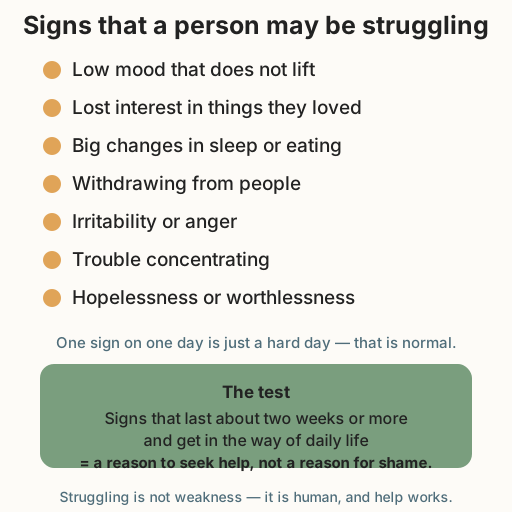
Learners learn to **recognize the signs that a person — themselves included — may be struggling with their mental health**: lasting low mood, lost interest, big changes in sleep or eating, withdrawal, irritability, and hopelessness. They learn the practical test — **signs that last about two weeks or more and get in the way of daily life are a reason to seek help, not a reason for shame.**
Objectives
Objectives
- D03.S4.09.02 Recognize signs of mental health struggles in themselves or others and describe how and where to seek help.
Essential question
What are the signs that someone — including me — is struggling with their mental health, and how do I tell ordinary hard days from something that needs help?
Key vocabulary
Materials
Standard materials
- Signs-of-struggle chart · 1 per learner A list of common signs organized by "lasting and getting in the way" vs. "an ordinary hard day," to sort and annotate
- Vignette cards · 1 set per group Short, gentle stories of people whose behavior has changed, to read and discuss (no diagnoses required)
Low-tech / no-cost
- A shared board or large paper Build the signs chart together; discuss the vignettes aloud
- Voice and a partner Talk through the signs and vignettes in pairs, with no printed cards
Enriched / lab & device
- An accurate youth mental-health explainer or poster · 1 for the group Optional; a reputable resource on recognizing signs in yourself and friends
- A notebook or note app · 1 per learner To keep a private reflection on signs and who to tell
Works in different contexts
- large-group Build the signs chart with the whole group, then small groups read one vignette each and share what they noticed, without naming anyone real
- multi-age Younger learners learn a few core signs and one trusted adult to tell; older learners discuss the "lasting and interfering" rule in depth
- self-directed A learner studies the signs chart, reads the vignettes, and writes a reflection distinguishing a hard day from a pattern that needs help
- level-grouped Learners ready to extend analyze why "lasting two weeks or more and getting in the way" is the practical test, not any single feeling
- outdoor-only Discuss aloud in a circle; the signs can be spoken and remembered, with no materials needed
Lesson 7 — Recognizing Mental-Health Struggle
Summary
Learners learn to recognize the signs that a person — themselves included — may be struggling with their mental health: lasting low mood, lost interest, big changes in sleep or eating, withdrawal, irritability, and hopelessness. They learn the practical test — signs that last about two weeks or more and get in the way of daily life are a reason to seek help, not a reason for shame.
Objectives
- Recognize signs of mental-health struggles in themselves or others. (D03.S4.09.02)
Connection
Everyone knows what a sprained ankle looks like — swelling, pain, not being able to walk on it — and no one is ashamed to rest it or see someone about it. Mental health is no different in kind: it can be hurt, and when it is, there are signs — in mood, sleep, appetite, energy, and how much a person pulls away from others. The difference is that we are taught to hide these signs instead of read them. Today you learn to read them — in yourself and in people you care about — so that a struggle can be met with help early, the way a sprain is, and never with shame.
Materials
- Signs-of-struggle chart
- Vignette cards
Preparation
- Copy the signs chart and vignette cards.
- Retrieval: from Grade 8, recall the signs of stress or distress and one self-care action; from Grade 7, recall how social media can affect mental health.
Facilitator note
This lesson is written to the learner (“you”). The concept to land: mental health is something everyone has, it moves along a spectrum, and a struggle shows up as a pattern of change — lasting low mood, lost interest in things once enjoyed, big changes in sleep or eating, withdrawal from people, irritability, trouble concentrating, and hopelessness — that lasts about two weeks or more and gets in the way of daily life. This is knowledge plus a compassionate skill, so use explicit instruction for the signs (worked example) and discussion for the vignettes (S-011). Teach the practical test plainly and repeatedly: it is not any single feeling that matters; it is a pattern — several signs, lasting, and interfering. Make the anti-stigma point the spine of the lesson: struggling is not weakness and not a character flaw; mental-health conditions are real and treatable, and naming a struggle is the first step to getting help (WHO adolescent mental health, S-311). The egalitarian lens: struggle does not discriminate — it touches every gender, every background, every culture — and no one deserves less care because of who they are; yet stigma and unequal access mean some people suffer in silence longer, which is an injustice to name. The global lens: cultures understand and express mental distress differently — some name it in the body, some in the spirit, some in the mind — and all are real ways of experiencing it; what is universal is that support helps. The ethics lens: how we respond to a friend who is struggling — with care, not gossip, not judgment — is a moral choice. The technology lens: digital life cuts both ways — social media and endless screens can deepen a struggle (comparison, disrupted sleep, withdrawal into a device), while the same technology — helplines, text and chat lines, teletherapy, support apps — can widen the path to help; the skill is to notice the effect and choose what supports you. Hold the room with care: use the vignettes, never a learner’s own story, for public discussion; let any learner pass; and if a learner or vignette touches on self-harm or suicide, handle it directly and safely — thank them for their honesty, do not leave them alone with it, and connect them to a trusted adult or service now (see the next lesson’s help-seeking paths; WHO, S-311). Do not teach methods, do not sensationalize, and always pair the hard truth with agency: help exists, and asking is a strength.
Procedure
- Recall (5 min). From Grade 8: what are signs that stress is building, and what is one thing that helps? Today we learn to read the bigger signals.
- Meet the signs (12 min). Worked example, guided on the chart: a person who is struggling may show low mood that does not lift, lost interest in things they loved, big changes in sleep or eating, withdrawal from people, irritability, trouble concentrating, or a sense of hopelessness or worthlessness. One sign on one day is a hard day — normal. The pattern is what matters.
- Learn the test (8 min). The practical test: several signs, lasting about two weeks or more, and getting in the way of daily life. That is the line where “a hard day” becomes “a reason to seek help.” There is no shame in crossing it — most people will, at some point in life.
- Read the vignettes (15 min). For each short story, ask: What changed for this person? Which signs do you notice? Has it lasted and gotten in the way? Do they need help — and who could they tell? Discuss, but never diagnose; only trained professionals diagnose, and you do not need a diagnosis to deserve care.
- Close (10 min). Write one sentence: a sign you now know to watch for, and one person you would tell if you saw it in yourself or a friend. Watching for a friend’s struggle is an act of love; naming it is the beginning of help.
Differentiation
- Support: Focus on three signs (lasting low mood, withdrawal, big sleep/eating changes) and one trusted adult to tell.
- Extension: Explain in your own words why “lasting two weeks or more and getting in the way” is a better test than any single feeling — and why a diagnosis is not required to seek help.
Assessment
- Formative (observation/self): Can the learner name several signs and apply the “lasting-and-interfering” test to a vignette?
- Portfolio artifact: The learner’s one-sentence reflection (a sign to watch for and a person to tell), kept privately in the portfolio.
Home connection
This week, notice the difference between your own ordinary hard days and anything that lingers. If a friend seems withdrawn for a while, one quiet, kind question — “you’ve seemed a bit low lately; want to talk?” — can be the door that lets help in.
Resources
- On adolescent mental health and recognizing distress: WHO, “Mental health of adolescents” (S-311).
- On explicit instruction and worked examples: Kirschner, Sweller & Clark (2006) (S-011).