Lesson 01 — Three Lenses on Right and Wrong
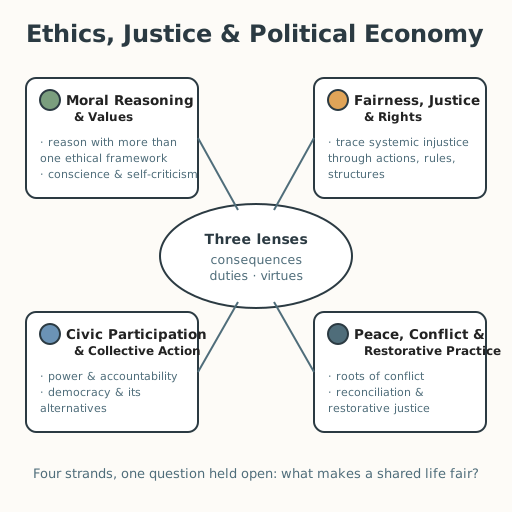
Learners recall Grade-8 ideas about weighing consequences, duties, and fairness, and preview this unit's four strands and the three ethical lenses. They meet the unit's organizing idea: a moral question can be read through more than one lens, and each lens shows something the others miss.
Objectives
Objectives
- D09.S1.09.01 Analyze a moral question using more than one ethical framework (such as consequences, duties, and virtues) and compare what each shows.
Essential question
How do I reason about a moral question — and what are the three lenses we will learn to use?
Key vocabulary
Materials
Standard materials
- Unit map sheet · 1 per learner A one-page map of the unit's four strands and the three lenses, to mark and return to across the unit
- Recall cards · 1 set per group Cards recalling Grade-8 ideas — weighing consequences, duties, fairness; fact vs. belief vs. value
Low-tech / no-cost
- A shared board or large paper Draw the four strands and three lenses together; no printed map needed
- Voice and memory Recall the Grade-8 ideas aloud as a group instead of using cards
Enriched / lab & device
- A digital slideshow of the four strands · 1 One image per strand — values, justice, civic life, peace — to preview each
- A wonder box (physical or shared document) · 1 A place to collect every learner's questions about justice and power to revisit at the close
Works in different contexts
- large-group Do the recall round as a whole group with ideas recorded on the board, then small groups sort the recall cards
- multi-age Younger learners match each recall idea to a picture; older learners state the idea in one sentence and connect it to the new unit
- self-directed A learner reads the unit map, writes three sentences recalling the Grade-8 ideas, and lists one question per strand
- level-grouped Learners ready to extend write a fourth Grade-8 idea not on the cards and explain why it matters here
- outdoor-only Point to a real shared space outdoors (a path, a well, a field) and ask who decides how this is used, and how we would settle a dispute about it.
Lesson 1 — Three Lenses on Right and Wrong
Summary
Learners recall Grade-8 ideas about weighing consequences, duties, and fairness, and preview this unit’s four strands and the three ethical lenses. They meet the unit’s organizing idea: a moral question can be read through more than one lens, and each lens shows something the others miss.
Objectives
- Begin to name three ethical frameworks — consequences, duties, and virtues — as ways to read a moral question. (D09.S1.09.01)
Connection
Think of a time you faced a choice where more than one thing seemed right at once — tell a hard truth that might hurt a friend, or stay quiet to spare them; share a scarce resource, or keep it for someone who needs it more. Every such moment is a moral question, and none of us has just one way of answering it. Today we meet three lenses — consequences, duties, and virtues — that people all over the world, in every culture and time, have used to think such questions through.
Materials
- Unit map sheet
- Recall cards
Preparation
- Copy the unit map sheet and recall cards.
- Retrieval: from Grade 8, recall (a) weighing consequences, duties, and fairness in a dilemma; (b) the difference between a fact, a belief, and a value; and (c) that justice has more than one meaning. Today we link those to the new unit.
Facilitator note
This lesson is written to the learner (“you”). It is the unit’s opening and retrieval pass, so the goals are modest: (1) recall three Grade-8 ideas — a moral dilemma can be weighed by consequences, duties, and fairness; facts, beliefs, and values are different kinds of claims; and justice has more than one meaning; (2) preview the unit’s four strands — moral reasoning & values; fairness, justice & rights; civic participation & collective action; peace, conflict & restorative practice; (3) plant the organizing idea: a moral question is read through more than one lens (consequences, duties, virtues), and each lens shows something the others miss. Do not teach the three lenses in depth today; just name and locate them. The ethics lens: right and wrong are questions we reason about, not slogans we accept. The egalitarian lens: always ask who benefits and who is left out. The global lens: every culture has ways of thinking about a good life and a fair society — none is the default. Hold questions open: nothing here is creed (philosophy §11). Distinguish evidence from values throughout (philosophy §5). Spacing note (S-039): this recall pass is what makes the unit’s ideas stick later.
Procedure
- Recall (10 min). In a small group, look at three recall cards: weighing consequences, duties, and fairness; fact vs. belief vs. value; justice has more than one meaning. For each, say in one sentence what you remember from Grade 8.
- Connect the three (5 min). What do all three have in common? (Each is about how we think about right and wrong — carefully, and with more than one answer on the table.)
- Meet the map (10 min). Look at the unit map. Four strands: moral reasoning & values, fairness, justice & rights, civic participation & collective action, peace, conflict & restorative practice. Read each goal aloud once; don’t worry about understanding them yet.
- Plant the big idea (10 min). The unit’s idea in one breath: a moral question can be read through three lenses — consequences (what happens, to whom?), duties (what do I owe, no matter what?), and virtues (what kind of person would I become?). Say it back in your own words.
- Wonder (10 min). Write one question about each strand in the wonder box. Which question do you most want answered by the end of the unit?
- Close (5 min). Today we remembered what we know and saw the road ahead. Next: we look closely through the first lens — consequences.
Differentiation
- Support: Give sentence starters for the recall round (“A moral dilemma is a choice where…”).
- Extension: Add a fourth Grade-8 idea of your own and say why it will matter in this unit.
Assessment
- Formative (observation): Can the learner recall each Grade-8 idea in one sentence and name the unit’s four strands and three lenses?
- Artifact: The completed unit map (or the learner’s written recall), kept in the portfolio.
Home connection
Ask someone at home: what is one decision you still think about — where you had to weigh what would happen against what you felt you owed? Bring the shape of the story (no names needed) to the next lesson.
Resources
- On explicit instruction and worked examples: Kirschner, Sweller & Clark (2006), https://doi.org/10.1207/s15326985ep4102_1 (S-011).
- On the payoff of spaced retrieval: Dunlosky et al. (2013), https://doi.org/10.1177/1529100612453266 (S-039).
- On the three ethical frameworks as distinct, long-standing traditions: Stanford Encyclopedia of Philosophy, “Consequentialism” (S-456); “Deontological Ethics” (S-457); “Virtue Ethics” (S-458).