Lesson 02 — Consequences: What Happens, to Whom?
Learners read an everyday moral question through the consequences lens — the family of traditions that judges an act by its results. They learn to trace who is helped, who is harmed, and who far away or in the future is affected, and they name both the lens's power and its blind spots.
Objectives
Objectives
- D09.S1.09.01 Analyze a moral question using more than one ethical framework (such as consequences, duties, and virtues) and compare what each shows.
Essential question
What does the consequences lens show about a moral question — and what does it miss?
Key vocabulary
Materials
Standard materials
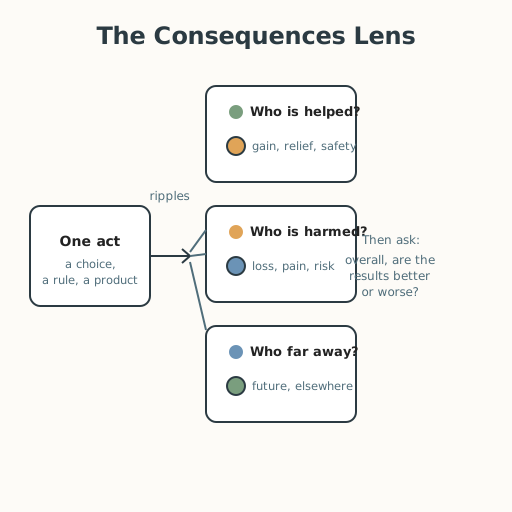
- Consequences ripple sheet · 1 per learner A diagram of one act fanning out to who is helped, harmed, and affected far away
- Worked-example dilemma card · 1 per pair A single everyday dilemma (a shared resource, a hard truth) to read through the consequences lens, worked together
Low-tech / no-cost
- A shared board or large paper Draw the ripple diagram together instead of using printed sheets
- Voice Read the dilemma aloud and discuss it in a circle
Enriched / lab & device
- A digital whiteboard · 1 Build the ripple diagram collaboratively, one branch per group
- A short news article or case · 1 per pair A current local or global decision whose consequences can be traced to specific people
Works in different contexts
- large-group Work the worked example as a whole group first, then pairs trace a second dilemma on their own sheets
- multi-age Younger learners name one helped and one harmed; older learners add a far-away or future consequence
- self-directed A learner chooses one dilemma, draws the ripple diagram, and writes a sentence for each branch
- level-grouped Learners ready to extend weigh the *overall* result and say what information would change their judgment
- outdoor-only Use a real shared resource outdoors — a path, water, shade — and trace who is helped or harmed by different rules for using it
Lesson 2 — Consequences: What Happens, to Whom?
Summary
Learners read an everyday moral question through the consequences lens — the family of traditions that judges an act by its results. They trace who is helped, who is harmed, and who far away or in the future is affected, and they name both the lens’s power and its blind spots.
Objectives
- Analyze a moral question through the consequences lens, tracing who is helped and harmed, and compare what this lens shows with what it leaves out. (D09.S1.09.01)
Connection
You decide to take a shortcut across a neighbor’s field, or to post something funny about someone, or to buy the cheaper item without asking where it was made. Each choice has results that reach beyond you — some people are helped, some are harmed, and some are affected far away or later. The consequences lens asks exactly that: what happens, to whom? It is one of the oldest and most common ways people everywhere judge right and wrong.
Materials
- Consequences ripple sheet
- Worked-example dilemma card
Preparation
- Copy the ripple sheet and dilemma card.
- Choose a worked-example dilemma that is local and recognizable — a shared resource, a hard truth, a promise kept or broken — and prepare to model it step by step.
Facilitator note
This lesson is written to the learner (“you”). Its goals: (1) introduce the consequences lens honestly — it is one family of traditions (consequentialism; its best-known form, utilitarianism, is associated with Jeremy Bentham and John Stuart Mill, and consequentialist reasoning appears early in Chinese Mohism, in Buddhist ethics, and in other traditions (S-466; S-467)), not the “correct” answer; (2) model once, then guide: work one dilemma together step by step (identify the act; trace who is helped, harmed, and affected far away or in the future; then weigh the overall result), before learners try a second on their own (Kirschner, Sweller & Clark 2006, S-011); (3) name the lens’s limits — it can miss duties and the kind of person one becomes, and “the greatest good for the greatest number” can overlook the few, which is why the egalitarian lens matters. The ethics lens: results matter, and so do the people they fall on. The egalitarian lens: always ask who is helped and who is left out — including those with the least voice. The global lens: the same reasoning runs through many traditions, but what counts as a good result is itself argued about across cultures. The environment lens: consequences reach non-human life and future generations too. Keep this lens as one way of seeing, not the whole truth — more lenses arrive in the next two lessons (philosophy §11).
Procedure
- Recall (5 min). Last time we met three lenses. Name them from memory (consequences, duties, virtues).
- Meet the lens (10 min). Read the consequences ripple sheet. The lens asks: what happens, to whom? Trace one act out to the people it helps, the people it harms, and the people far away or in the future it touches.
- Worked example (15 min). Together, read the worked-example dilemma. Step by step: (a) name the act; (b) list who is helped; (c) list who is harmed; (d) list who far away or later is affected; (e) weigh the overall result. Use the facilitator’s model as your guide.
- Guided practice (15 min). In pairs, take a second dilemma and fill your own ripple sheet — helped, harmed, far away. Then say aloud: overall, are the results better or worse?
- Name the limits (5 min). What does this lens miss? (Duties we owe regardless of results; the kind of person we become; and whether “the greatest good” quietly overlooks the few.)
- Close (5 min). Today we saw through one lens. Next: the duties lens — what we owe, no matter what.
Differentiation
- Support: Provide the “helped / harmed / far away” categories pre-labeled and one worked branch to complete.
- Extension: Add a future generation and a non-human branch to the ripple, and say how the judgment shifts.
Assessment
- Formative (observation): Can the learner trace helped, harmed, and far-away consequences for a new dilemma, and name at least one thing the lens misses?
- Artifact: The completed ripple sheet (or written trace), kept in the portfolio.
Home connection
Think of one everyday choice your household makes (what to buy, how to travel, how to share space). List one person or thing it helps and one it harms. Bring one sentence to share next time.
Resources
- On consequentialism and utilitarianism as traditions: Stanford Encyclopedia of Philosophy, “Consequentialism,” https://plato.stanford.edu/entries/consequentialism/ (S-456).
- On consequentialist reasoning in Chinese Mohism: Stanford Encyclopedia of Philosophy, “Mohism,” https://plato.stanford.edu/entries/mohism/ (S-466).
- On consequentialist reasoning in Buddhist ethics: Stanford Encyclopedia of Philosophy, “Ethics in Indian and Tibetan Buddhism,” https://plato.stanford.edu/entries/ethics-indian-buddhism/ (S-467).
- On explicit instruction and worked examples: Kirschner, Sweller & Clark (2006), https://doi.org/10.1207/s15326985ep4102_1 (S-011).