Lesson 06 — Conscience & Self-Criticism: Keeping My Values Honest
Learners turn from analyzing questions to forming their own values. They meet conscience as a loop — act, reflect, self-criticize, revise — and practice honest self-criticism that corrects values without collapsing into self-condemnation, producing a values reflection as a portfolio artifact.
Objectives
Objectives
- D09.S1.09.02 Evaluate the role of conscience and self-criticism in forming one's own values.
Essential question
What role do conscience and self-criticism play in forming my own values — and how do I practice them without self-condemnation?
Key vocabulary
Materials
Standard materials
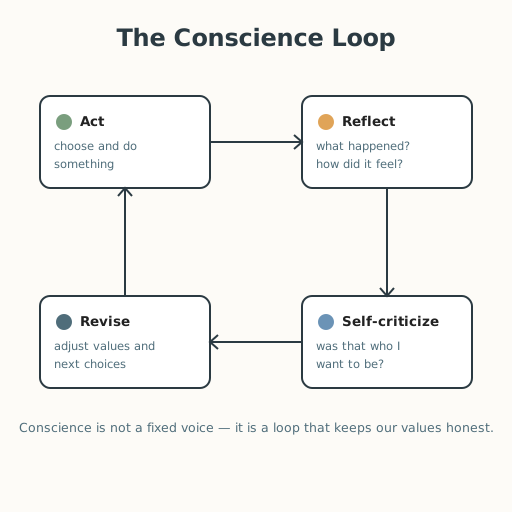
- Conscience loop sheet · 1 per learner A four-step loop — act, reflect, self-criticize, revise — for forming and correcting values
- Values reflection journal page · 1 per learner A page to record one value, where it came from, and how it has been tested and revised
Low-tech / no-cost
- A shared board or large paper Draw the loop together and record values in a group conversation
- Voice and quiet time Reflect aloud or in silence; no printed pages needed
Enriched / lab & device
- A private digital journal · 1 A secure personal document for the values reflection, shared only if the learner chooses
- Short excerpts on conscience from more than one tradition · 1 set A few lines on conscience, self-examination, and inner correction across cultures
Works in different contexts
- large-group Reflect in pairs, then invite a few to share (voluntary only); never require a learner to disclose private values
- multi-age Younger learners draw or act out one value; older learners write where it came from and how it was tested
- self-directed A learner works the loop alone, writing about one value — its origin, a test, and a revision — in private
- level-grouped Learners ready to extend distinguish self-criticism (honest correction) from self-condemnation (destructive), and write the difference
- outdoor-only Walk a short path alone or in pairs and reflect on one value silently; return and write one sentence
Lesson 6 — Conscience & Self-Criticism: Keeping My Values Honest
Summary
Learners turn from analyzing questions to forming their own values. They meet conscience as a loop — act, reflect, self-criticize, revise — and practice honest self-criticism that corrects values without collapsing into self-condemnation, producing a values reflection as a portfolio artifact.
Objectives
- Evaluate the role of conscience and self-criticism in forming one’s own values. (D09.S1.09.02)
Connection
After a choice you regret, a quiet voice asks: was that really who I want to be? That voice — and the habit of listening to it, questioning yourself, and changing course — is how a person’s values stop being inherited slogans and become their own. Every tradition has a name for this inner correction. Today you learn to do it honestly and kindly, because the point is growth, not punishment.
Materials
- Conscience loop sheet
- Values reflection journal page
Preparation
- Copy the loop sheet and journal page.
- Prepare to model the loop with a mild, low-stakes example of your own (never a learner’s), so learners see honest self-correction done without shame.
Facilitator note
This lesson is written to the learner (“you”). Its goals: (1) define conscience not as a fixed, infallible voice but as a loop — act, reflect, self-criticize, revise — that keeps values honest; (2) distinguish self-criticism (honest, specific, corrective) from self-condemnation (global, destructive: “I am bad”), and insist on the former; (3) hold this as private, voluntary work — a learner’s values are their own, and no one is required to disclose (philosophy §6, §8). The ethics lens: forming values is a discipline, not a feeling. The egalitarian lens: self-criticism should ask whether my values quietly favor people like me over others. The social-emotional lens: keep the tone kind — this is about growth, never shame, and a learner may always pass or step away (facilitation “holding difficult topics safely”). The global lens: conscience and self-examination are named across traditions — in philosophy, faith, and Indigenous practice — and none owns the idea. Distinguish evidence from values: that self-examination improves judgment is supported by reflective-practice evidence; which values one holds is a personal matter the lesson never grades.
Procedure
- Retrieval (5 min). Last time we compared three lenses. Now, name from memory: what is the difference between a value and a fact? (A value is what we hold to be good; a fact is how things are.)
- Meet the loop (10 min). Read the conscience loop sheet. Conscience is not a fixed voice — it is a loop: act, reflect on what happened, self-criticize honestly, revise your values and next choices, then act again.
- Model it (10 min). Watch the facilitator work the loop on a mild example of their own — naming what happened, what the choice revealed about a value, and what they will revise. Notice: no self-condemnation, only honest correction.
- Two kinds of inner criticism (5 min). Tell the difference: self-criticism says “that choice was unfair; I can do better” (specific, corrective); self-condemnation says “I am worthless” (global, destructive). Which one builds a person?
- Reflect on your own values (15 min). Privately, choose one value you hold. On your journal page, write: (a) what it is; (b) where it came from — a family, a tradition, a teacher, an experience; (c) one time it was tested; (d) whether the test changed it, and how. This is your own; you share only what you choose.
- Close (5 min). Values are formed, not found — and self-criticism is how they stay honest. Next: we turn from the inner life to the wider world — systemic injustice.
Differentiation
- Support: Provide sentence starters for the journal (“I hold the value of… because…”; “It was tested when…”).
- Extension: In writing, distinguish self-criticism from self-condemnation and give one example of each in a character from a story or history.
Assessment
- Formative (self): Can the learner name one value, its origin, and how it was tested and revised — and do so without self-condemnation?
- Artifact (portfolio): The values reflection journal page (shared only as the learner chooses).
Home connection
Ask someone at home: what value did you hold when you were my age that you later revised, and what changed it? Bring one sentence next time.
Resources
- On reflection and self-correction as a practice of judgment: Dunlosky et al. (2013), https://doi.org/10.1177/1529100612453266 (S-039).
- On respectful engagement across cultural difference: UNESCO, “Universal Declaration on Cultural Diversity,” https://www.unesco.org/en/legal-affairs/unesco-universal-declaration-cultural-diversity (S-389).