Lesson 12 — The Roots of Conflict: Inequality, Fear, Scarcity
Learners analyze the causes of conflict and violence — inequality, fear, and scarcity — and how they can be addressed at the root rather than only at the surface. They trace a case from root causes through conflict to possible remedies, producing a roots-of-conflict analysis as a portfolio artifact.
Objectives
Objectives
- D09.S4.09.01 Analyze the causes of conflict and violence, including inequality, fear, and scarcity, and how they can be addressed at the root.
Essential question
What causes conflict and violence — and how can inequality, fear, and scarcity be addressed at the root?
Key vocabulary
Materials
Standard materials
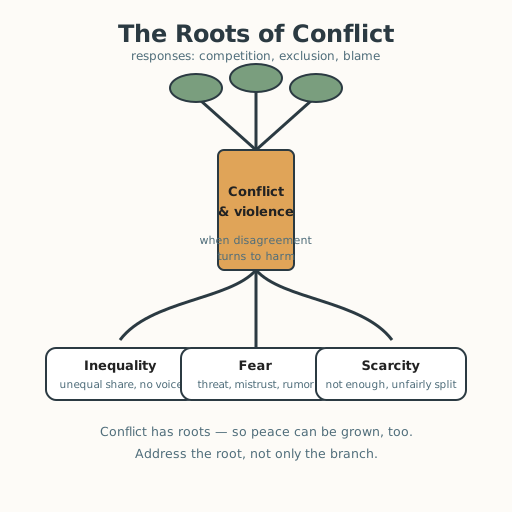
- Roots-of-conflict tree sheet · 1 per learner A tree diagram with roots of inequality, fear, and scarcity feeding a trunk of conflict and violence
- Case study · 1 per learner A short, sourced case of a conflict where root causes can be traced
Low-tech / no-cost
- A shared board or large paper Draw the tree together instead of using printed sheets
- Voice Discuss the case aloud, each learner naming one root cause
Enriched / lab & device
- A digital whiteboard · 1 Co-build the tree and annotate a current conflict with sourced root causes
- A short dataset on inequality and conflict · 1 per group A few documented measures linking inequality and scarcity to conflict risk
Works in different contexts
- large-group Model one case whole-group, then groups trace a second and present one root and one remedy
- multi-age Younger learners name one root (not enough, or fear, or unfairness) from a story; older learners write the full analysis
- self-directed A learner reads a case, fills the tree, and writes how one root could be addressed
- level-grouped Learners ready to extend distinguish the root from the trigger and argue which root is most consequential in their case
- outdoor-only Observe a real competition over a scarce outdoor resource (water, space, shade) and trace its root causes and a fair fix
Lesson 12 — The Roots of Conflict: Inequality, Fear, Scarcity
Summary
Learners analyze the causes of conflict and violence — inequality, fear, and scarcity — and how they can be addressed at the root rather than only at the surface. They trace a case from root causes through conflict to possible remedies, producing a roots-of-conflict analysis as a portfolio artifact.
Objectives
- Analyze the causes of conflict and violence, including inequality, fear, and scarcity, and how they can be addressed at the root. (D09.S4.09.01)
Connection
Most conflict does not start with a single sudden insult; it grows from deeper ground — when some have far more than others (inequality), when people feel unsafe or mistrust one another (fear), and when there is not enough to go around and no fair way to share it (scarcity). If you want peace, you cannot only cut the branches; you must tend the roots. Today you learn to see the roots — and the remedies that match them.
Materials
- Roots-of-conflict tree sheet
- Case study
Preparation
- Copy the tree sheet and case studies.
- Choose a short, sourced case of conflict with traceable root causes (a dispute over land, water, wages, or belonging), at a depth the age can hold, and always paired with what people did to address it — hope attached (development “9–12”; facilitation “holding difficult topics safely”).
Facilitator note
This lesson is written to the learner (“you”). Its goals: (1) teach the root causes of conflict and violence — inequality (unequal share and unequal voice), fear (threat, mistrust, rumor), and scarcity (genuine shortage or unfair division) — as causes, distinct from the surface trigger that ignites them; (2) model once, then guide: trace one case from roots to conflict to remedy, then let learners trace another (Kirschner, Sweller & Clark 2006, S-011); (3) keep it non-dogmatic — these are among the best-supported causes, not the only ones, and “addressing the root” is offered as a strategy to evaluate, not a formula to accept (philosophy §11). The ethics lens: understanding causes is not excusing violence — it is the precondition for ending it. The egalitarian lens: ask whose fear and whose scarcity are centered, and whether the remedies would share power, not just resources. The environment lens: scarcity is often environmental — water, land, a changing climate — so peace and stewardship are linked. The global lens: conflict looks different across societies; present each case as one place’s story. Distinguish evidence from values: that inequality and scarcity correlate with conflict is a documented finding (cite a source); that we should reduce them is a value we argue for. This is a portfolio artifact — keep the analysis.
Procedure
- Retrieval (5 min). From memory: what is the difference between a conflict (a disagreement) and violence (harm)? (One sentence — you met this in Grade 5.)
- Meet the tree (10 min). Read the roots-of-conflict sheet. Three roots feed the trunk of conflict and violence: inequality, fear, scarcity. The branches are the responses — competition, exclusion, blame. The roots can be tended.
- Worked example (15 min). Together, trace one case: (a) name the conflict; (b) find the roots — which are inequality, fear, scarcity? (c) name the surface trigger; (d) propose one remedy for each root, and one way to prevent the next conflict.
- Trace a second case (15 min). In groups, work a second case through the same steps. End by naming the root your remedy addresses — and why addressing the root differs from punishing the trigger.
- Weigh (5 min). Which root is hardest to address, and why? What would it take — sharing resources, building trust, or sharing power?
- Close (5 min). Peace is grown at the roots. Next: reconciliation and restorative justice — what happens after serious harm.
Differentiation
- Support: Provide the tree pre-labeled and one worked root and remedy to model.
- Extension: Distinguish the root from the trigger in your case and argue which root is most consequential — and which remedy is most likely to last.
Assessment
- Formative (observation): Can the learner identify inequality, fear, or scarcity as a root cause in a case and propose a remedy aimed at the root rather than the surface?
- Artifact (portfolio): The completed roots-of-conflict analysis.
Home connection
Ask someone at home: have you ever seen a conflict where the real cause was not enough to go around, or fear, or unfairness — and what finally helped? Bring one sentence next time.
Resources
- On violence, peace, and structural roots of conflict: Galtung (1969), “Violence, Peace, and Peace Research,” Journal of Peace Research 6(3), https://doi.org/10.1177/002234336900600301 (S-462).
- On inequality and its measurement across countries: World Inequality Lab, “World Inequality Report,” https://wir2022.wid.world/ (S-464).
- On peace, justice, and strong institutions as a shared goal: United Nations, Sustainable Development Goal 16, https://sdgs.un.org/goals/goal16 (S-463).