Lesson 13 — Reconciliation & Restorative Justice
Learners evaluate reconciliation and restorative justice as responses to serious harm. They learn the three restorative questions — what happened, who was harmed, how do we make it right — and weigh both the possibilities (repair, truth, restored relationship) and the limits (when harm is too great, when power is too unequal, when repair is refused), producing an evaluation as a portfolio artifact.
Objectives
Objectives
- D09.S4.09.02 Evaluate reconciliation and restorative justice as responses to serious harm, including their possibilities and limits.
Essential question
How do reconciliation and restorative justice respond to serious harm — and what are their possibilities and limits?
Key vocabulary
Materials
Standard materials
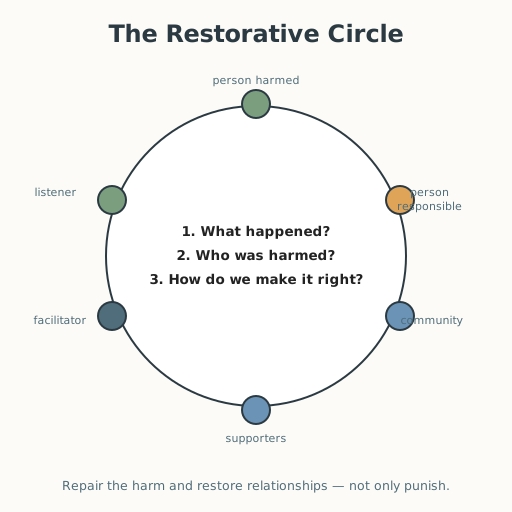
- Restorative circle sheet · 1 per learner A circle with the three restorative questions — what happened, who was harmed, how do we make it right
- Case study · 1 per learner A short, sourced case of reconciliation or restorative justice after serious harm
Low-tech / no-cost
- A shared board or large paper Draw the circle together and sit in a real circle to discuss
- Voice Discuss the case aloud, each learner naming one need or one way to repair
Enriched / lab & device
- A digital whiteboard · 1 Co-build the circle and annotate a documented restorative process
- Two contrasting cases · 1 set per group One where reconciliation succeeded and one where it fell short, to compare
Works in different contexts
- large-group Model one case whole-group, then groups read contrasting cases and present the possibilities and limits
- multi-age Younger learners name what a harmed person might need; older learners write the evaluation
- self-directed A learner reads a case, fills the circle, and writes one paragraph on possibilities and limits
- level-grouped Learners ready to extend weigh restorative justice against punishment for a specific harm and defend a reasoned position
- outdoor-only Sit in a circle outdoors and use the three restorative questions for a real or role-played harm in a shared space
Lesson 13 — Reconciliation & Restorative Justice
Summary
Learners evaluate reconciliation and restorative justice as responses to serious harm. They learn the three restorative questions — what happened, who was harmed, how do we make it right — and weigh both the possibilities (repair, truth, restored relationship) and the limits (when harm is too great, when power is too unequal, when repair is refused), producing an evaluation as a portfolio artifact.
Objectives
- Evaluate reconciliation and restorative justice as responses to serious harm, including their possibilities and limits. (D09.S4.09.02)
Connection
After something is broken — a trust, a community, a life — punishment alone asks only “who is to blame, and what should they suffer?” Restorative justice asks three different questions: what happened, who was harmed, and how do we make it right? It is not softness; it is a demanding practice with real power and real limits. Today you learn to judge it honestly, not to admire or dismiss it.
Materials
- Restorative circle sheet
- Case study
Preparation
- Copy the circle sheet and case studies.
- Choose short, sourced cases of reconciliation or restorative justice after serious harm, including at least one that shows its limits or failure, so learners weigh both sides. Hold heavy content with care and always connect to agency (facilitation “holding difficult topics safely”).
Facilitator note
This lesson is written to the learner (“you”). Its goals: (1) teach restorative justice accurately — it centers the three questions (what happened; who was harmed and what do they need; who is responsible, and how is the harm repaired and the relationship restored), and its modern frame traces to Howard Zehr and the International Institute for Restorative Practices, with older roots in Indigenous peacemaking (e.g., Diné hózhó and peacemaking circles); (2) hold both sides — its possibilities (truth, repair, restored relationship, accountability without mere vengeance) and its limits (some harms may be too great; it can fail if power is unequal or if the responsible person refuses; it is not a substitute for justice where impunity would result); (3) avoid dogma — present restorative justice as one defensible response, compared with others, never as the only right answer (philosophy §11). The ethics lens: repair is a moral achievement, not a formula. The egalitarian lens: ask whether the process shares power or reproduces the original inequality. The global lens: reconciliation looks different across cultures — truth commissions, peacemaking circles, community courts — none is the default. The community lens: serious harm breaks relationships, and repair must include the community. Distinguish evidence from values: that restorative practices exist and are documented is a fact (cite sources); that they are preferable in a given case is a value learners argue. This is a portfolio artifact — keep the evaluation.
Procedure
- Retrieval (5 min). From memory: what are the three roots of conflict (inequality, fear, scarcity)? Name them.
- Meet the circle (10 min). Read the restorative circle sheet. Instead of “who is to blame,” restorative justice asks: 1. What happened? 2. Who was harmed? 3. How do we make it right? Around the circle sit the person harmed, the person responsible, supporters, and a facilitator.
- Worked example (15 min). Together, evaluate one case: (a) what happened; (b) who was harmed, and what did they need; (c) who took responsibility, and how; (d) how was repair made — or not; (e) where did the process work, and where did it reach its limit?
- Evaluate a second case (15 min). In groups, work a contrasting case — ideally one where reconciliation fell short. Answer the same five questions, and end by naming one possibility and one limit.
- Weigh (5 min). For what kinds of harm does repair work best? When is it not enough? Is it ever a replacement for justice, or only a form of it?
- Close (5 min). Repair is possible — and it is hard, and it has limits. Next: our capstone, where every thread of this unit is woven together.
Differentiation
- Support: Provide the five evaluation questions pre-printed and one worked answer.
- Extension: In writing, weigh restorative justice against punishment for one specific harm and defend a reasoned position, naming the conditions under which you would choose each.
Assessment
- Formative (observation): Can the learner name the three restorative questions and state one possibility and one limit, grounded in a case?
- Artifact (portfolio): The completed reconciliation-and-restorative-justice evaluation.
Home connection
Ask someone at home: after a serious falling-out, what actually repaired it — an apology, time, an honest talk, a change in behavior? Bring one sentence next time.
Resources
- On restorative justice: Zehr (1990), Changing Lenses (S-161); International Institute for Restorative Practices (S-022).
- On peace, justice, and strong institutions: United Nations, Sustainable Development Goal 16, https://sdgs.un.org/goals/goal16 (S-463).