Lesson 14 — Capstone: Reasoning Across the Whole
Learners gather the unit's eight ideas into one web and write a short synthesis, showing how reasoning across frameworks, justice and rights, power and accountability, and peace and repair belong to a single way of seeing a shared life. The capstone doubles as a spaced, interleaved retrieval pass and the unit's closing celebration.
Objectives
Objectives
- D09.S1.09.01 Analyze a moral question using more than one ethical framework (such as consequences, duties, and virtues) and compare what each shows.
- D09.S1.09.02 Evaluate the role of conscience and self-criticism in forming one's own values.
- D09.S2.09.01 Analyze a systemic injustice, tracing how individual actions, rules, and structures combine to produce unfair outcomes.
- D09.S2.09.02 Evaluate the idea of human rights across cultures, including critiques that they reflect some traditions more than others.
- D09.S3.09.01 Analyze how power is distributed in a society and how citizens can hold power accountable, using a specific case.
- D09.S3.09.02 Evaluate the strengths and limits of democratic participation, and compare with alternatives across different societies.
- D09.S4.09.01 Analyze the causes of conflict and violence, including inequality, fear, and scarcity, and how they can be addressed at the root.
- D09.S4.09.02 Evaluate reconciliation and restorative justice as responses to serious harm, including their possibilities and limits.
Essential question
How do the ideas of this unit — reasoning, justice, power, and peace — weave together into one way of seeing a shared life?
Key vocabulary
Materials
Standard materials
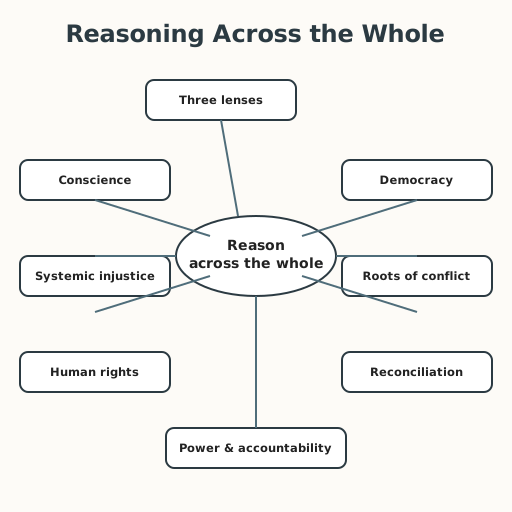
- Capstone web sheet · 1 per learner A web connecting the unit's eight ideas around the center "reason across the whole"
- Portfolio folder · 1 per learner The learner's collected artifacts from this unit, to review and connect
- Synthesis prompt · 1 per learner One question that asks learners to weave the unit together (see Facilitator note)
Low-tech / no-cost
- A shared board or large paper Draw the web together and build the connections aloud
- Voice and memory Recall each idea from memory in a circle before writing
Enriched / lab & device
- A digital portfolio or document · 1 Gather the artifacts digitally and write the synthesis there
- A gallery walk or shared presentation · 1 Display the syntheses and let learners respond to one another's work
Works in different contexts
- large-group Build the web whole-group, then learners write individually and share one connection in a closing circle
- multi-age Younger learners match each idea to an artifact from their folder; older learners write the synthesis
- self-directed A learner reviews their artifacts, fills the web, and writes the synthesis alone
- level-grouped Learners ready to extend write the synthesis as a short, reasoned position on one live question, citing the unit's ideas
- outdoor-only Hold a closing circle outdoors; each learner speaks one idea they will carry and one thing they will do with it
Lesson 14 — Capstone: Reasoning Across the Whole
Summary
Learners gather the unit’s eight ideas into one web and write a short synthesis, showing how reasoning across frameworks, justice and rights, power and accountability, and peace and repair belong to a single way of seeing a shared life. The capstone doubles as a spaced, interleaved retrieval pass and the unit’s closing celebration.
Objectives
- Reconnect and apply the unit’s eight goals — reasoning across frameworks, conscience and self-criticism, systemic injustice, human rights, power and accountability, democracy and its alternatives, the roots of conflict, and reconciliation — in one synthesis. (all eight grade-9 D09 objectives)
Connection
You have spent this unit learning eight ways of seeing the common life — how to reason about a hard choice, how to spot unfairness built into a system, how to weigh power and democracy, how to understand conflict and repair harm. None of these stands alone. A person who can hold them together is a person who can help build a fairer world. Today you weave them into one whole — and decide what you will carry with you.
Materials
- Capstone web sheet
- Portfolio folder
- Synthesis prompt
Preparation
- Copy the web sheet and synthesis prompt.
- Have learners gather their portfolio artifacts from this unit. Prepare the synthesis prompt — e.g., “Choose one real question from your own community or the wider world. Read it through the three lenses, name one systemic or rights dimension, and one question of power or peace it raises. What would you do, and why?”
Facilitator note
This lesson is written to the learner (“you”). It is the unit’s capstone and spaced retrieval pass: recall all eight goals, connect them into one web, then synthesize (Dunlosky et al. 2013, S-039). The goals: (1) retrieve each idea from memory before opening notes; (2) connect the eight into a single web, so learners see them as one discipline rather than eight lessons; (3) write a short synthesis on one real question — the unit’s summative demonstration; (4) celebrate mastery without ranking (philosophy §8). Keep it open: learners may weigh the ideas differently and reach different conclusions — the standard is reasoned synthesis, not a single right answer (philosophy §11). The ethics lens: the whole is a way of asking “what is right, and for whom?” The egalitarian lens: the synthesis must keep asking who benefits and who is left out. The global lens: the synthesis should honor that these ideas appear in many cultural forms. The community lens: close with what each learner will do — agency, never nihilism (philosophy §12). This is the unit’s final portfolio artifact.
Procedure
- Retrieve (10 min). Without opening your notes, name the unit’s eight ideas from memory: three lenses; conscience; systemic injustice; human rights; power; democracy; roots of conflict; reconciliation. Check against the web sheet — fill in any you missed.
- Build the web (10 min). On the capstone web sheet, draw one line connecting two ideas and write, along the line, how they belong together (e.g., “systemic injustice ↔ power: unfair arrangements are held in place by who has power”). Add at least three connections.
- Choose a question (5 min). Read the synthesis prompt and choose one real question — from your community or the wider world — that genuinely matters to you.
- Synthesize (20 min). Write one strong paragraph: read your question through the three lenses; name one systemic or rights dimension; name one question of power or peace it raises; and say what you would do and why. Use at least three of the unit’s ideas by name.
- Share and celebrate (10 min). In a closing circle, each person shares one sentence: one idea they will carry, and one thing they will do with it. No ranking — only appreciation.
- Close (5 min). You have reasoned across the whole. Carry these tools into the world — and into Grade 10, where they deepen further.
Differentiation
- Support: Provide sentence starters for the synthesis (“My question is…”; “The three lenses show…”; “The question of power here is…”).
- Extension: Write the synthesis as a short, reasoned position on one live question, citing the unit’s ideas and acknowledging the strongest counter-argument.
Assessment
- Summative (portfolio): Does the synthesis use at least three of the unit’s ideas by name, reason across more than one lens, and end in agency rather than despair?
- Self: The learner reviews their own folder and names the idea that grew most in their thinking.
Home connection
Show someone at home your synthesis, and tell them the one thing you will do with it. Ask them what they think — and listen.
Resources
- On the payoff of spaced and interleaved retrieval: Dunlosky et al. (2013), https://doi.org/10.1177/1529100612453266 (S-039).
- On explicit instruction and worked examples: Kirschner, Sweller & Clark (2006), https://doi.org/10.1207/s15326985ep4102_1 (S-011).