Lesson 01 — The Story I Am Writing
Learners construct a coherent personal narrative that connects their past, present, and hoped-for future — the "who I am becoming" reflection that opens the year-end capstone. They gather three chapters, find the thread that links them, and name a theme, holding the story as theirs to keep writing.
Objectives
Objectives
- D01.S2.09.01 Construct a coherent personal narrative that connects their past, present, and hoped-for future.
Essential question
What coherent story now connects my past, present, and hoped-for future?
Key vocabulary
Materials
Standard materials
- Narrative map worksheet · 1 per learner A one-page organizer with three columns — past, present, hoped-for future — and a thread line linking them
- Writing journal or notebook · 1 per learner For drafting the reflective narrative
- Past artifacts (optional) · as available Any earlier work, photo, or object the learner chose to bring to stand for a past chapter
Low-tech / no-cost
- Folded paper or a stick drawn in soil Divide a page into three parts, or draw the thread on the ground, and tell the story aloud
- Voice and memory The narrative can be spoken and remembered rather than written
Enriched / lab & device
- Digital slide or voice memo · 1 per learner Build the narrative as a short audio or slide story to add to the digital portfolio
- Timeline app or shared document · 1 per group A collaborative timeline for the class "river of stories"
Works in different contexts
- large-group Model one whole-class example on the board, then learners draft independently; share in small circles of three to four
- multi-age Younger learners tell a two-part story (then, now); older learners add the hoped-for future and a theme
- self-directed A learner fills the three columns alone, then writes or records the thread in one paragraph
- level-grouped Learners ready to extend name a turning point and a theme and connect them with reasons, not just events
- outdoor-only Walk a short path and stop at three points — where I have been, where I am, where I hope to go — then speak the thread
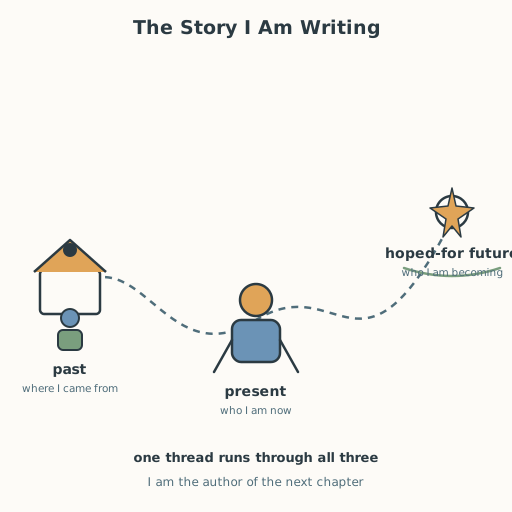
Lesson 1 — The Story I Am Writing
Summary
Learners construct a coherent personal narrative that connects their past, present, and hoped-for future — the “who I am becoming” reflection that opens the year-end capstone. They gather three chapters, find the thread that links them, and name a theme, holding the story as theirs to keep writing — never as a finished verdict.
Objectives
- Construct a coherent personal narrative that connects my past, present, and hoped-for future. (D01.S2.09.01)
Connection
Every life is a story being told as it happens. The chapters you have already lived — the place you came from, the people who shaped you, the hard and joyful turns — do not stay in the past; they are the reasons you are who you are today and the material from which your future will be built. Whether you grew up by a river, a sea, a mountain, a desert, or a city street, you have a “then,” a “now,” and a “next.” Pulling them into one story — not a perfect story, a true one — is how you begin to author the next chapter instead of only watching it happen.
Materials
- Narrative map worksheet (three columns: past, present, hoped-for future, with a thread line)
- Writing journal or notebook
- Past artifacts (optional)
Preparation
- Copy or draw the narrative map worksheet.
- Retrieval: from Grade 8’s “who I am becoming” work and this year’s identity unit, recall the idea that identity is a changing story, not a fixed fact. Today we write the current page of it.
Facilitator note
This lesson is written to the learner (“you”). The idea to land: a personal narrative is coherent when its parts — past, present, future — are held together by a thread of meaning, not just listed as events. That thread is what McAdams calls narrative identity: an internalized, evolving life story that links the reconstructed past, the experienced present, and the imagined future to give a life unity and purpose (S-404). The future-facing part draws on Markus and Nurius’s possible selves — the selves a person hopes, and fears, to become (S-399). Both are descriptive theories, not rules: a learner’s story may be fragmented, uncertain, or multiple, and “I don’t know yet” is a complete and honest answer. Do not rank stories; there is no “best” life to have lived (philosophy §8, §11).
Model the skill once, then let learners practice (worked example → guided practice → independent work; S-011). The ethics lens: a truthful narrative includes the hard chapters without turning a life into a verdict — the point is agency, not blame. The global lens: every culture tells life stories, but in different shapes — some linear, some cyclical, some carried in song, genealogy, or land (S-404 is one framework among many; do not present the three-part arc as universal). The egalitarian lens: every learner’s story is worth telling and hearing; no life is more “interesting” than another. The technology & environment lens: the feeds, platforms, and devices around us invite a polished, edited version of a life, while the places we live — land, water, weather, city or countryside — are part of the story too; a coherent narrative tells the true story of both, not a filter-perfect one, and the medium (paper, voice, screen, soil) should serve the truth rather than replace it. The social-emotional lens: recalling the past can raise real feeling — invite, never force, and let learners choose what to share (facilitation.md). Keep the tone gentle and forward-looking: this is the capstone, and the goal is a learner who feels like the author of their own life.
Procedure
- Recall (5 min). Think back: how did you describe yourself at the start of this year? What has changed since? You do not have to share aloud — just notice that the “you” of then and the “you” of now are connected but not identical.
- Meet the narrative map (8 min). Look at the three columns: past, present, hoped-for future. Watch a worked example: a life with three chapters — then: a move to a new place and the fear of starting over; now: the friendships and skills built there; next: a hope to keep building things that help others. Notice the thread: “starting over taught me I can build.” That one sentence is the coherence that turns a list into a story.
- Gather your chapters (15 min). Fill your own three columns. Past: two or three real moments, people, or places that made you. Present: what you value, do, and care about now. Hoped-for future: the possible self you hope to become — and, if you wish, one you hope not to become. You may use an artifact (a photo, an old project, an object) to stand for a chapter.
- Find the thread (12 min). Read across your three columns and ask: what connects them? Write one sentence — the thread. Then give it a name if you can: a theme such as “I keep going,” “people matter to me,” “I make things,” or your own words. If no thread appears yet, write “still unfolding” — that is honest, and it is enough.
- Draft the story (12 min). Write or record one short paragraph that moves from past to present to future along your thread. End with the next page you want to write.
- Close (3 min). Remember: this is your story, and you hold the pen. It is not finished — you are still writing it.
Differentiation
- Support: Offer a two-column version (then, now) and a sentence starter for the thread (“What I learned from that is…”).
- Extension: Add a turning point — the moment the story changed direction — and explain why it turned, connecting it to the theme.
Assessment
- Formative (self): Can the learner state, in one sentence, the thread that links their past, present, and future — even if that thread is “still unfolding”?
- Portfolio artifact (summative for the unit): The narrative map and the drafted narrative, added to the year-end portfolio as the “who I am becoming” reflection.
Home connection
Ask an older family member or trusted adult: what is one chapter of your life you are glad you lived, and what did it teach you? Listen for their thread. Then tell them one thing you hope for in your own next chapter.
Resources
- On narrative identity — the evolving life story linking past, present, and future: McAdams (2001), “The Psychology of Life Stories,” https://doi.org/10.1037/1089-2680.5.2.100 (S-404).
- On possible selves — the selves we hope and fear to become: Markus & Nurius (1986), “Possible Selves,” https://doi.org/10.1037/0003-066X.41.9.954 (S-399).
- On explicit modeling + guided practice before independent work: Kirschner, Sweller & Clark (2006), https://doi.org/10.1207/s15326985ep4102_1 (S-011).