Lesson 02 — Me and My Society: Shaped and Shaping
Learners analyze how a person's identity is shaped by their society — family, schooling, media, culture, laws, the economy, and peers — and how that identity, in turn, shapes the choices a person makes and the society around them. They map the two-way influence in their own lives and in cases, and close by naming one choice through which they are shaping their society back.
Objectives
Objectives
- D01.S2.09.02 Analyze how a person's identity is shaped by their society and, in turn, shapes their choices.
Essential question
How does my society shape who I am — and how do I, in turn, shape it back?
Key vocabulary
Materials
Standard materials
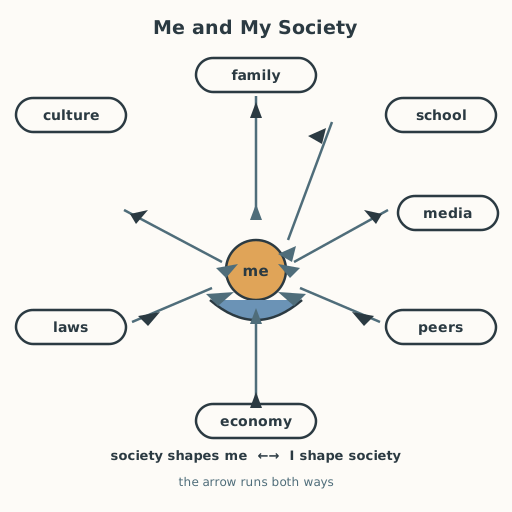
- Two-way influence map · 1 per learner A page with "me" at the center and surrounding nodes — family, school, media, culture, laws, economy, peers — each with an arrow in and an arrow out
- Identity-and-choice case cards · 1 set per group Short scenarios of a person whose choices both reflect and reshape their society (e.g., starting a study group, wearing a style, volunteering, choosing a career against expectations)
Low-tech / no-cost
- A circle drawn on the ground Stand in the middle as "me"; place labeled stones as the shaping forces; draw arrows in and out with a stick
- Voice and role-play Act out a shaping force (a law, an ad, a family rule) and the person's reply back to it
Enriched / lab & device
- A short news or social-media clip · 1 Age-appropriate, showing a person or group changing a norm — to analyze as "shaping back"
- Shared digital canvas · 1 per group Build the two-way map collaboratively and present it
Works in different contexts
- large-group Build one class map on the board, then small groups analyze different case cards and report back
- multi-age Younger learners name one force that shapes them; older learners trace the two-way arrow and the choices it opens or closes
- self-directed A learner fills the map for their own life and writes one paragraph on a choice that shaped their society back
- level-grouped Learners ready to extend analyze an institution (a school rule, a platform, a law) and propose one change they could push for
- outdoor-only Look at the built and natural world around you — a road, a market, a shared garden — and name how it shapes people and how people shaped it
Lesson 2 — Me and My Society: Shaped and Shaping
Summary
Learners analyze how a person’s identity is shaped by their society — family, schooling, media, culture, laws, the economy, and peers — and how that identity, in turn, shapes the choices they make and the society around them. They map the two-way influence in their own lives and in cases, and close by naming one choice through which they are already shaping their society back.
Objectives
- Analyze how a person’s identity is shaped by their society and, in turn, shapes their choices. (D01.S2.09.02)
Connection
No one becomes who they are alone. The language you speak, the food you grew up eating, the rules your school or family taught you, the ads and feeds you see, the laws that allow or block what you can do — all of these shape the person you are becoming. But the arrow does not point only one way. The very choices you make with that shaped self — what you study, what you refuse, who you stand with, what you make — bend the people and rules around you back. In a village, a city, or a migrant camp, in a classroom or online, you are both made by your world and a maker of it.
Materials
- Two-way influence map (“me” at center; surrounding nodes, each with an arrow in and an arrow out)
- Identity-and-choice case cards
Preparation
- Copy the two-way influence map and the case cards.
- Retrieval: from Lesson 1, recall the thread of your own story. Today we ask who or what pulled on that thread — and how you have pulled back.
Facilitator note
This lesson is written to the learner (“you”). The idea to land: identity is not a private possession but a two-way exchange — society shapes the self, and the self shapes its society back through the choices it makes. The shaping side is the classic insight of socialization: families, schools, media, laws, and the economy teach us what is normal, possible, and valued (CASEL’s “social awareness” names this ability to read those forces; S-001). The “shaping back” side is agency — and the heart of Erikson’s account of identity as an ongoing, lifelong process, never a finished fact (S-155). The group side draws on social identity: we take part of our sense of self from the groups we belong to, which is why belonging can be so powerful — for good and for exclusion (Tajfel’s minimal-group work; S-232). Hold the distinction carefully: the facts that societies shape people and people shape societies are documented; the values — that everyone deserves a fair chance to shape their world — is a commitment, not a measurement (philosophy §5).
The egalitarian lens is central: ask who gets shaped most and listened to least? — whose choices are widened and whose are narrowed by the same rules. The ethics lens: if society shapes me, how responsible am I for the society I shape back? The global lens: the shaping forces differ across cultures (some are shaped more by family and tradition, others by media and markets), but the two-way arrow is human everywhere — avoid any single culture as the “normal” case. The technology & environment lens: today the media, platforms, and built environments around us are among the most powerful shapers, and among the things learners can most readily shape back. End on agency, not determinism — a learner who sees the forces shaping them is more free, not less, because they can name and answer them (facilitation.md).
Procedure
- Recall (5 min). From your narrative map: who or what helped make you the person in the “present” column? Name two forces quietly to yourself.
- Meet the two-way map (8 min). Look at “me” in the center and the surrounding nodes: family, school, media, culture, laws and government, the economy and work, peers. For one node, watch a worked example: media shapes how a person sees success (arrow in); the same person, choosing to make and post honest, kind content, shapes what others see (arrow out). Society shapes me; I shape society.
- Map your own two-way influence (12 min). Fill the map for your own life. For each node, write one way it has shaped you, and one way your choices have reached back — a habit, a word, a stand, a thing you made or joined.
- Analyze cases (15 min). In a group, take the case cards. For each person: which forces shaped them, and which choices shaped their society back? Notice how the same force (a family rule, a law, a trend) can widen one person’s choices and narrow another’s.
- Reflect (10 min). Write one paragraph: name the force that has shaped you most, and one choice through which you are — or want to be — shaping your society back.
- Close (5 min). You are not only a product of your world; you are a producer of it. What will you shape?
Differentiation
- Support: Provide the map with two nodes pre-filled (arrows labeled “shapes me” and “I shape it”) and ask learners to complete one more.
- Extension: Analyze one institution — a school rule, a platform’s design, a law — and propose one concrete change a young person could realistically push for.
Assessment
- Formative (observation): Can the learner name a force that shaped them and a choice through which they shaped (or could shape) their society back?
- Portfolio artifact (summative for the unit): The completed two-way influence map and reflection paragraph, added to the year-end portfolio.
Home connection
Ask at home: what is one rule or habit of our household or neighborhood that shaped you — and one thing about it you have helped change? Notice the arrow running both ways in your own family.
Resources
- On reading social forces as part of self-awareness: CASEL, “Fundamentals of SEL,” https://casel.org/fundamentals-of-sel/ (S-001).
- On identity as a lifelong, ongoing process: Erikson (1950), Childhood and Society (S-155).
- On how group belonging shapes the self: Tajfel (1970), “Experiments in Intergroup Discrimination,” Scientific American (S-232).
- On explicit modeling + guided practice before independent work: Kirschner, Sweller & Clark (2006), https://doi.org/10.1207/s15326985ep4102_1 (S-011).