Lesson 01 — The History Under My Feelings
Learners trace how a chapter of their own personal history shapes the way they experience and name an emotion, building the "emotion is experienced through history" idea that opens the unit.
Objectives
Objectives
- D01.S1.10.01 Explain how personal history and culture shape the way a person experiences and names emotion.
Essential question
How does my personal history shape the way I experience and name emotion?
Key vocabulary
Materials
Standard materials
- Emotion-history map worksheet · 1 per learner A two-column organizer — a memory or life chapter on the left, the feeling and its name on the right — with a connecting line
- Writing journal · 1 per learner
- Something from the past (optional) · as available A photo, object, or song a learner chooses to stand for a chapter of their life
Low-tech / no-cost
- Paper folded into two columns, or lines drawn in the ground Divide a page (or a patch of soil) into "then" and "what I feel now"
- Voice and memory The map can be spoken and held in memory rather than written
Enriched / lab & device
- Digital slide or voice memo · 1 per learner Build the emotion-history map as a short audio or slide to add to a digital portfolio
- Shared timeline document · 1 per group A collaborative class "river of feeling" learners can contribute to
Works in different contexts
- large-group Model one whole-class example on the board, then learners map their own in pairs; share only in small circles of three to four
- multi-age Younger learners map one memory to one feeling; older learners connect several chapters and name a pattern
- self-directed A learner fills the map alone, then writes or records one paragraph linking a life chapter to a present feeling
- level-grouped Learners ready to extend name the *meaning* they made from the experience — not just the event and the feeling, but the sense they built from it
- outdoor-only Walk a short path and stop at two points — a "then" memory and the "now" feeling it shaped — then speak the link
Lesson 1 — The History Under My Feelings
Summary
Learners trace how a chapter of their own personal history shapes the way they experience and name an emotion. They build an emotion-history map — a memory or life chapter on one side, the feeling and its name on the other — and name the meaning they made from it. This opens the unit’s first big idea: emotion is not just a reaction to what is happening now; it is experienced through the history we carry.
Objectives
- Explain how personal history shapes the way a person experiences and names emotion. (D01.S1.10.01)
Connection
Two people can live through the same moment — a thunderstorm, a family move, a farewell — and feel it differently, because each carries a different past into it. The storm that frightens one person is the storm that soothes another who grew up falling asleep to rain on a roof. Whether you come from a busy city, a quiet farm, a coast, or a mountain town, your history is part of how you feel and which name you give the feeling. That is not a weakness in you; it is how every human heart works.
Materials
- Emotion-history map worksheet (two columns: a memory / life chapter, and the feeling with its name)
- Writing journal
- Something from the past (optional)
Preparation
- Copy or draw the emotion-history map worksheet.
- Retrieval: from earlier grades, recall the idea that feelings have triggers, thoughts, and body sensations. Today we add the layer above them all: history. Recall too that the same situation can make different people feel differently — today we explain why, partly, through history.
Facilitator note
This lesson is written to the learner (“you”). The idea to land: a feeling is not a bare event in the body; it is experienced and named through the personal history a person brings to it. That claim draws on the constructed-emotion account, which holds that emotion concepts are built from past experience, culture, and language (S-401), and on the broader emotional-literacy tradition that precise naming helps regulation (S-015). Both are descriptive theories, not verdicts: a learner’s feeling is real and valid whether or not they can trace its history, and “I can’t find the link yet” is a complete and honest answer. Do not rank lives; there is no “best” history to have had (philosophy §8, §11).
Model the skill once, then let learners practice (worked example → guided practice → independent work; S-011). The ethics lens: tracing history is about understanding, never about blaming someone in your past — the goal is agency over the present, not a verdict on the past. The global lens: every culture understands emotion through its own history and words; the “event → feeling” shape is one useful frame, not a universal law (S-401 is one account among many). The egalitarian lens: every learner’s history is worth mapping and hearing; no history is more “interesting” than another. The technology & environment lens: the feeds and devices around us often present emotion as an instant, sharable reaction — a like, a react emoji — while a feeling actually arrives carrying years of history; noticing that depth is a small act of resistance to the instant-and-forget pull of the feed. The social-emotional lens: recalling the past can raise real feeling — invite, never force, and let learners choose what to share (facilitation.md). Keep the tone gentle and forward-looking: the point is a learner who feels like the author of their own emotional life.
Procedure
- Recall (5 min). Think back: have you ever felt something strongly and a friend felt the same moment differently? You do not have to share aloud — just notice that two people can stand in the same rain and feel two different things.
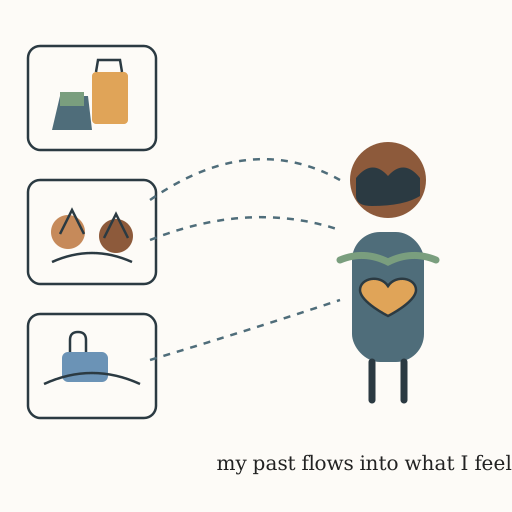
- Meet the map (8 min). Look at the two columns: a memory / life chapter and the feeling, with its name. Watch a worked example: then — a move to a new place and the fear of starting over; now — an unexpected clench in the chest when meeting new people, named “anxious, like being new again.” Notice the link: the past event is not just remembered; it is re-experienced inside the present feeling.
- Gather your chapters (15 min). Fill your own map. On the left, write two or three real moments, people, or places from your life. On the right, name the feeling each one tends to stir in you now. You may use a photo or object to stand for a chapter.
- Find the meaning (12 min). Read across a row and ask: what did I learn, or come to believe, from that experience — and how does it color what I feel now? Write one sentence of meaning for at least one row. If no meaning appears yet, write “still making sense of it” — that is honest, and it is enough.
- Draft (12 min). Write or record one short paragraph that moves from a life chapter to the feeling it shapes today, ending with the name you give that feeling now, in your own words.
- Close (3 min). Remember: your history is not a verdict on you. It is part of how you feel — and once you can see it, you can begin to choose how you respond to it.
Differentiation
- Support: Offer a one-row version with a sentence starter (“When ___ happened, I learned ___, and now I sometimes feel ___.”).
- Extension: Connect two chapters to the same feeling and explain how they reinforce each other, or name a feeling you experience that a friend would name differently.
Assessment
- Formative (self): Can the learner state, in one sentence, how a chapter of their history shapes a present feeling and the name they give it — even if the link is “still making sense of it”?
- Portfolio artifact (summative for the unit): The emotion-history map and the drafted paragraph, added to the unit portfolio as the “history under my feelings” reflection.
Home connection
Ask an older family member or trusted adult: what is one memory from your past that still shows up in how you feel today? Listen for the link between their then and their now. Then tell them one feeling of yours you can now trace to a chapter of your own life.
Resources
- On emotion concepts built from past experience, culture, and language: Barrett, How Emotions Are Made (2017), https://lisafeldmanbarrett.com/books/how-emotions-are-made/ (S-401).
- On labeling emotions with precision: the RULER approach, Yale Center for Emotional Intelligence, https://www.rulerapproach.org/ (S-015).
- On modeling + guided practice before independent work: Kirschner, Sweller & Clark (2006), https://doi.org/10.1207/s15326985ep4102_1 (S-011).