Lesson 02 — The Words My Culture Gave Me
Learners compare how different languages and cultures name emotion, discovering that the words a culture gives a person shape what they can notice, name, and value about their inner life.
Objectives
Objectives
- D01.S1.10.01 Explain how personal history and culture shape the way a person experiences and names emotion.
Essential question
How does culture shape the way a person names and values emotion?
Key vocabulary
Materials
Standard materials
- Emotion-word chart · 1 per pair A three-column table — the feeling, one culture's word for it, and what the word adds that a simple label misses
- Index cards or slips of paper · 1 set per group For writing and sorting emotion words from different languages
Low-tech / no-cost
- Spoken words and memory Learners share emotion words from their own home languages aloud; no cards needed
- A patch of ground or a big sheet of paper Draw the three columns together in the shared space
Enriched / lab & device
- Online dictionary or translation app · 1 per group To look up and compare emotion words across languages
- Audio clips of home-language emotion words · as available Learners record themselves saying a feeling word in their home language and its meaning
Works in different contexts
- large-group Collect home-language emotion words on a shared board, then sort in small groups; invite a few to share what a word adds
- multi-age Younger learners offer one home-language feeling word and what it means; older learners explain what the word adds that a plain label misses
- self-directed A learner gathers three emotion words from their own or another language and writes what each one adds
- level-grouped Learners ready to extend name a feeling their own language has no single word for, and describe it in several words
- outdoor-only Sit in a circle and pass a spoken feeling word around; each person adds what the word calls up for them
Lesson 2 — The Words My Culture Gave Me
Summary
Learners compare how different languages and cultures name emotion, discovering that the words a culture gives a person shape what they can notice, name, and value about their inner life. They meet the idea of emotional granularity — rich, precise emotion words — and the idea of display rules — what a culture says may be shown, hidden, or prized. They close by gathering emotion words from their own home languages.
Objectives
- Explain how culture shapes the way a person experiences and names emotion. (D01.S1.10.01)
Connection
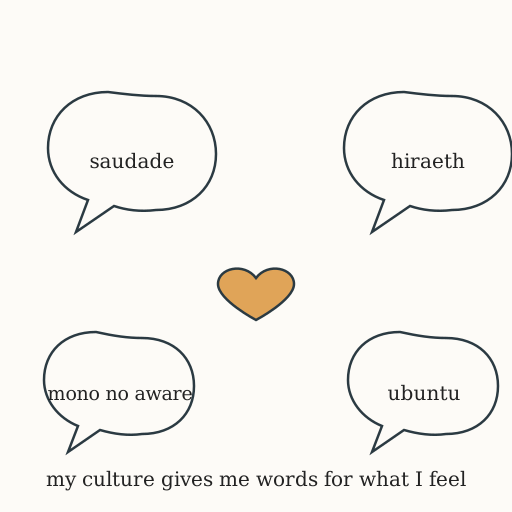
Some feelings are hard to put into words — until you meet a word from somewhere else that fits exactly. A Portuguese speaker has saudade, a deep, sweet longing for something absent; a Welsh speaker has hiraeth, a homesickness for a home that may no longer exist. The language you grew up in gives you some drawers for your feelings already open, and others you may not yet have a name for. Naming is not just labeling — it is seeing more clearly what you feel.
Materials
- Emotion-word chart (three columns: the feeling, one culture’s word, what the word adds)
- Index cards or slips of paper
Preparation
- Copy or draw the emotion-word chart.
- Retrieval: from Lesson 1, recall that personal history shapes how we feel. Today we add the second layer: culture — the shared words, norms, and values of the people around us — also shapes how we name and value feeling.
Facilitator note
This lesson is written to the learner (“you”). The ideas to land: (1) emotion words vary across languages and cultures, and a culture’s words shape what its members can easily notice and name; (2) precise emotion words (“emotional granularity”) are associated with finer-grained experience and better regulation. The first is a well-documented linguistic and anthropological fact; the second comes from the constructed-emotion literature, which holds that richer emotion vocabulary is associated with more differentiated experience and better regulation (S-401), and from the labeling tradition (S-015). Hold both as descriptions, not laws: a person with few emotion words still feels deeply, and no language is “richer” or “better” than another — each opens some doors and, like all languages, leaves others to be opened by words or gestures (philosophy §4, §11).
Model the skill once, then let learners practice (S-011). The global lens is the heart of this lesson: treat every home language as a bearer of dignity and wealth, and never rank one language’s feeling words above another’s (S-019 frames multilingualism this way). The egalitarian lens: a learner whose home language is not the school’s majority language is not “behind” — they carry a whole vocabulary of feeling others may not have. The ethics lens: naming another culture’s untranslatable word is an act of respect — pronounce it with care, credit its speakers, and never turn a living word into a specimen. The technology & environment lens: translation apps and feeds flatten feeling into a small set of emoji and “react” options, which can shrink the very granularity this lesson is building; notice both the gift and the flattening. The social-emotional lens: feelings about language and belonging can run deep — invite, never force, and let learners offer words only if they wish.
Procedure
- Recall (5 min). From Lesson 1: your history shapes how you feel. Today, meet the second shaper: your culture — the words, norms, and values of the people around you.
- Meet the word chart (10 min). Look at a worked example: saudade (Portuguese) — a deep, sweet longing for something or someone absent, more than “missing” and more than “sad.” Notice what the word adds: it names a feeling a single English word can only circle around. Now look at the other examples on the card set (such as hiraeth, mono no aware, ubuntu) and ask: what does each word let its speakers see?
- Gather home words (15 min). In a small group, share feeling words from your own home languages — or words you have heard older family members use. For each, write on a card: the word, the language, and what it names that a plain label misses. If you share no second language, describe a feeling you have no single word for.
- Name what your culture values (12 min). Talk together: in your family or community, which feelings are welcomed and shown, and which are hidden or discouraged? These are display rules. Notice that they are rules, not truths — and that knowing them is the first step to choosing which to keep.
- Draft (10 min). Write or record a few sentences: the words my culture gave me shape what I notice and name when I feel. Name one feeling you can now say more precisely.
- Close (3 min). Remember: your language is a treasure, and so is every other person’s. More words for feeling mean more ways to see yourself.
Differentiation
- Support: Offer a short list of example words with plain-language meanings, and a sentence starter (“In my family, we show ___, but we tend to hide ___.”).
- Extension: Compare two words from different languages for near-neighbor feelings (for example, envy vs. jealousy, or saudade vs. nostalgia) and explain the difference each word draws.
Assessment
- Formative (peer): In pairs, can each learner explain one feeling word — theirs or an example — and what it adds that a simple label misses?
- Portfolio artifact (summative for the unit): The emotion-word chart and the drafted reflection, added to the unit portfolio.
Home connection
Ask someone at home: what is a feeling word in our family’s language that has no exact translation — and what does it mean? Write it down with its meaning, and bring it to share if you wish.
Resources
- On emotion words and emotional granularity: Barrett, How Emotions Are Made (2017), https://lisafeldmanbarrett.com/books/how-emotions-are-made/ (S-401).
- On multilingualism as wealth and dignity: UNESCO International Mother Language Day, https://www.unesco.org/en/days/mother-language (S-019).
- On labeling emotions with precision: the RULER approach, https://www.rulerapproach.org/ (S-015).
- On modeling + guided practice: Kirschner, Sweller & Clark (2006), https://doi.org/10.1207/s15326985ep4102_1 (S-011).