Lesson 11 — Independent and Connected
Learners balance independence with knowing when and how to seek help. They sort situations into "try alone first" and "seek help now," practice the concrete how of asking, and see that healthy independence is not isolation but judgment.
Objectives
Objectives
- D01.S3.10.02 Balance independence with knowing when and how to seek help, and act on that judgment.
Essential question
How do I balance independence with knowing when and how to seek help?
Key vocabulary
Materials
Standard materials
- Try alone / seek help cards · 1 set per group Short scenarios; learners sort each into "try alone first," "seek help now," or "it depends — and here is how"
- Writing journal · 1 per learner
Low-tech / no-cost
- A two-sided sign and spoken scenarios Learners step to one side for "try alone" and the other for "seek help," then discuss the close calls
- Voice and memory The reflection can be spoken rather than written
Enriched / lab & device
- Device with a help resource (tutor, hotline, library, mentor list) · 1 per group To identify real, available help channels and practice choosing one
- Role-play scripts for asking for help · 1 per pair Practice the concrete how of asking — who, when, and what to say
Works in different contexts
- large-group Sort scenarios whole-class by moving to two sides of the room, then discuss the close calls and role-play the "how"
- multi-age Younger learners sort simple scenarios; older learners add "how" and "who" — the concrete ask
- self-directed A learner sorts the scenarios alone, then writes one paragraph on a real situation where they will need help and how they will ask
- level-grouped Learners ready to extend distinguish healthy independence from isolation, and map their own "help network"
- outdoor-only Use the two-sided sign and spoken scenarios in a circle outdoors; role-play the ask with a partner
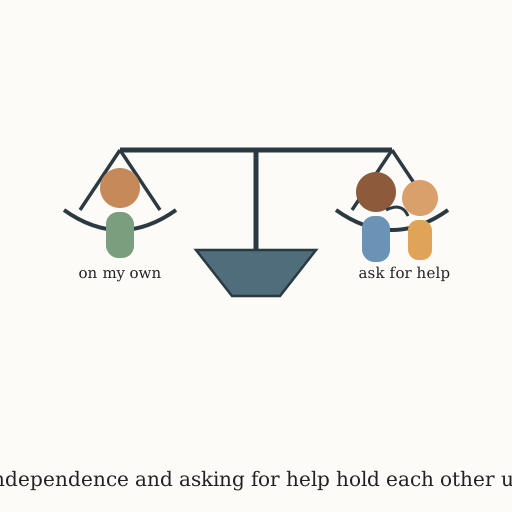
Lesson 11 — Independent and Connected
Summary
Learners balance independence with knowing when and how to seek help. They sort situations into “try alone first” and “seek help now”, practice the concrete how of asking — who, when, and what to say — and come to see that healthy independence is not isolation but judgment: the practiced skill of knowing which way the moment calls. This enacts D01.S3.10.02.
Objectives
- Balance independence with knowing when and how to seek help, and act on that judgment. (D01.S3.10.02)
Connection
There are two opposite ways to get stuck: to give up and ask for help before you have tried, and to refuse help until the small problem has grown huge. The skilled person walks between them — they try hard on their own, and they know the moment to reach out. A climber checks their own rope and calls to a partner before a risky move; a farmer works their own field and borrows a neighbor’s hands at harvest. Independence and asking for help are not enemies — they are two hands of the same capable person.
Materials
- Try alone / seek help cards (short scenarios to sort)
- Writing journal
Preparation
- Copy or draw the scenario cards.
- Retrieval: from Lesson 10, recall your self-directed learning plan. Today we add the skill that makes self-direction wise rather than lonely: knowing when and how to seek help.
Facilitator note
This lesson is written to the learner (“you”). The ideas to land: (1) seeking help is a skill, not a weakness — and knowing when to seek it is part of mature independence; (2) the skill has concrete parts: try alone first, recognize the limit, choose who to ask, and ask clearly; (3) refusing help when it is needed is not strength but a different kind of getting stuck. The evidence: mastery/feedback loops and relationships are among the strongest learning levers (S-007, S-012), and asking for help is how a self-directed learner gets feedback — so help-seeking is continuous with Lesson 10, not opposed to it. The “try alone first” instinct is honored; the point is joint judgment, not endless independence (philosophy §6, §8).
Model the skill once, then let learners practice (S-011). The ethics lens: asking for help is also an act of fairness to oneself and to the task — pretending you don’t need help can waste others’ time and your own. The egalitarian lens: not everyone has been taught that it is safe or normal to ask; make asking ordinary and honored in this space, and notice that some learners have fewer people to ask — which is why we build a community help network, not just a private one. The global lens: cultures differ in how asking is valued — in some, asking is a sign of humility and belonging; in others, of weakness — and neither is the “true” one; the skill is to read the room and still get what you need. The technology & environment lens: a help channel can be a person, a library, a mentor, a hotline, or a trusted online source — name the real channels available to you, and remember that not every online answer is trustworthy (recall evaluating sources). The social-emotional lens: asking can feel vulnerable; practice lowers the fear. Watch for learners who are quietly drowning rather than asking — the facilitator’s own invitation to ask is part of the lesson. Keep “I don’t have anyone to ask” a solvable problem to build toward, never a verdict.
Procedure
- Recall (5 min). Think of a time you needed help and either asked too late or didn’t ask at all. Notice the cost of the delay — no blame, just noticing.
- Meet the balance (10 min). Learn the frame: try alone first means giving your own best effort and your own judgment a real chance; seek help now means recognizing a limit — danger, stuckness, or a task too big for one person — and reaching out. Watch a worked example: a math problem (try alone first — reread, try a second way) versus a sign of real harm in a friend (seek help now — a trusted adult, today).
- Sort the scenarios (15 min). In a group, sort the cards into “try alone first,” “seek help now,” and “it depends.” Discuss the close calls — and for each “seek help now,” name who you would ask and what you would say.
- Practice the ask (12 min). In pairs, role-play one “seek help” scenario. Use a clear three-part ask: what I need, what I have already tried, and one specific question. Swap roles and try again — the point is practice, not performance.
- Map your network (8 min). Write down two or three people or places you could actually ask — a family member, a teacher, a mentor, a library, a helpline — and one thing each is good for.
- Close (3 min). Remember: the person who can do it alone and knows when to reach out is the strongest person in the room. Independence and help are two hands of the same capable person — you.
Differentiation
- Support: Offer a two-scenario sort with clear answers and a three-part ask sentence starter (“I need ___, I’ve tried ___, could you help me with ___?”).
- Extension: Distinguish healthy independence from isolation, and write one situation where asking early would have been the stronger move — and why.
Assessment
- Formative (peer): Can each learner sort the scenarios and, for one “seek help now” case, name who they would ask and give a clear three-part ask?
- Portfolio artifact (summative for the unit): The help-network map and a one-line reflection, added to the unit portfolio.
Home connection
Ask a trusted adult: when was a time asking for help made you stronger, not weaker? Then name one person or place on your help network to them.
Resources
- On relationships and feedback as strong learning levers: Hattie, Visible Learning (2008) (S-012); Bloom (1984), “The 2 Sigma Problem,” https://en.wikipedia.org/wiki/Bloom%27s_2_sigma_problem (S-007).
- On modeling + guided practice: Kirschner, Sweller & Clark (2006), https://doi.org/10.1207/s15326985ep4102_1 (S-011).