Lesson 12 — Acting on My Judgment
Learners turn their self-directed learning plan and help-seeking judgment into action: they take a first step, run a progress check, seek or withhold help on purpose, and gather the unit's artifacts into a portfolio — closing the unit by acting on their own judgment.
Objectives
Objectives
- D01.S3.10.01 Direct their own learning by choosing goals, resources, and ways to check their own progress.
- D01.S3.10.02 Balance independence with knowing when and how to seek help, and act on that judgment.
Essential question
How do I turn my self-directed plan and my help-seeking judgment into action — and gather what I have learned?
Key vocabulary
Materials
Standard materials
- Unit portfolio checklist · 1 per learner A list of the unit's artifacts — emotion-history map, emotion-word chart, comparison log, empathy note, contagion map, identity map, comparison chart, labels worksheet, considered position, learning plan, help network — to gather and reflect on
- Action log · 1 per learner A simple record — the goal step I took, the progress check I ran, the help I sought or chose not to seek, and what I learned
- Writing journal · 1 per learner
Low-tech / no-cost
- Paper and pencil Draw the checklist and action log by hand
- Voice and memory The gathering and reflection can be spoken and remembered
Enriched / lab & device
- Digital portfolio folder · 1 per learner Assemble the unit's artifacts in a shareable digital folder or slide deck
- Device for a peer-review exchange · 1 per group To give and receive a kind, useful comment on one artifact
Works in different contexts
- large-group Run the portfolio gathering as a whole-class checklist, then small circles share one artifact and one next step each
- multi-age Younger learners gather three artifacts and state one next step; older learners gather all artifacts and connect them to their considered position
- self-directed A learner completes the checklist and action log alone, then writes a closing reflection on the unit's thread
- level-grouped Learners ready to extend write the unit's thread in one paragraph — how feeling, identity, and purpose now connect for them
- outdoor-only Gather the artifacts and walk a closing circle, each learner speaking one artifact and one next step
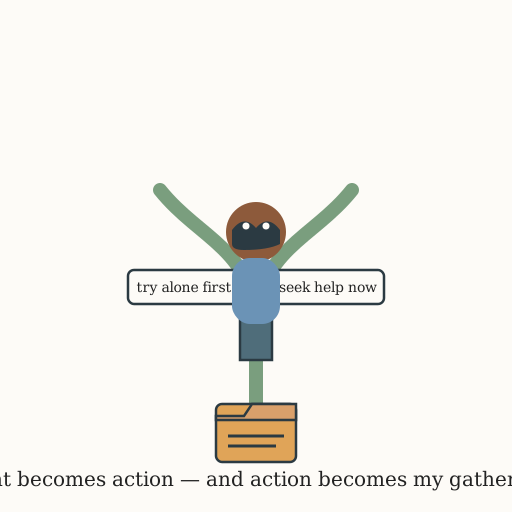
Lesson 12 — Acting on My Judgment
Summary
Learners turn their self-directed learning plan and help-seeking judgment into action. They take a first step, run a progress check, seek or withhold help on purpose, and gather the unit’s artifacts into a portfolio — closing the unit by acting on their own judgment and seeing the whole arc: feeling, identity, and purpose as one authored life. This completes D01.S3.10.01 and D01.S3.10.02.
Objectives
- Direct their own learning by choosing goals, resources, and ways to check their own progress. (D01.S3.10.01)
- Balance independence with knowing when and how to seek help, and act on that judgment. (D01.S3.10.02)
Connection
A plan is only a promise until the first step is taken. This lesson is the step. You will do the thing you planned — even a small piece of it — then stop and look: did it work? what did the check show? do I keep going alone, or reach out? That stop-and-look moment, repeated, is what turns a learner into an author: not someone who follows a path, but someone who walks, watches, and adjusts. And the work you gather along the way is the proof — to yourself — that you have been writing your own story all along.
Materials
- Unit portfolio checklist
- Action log (goal step, progress check, help sought or withheld, what I learned)
- Writing journal
Preparation
- Copy or draw the checklist and action log.
- Retrieval: gather the unit’s artifacts from Lessons 1–11 — the emotion-history map, the emotion-word chart, the comparison log, the empathy note, the contagion map, the identity map, the comparison chart, the labels worksheet, the considered position, the learning plan, and the help network. Today we act and gather.
Facilitator note
This lesson is written to the learner (“you”). The idea to land: judgment is only real when it becomes action — and the unit closes by acting (taking a step, checking progress, seeking help on purpose) and by gathering the evidence into a portfolio. This is the unit’s summative moment: a portfolio that shows growth through the learner’s own explanations and artifacts, not a score (philosophy §8; the scope’s “no high-stakes tests” commitment). The science-of-learning through-line: spaced retrieval — gathering and re-reading one’s own work across the unit — deepens learning (S-039).
Model the action-log entry once, then let learners practice (S-011). The intellectual lens: this is metacognition closed into a loop — plan, act, check, adjust — now performed, not just described. The ethics lens: acting on judgment includes honesty in the check — reporting what really happened, not what you wished. The egalitarian lens: a portfolio of your own work is the great equalizer — it measures growth, not rank, and every learner’s gathered work is worthy of celebration. The global lens: gathering one’s own work as evidence of learning is a practice with cousins everywhere — the apprentice’s finished piece, the healer’s recorded cases, the storyteller’s remembered stories — all ways humans have long kept the proof of their becoming. The technology & environment lens: a portfolio can live on paper or on screen; choose the medium that serves your keeping and sharing, and notice that what we preserve — and what we let go — is itself a judgment. The social-emotional lens: this is a moment of pride and sometimes of uncertainty (“is this enough?”). The answer is yes: growth, not perfection, is the measure, and every artifact here is evidence of a person authoring their own life. Celebrate each learner, not by ranking, but by honoring the work.
Procedure
- Recall (5 min). Look back over the unit: you traced the history under your feelings, named the words your culture gave you, saw through the mirror in your pocket, examined who told you who you are, wrote your considered position, and built your own learning plan. Today you act on it — and gather it all.
- Take the first step (15 min). From your learning plan, do one real, small step now — read the first page, ask the first question, practice the first five minutes. If your step needs a person or place not here, write the exact step and the time you will take it.
- Run the check (12 min). Use your action log. Record the step you took, then run the progress check you planned: what can you now do or show that you could not before? Be honest — a small real gain beats a large imagined one.
- Choose: alone or help (10 min). Based on the check, make the judgment: do I keep going alone, or seek help? If help, write who and what you will ask (your three-part ask from Lesson 11). If alone, write the next step. Either way, you are acting on judgment — that is the skill.
- Gather the portfolio (10 min). Use the checklist to assemble the unit’s artifacts in order. On a cover page or first slide, write one sentence that threads them together: this is the work of someone learning to author their own life.
- Close (3 min). Look at what you have gathered. This is not a pile of papers — it is the record of you, doing the work of becoming. You did that.
Differentiation
- Support: Offer a three-artifact checklist and a sentence starter for the thread (“This unit, I learned to ___ and ___.”).
- Extension: Write the unit’s thread in one paragraph — how feeling, identity, and purpose now connect for you — and name one thing you will carry into the next unit.
Assessment
- Summative (portfolio): The assembled unit portfolio — all artifacts plus the action log and the one-sentence thread — as the unit’s closing evidence of growth.
- Formative (peer): In a small circle, each learner shares one artifact and one next step, and receives one kind, useful comment.
Home connection
Share your portfolio with a trusted adult — not for a grade, but for the telling. Tell them the thread: what this unit taught you about being the author of your own life.
Resources
- On spaced retrieval deepening learning: Dunlosky et al. (2013), https://doi.org/10.1177/1529100612453266 (S-039).
- On mastery and feedback: Bloom (1984), “The 2 Sigma Problem,” https://en.wikipedia.org/wiki/Bloom%27s_2_sigma_problem (S-007).
- On modeling + guided practice: Kirschner, Sweller & Clark (2006), https://doi.org/10.1207/s15326985ep4102_1 (S-011).