Lesson 01 — The Body Under Chronic Stress
Learners distinguish the acute stress response — a useful alarm — from chronic stress, an alarm that never turns off and slowly wears on mood, thinking, and long-term health. They trace the physiology and close with a body-based calm-down.
Objectives
Objectives
- D03.S1.10.01 Analyze how chronic stress, sleep, and movement shape mood, thinking, and long-term health.
Essential question
What is chronic stress, and what does it do to my mood, my thinking, and my long-term health?
Key vocabulary
Materials
Standard materials
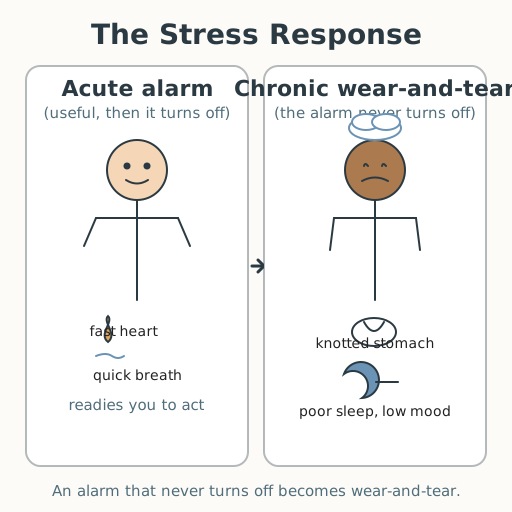
- Stress-response diagram · 1 per learner or projected A two-panel visual — the acute alarm (fast heartbeat, tense muscles) and the chronic wear-and-tear (sleeplessness, low mood, tension)
- Writing journal · 1 per learner
Low-tech / no-cost
- Paper folded into two columns, or lines drawn in the ground One side "alarm that passes," the other "alarm that stays on"
- Voice and body Act out the acute response (quick breath, tensed shoulders) and the calm return, so the idea lives in the body
Enriched / lab & device
- Short physiology video clip · 1 per class An age-appropriate clip showing the nervous system's alarm and calm branches
- Heart-rate or breathing app (optional) · 1 per pair To notice the body shift from arousal to calm during the closing practice
Works in different contexts
- large-group Model the two-panel diagram whole-class, then learners fill their own; share only in small circles of three to four
- multi-age Younger learners name one stress signal and one calm-down; older learners trace the full acute-to-chronic pathway and name an allostatic-load example
- self-directed A learner fills the diagram alone and writes one paragraph linking a chronic stressor to a body or mood signal
- level-grouped Learners ready to extend connect the physiology to the concept of allostatic load and to sleep's role (previewing Lesson 2)
- outdoor-only Walk a short path; at two stops, notice a body signal of alert and then practice one slow breath to feel the shift toward calm
Lesson 1 — The Body Under Chronic Stress
Summary
Learners distinguish acute stress — a useful alarm that readies the body for a challenge and then turns off — from chronic stress, an alarm that stays on and slowly wears on mood, thinking, and long-term health. They trace the physiology (sympathetic “alarm” and parasympathetic “calm” branches) and close with a body-based calm-down: slow breathing and a tense-and-release practice.
Objectives
- Analyze how chronic stress, sleep, and movement shape mood, thinking, and long-term health — beginning with the stress side of the picture. (D03.S1.10.01)
Connection
Think of a moment you had to act fast — a sudden noise, a near miss, a big test announcement. Your heart sped, your muscles tensed, your attention narrowed. That is your body’s alarm system, and it is a good thing: it got you ready. The problem is when the alarm never turns off — when the pressure of bills, exams, caregiving, housing, or a hard home never lets up. Then the same system that was meant to save you for a moment begins to wear on you for months. Whether you live in a busy city, a quiet farm, a coast, or a mountain town, every human body runs this same alarm — and every body can learn to help it settle.
Materials
- Stress-response diagram (acute alarm vs. chronic wear-and-tear)
- Writing journal
Preparation
- Copy or draw the stress-response diagram.
- Retrieval: from Grade 9, recall the somatic basis of emotion — that body state shapes mood and thinking (D03.S1.09.01). Today we go one layer deeper: what happens when the body’s stress state never turns off.
- Preview the closing calm-down practice so you can lead it smoothly.
Facilitator note
This lesson is written to the learner (“you”). The idea to land: stress is a physiological alarm, and the harm is not in feeling it once but in never turning it off — the “wear-and-tear” of chronic stress. The physiology is well documented: an acute stressor activates the sympathetic branch (fast heart, adrenaline/cortisol, tensed muscles), and the parasympathetic branch returns the body to calm; when the response stays on, the costs accumulate as muscle tension, cardiovascular strain, digestive and sleep disruption, and mood effects (S-338, S-339). Slow, deliberate breathing — especially a longer exhale — is one evidence-backed way to help the body return to calm (S-340), and tense-and-release practice has been used for a century to do the same (S-227). Present these as descriptive science, not as a verdict: feeling stressed is a real signal, never a personal failing.
Model the skill once, then let learners practice (worked example → guided practice → independent work; S-011). The ethics lens: the goal is understanding and agency, never blame — a learner under chronic stress is not “doing it wrong.” The egalitarian lens: stress is not distributed fairly — poverty, displacement, discrimination, and unsafe conditions impose chronic stress on whole communities, so stress is a justice question as much as a personal one. The global lens: every culture has both words for distress and ways of settling the body; the science here is one account among many, and the calm-down we practice draws on breathing traditions held side by side with respect (S-340). The technology & environment lens: our environments and devices can keep the alarm ringing — constant notifications, a never-ending feed, an always-on world — and noticing that is part of the analysis. The social-emotional lens: this topic can touch real hardship; invite, never force, and let learners choose what to share. Keep the tone gentle and forward-looking: the point is a learner who feels they can do something for their own body.
Procedure
- Recall (5 min). Think back to Grade 9: a feeling has a home in the body — worry can knot a stomach, joy can lift a chest. Notice: that is the body and mind talking to each other. Today we ask what happens when the body’s alarm stays on too long.
- Meet the alarm (10 min). Look at the two-panel diagram. On the left, the acute alarm: a fast heart, quick breath, tensed muscles, narrowed attention — the body getting you ready to act. On the right, the chronic wear-and-tear: the same alarm, but it never turns off — clouded mood, tired eyes, a knotted stomach, trouble sleeping. Learn the two branches: the sympathetic branch rings the alarm; the parasympathetic branch settles the body again (S-338, S-339).
- Feel it in your body (8 min). Watch a worked example, then try it. Sit still and quietly notice: where is your body carrying tension right now — shoulders, jaw, hands, stomach? Now take one slow breath in through the nose, and a longer, slower breath out through the mouth. Notice the tiny shift toward calm on the exhale (S-340).
- Trace acute to chronic (12 min). In your journal, list two or three real stressors in your life. Mark each: is it a passing alarm (an exam, a race, a performance — it fires, then fades) or a staying alarm (something that presses for weeks or months)? Write one sentence about how a staying alarm shows up in your body or mood — tension, tiredness, low mood, a racing mind.
- Practice settling (12 min). Learn a tense-and-release: squeeze your hands into fists as you breathe in, hold for a count, then let go completely as you breathe out (S-227). Move through two or three spots — hands, shoulders, jaw — letting each one soften. Notice the contrast between “on” and “off.”
- Draft (5 min). Write or record one sentence: stress is a useful alarm; the harm is when it never turns off — here is one thing I can do to help my body settle.
- Close (3 min). Remember: you are not failing when you feel stressed. You are a body with an alarm system — and you are learning, slowly, to help it rest.
Differentiation
- Support: Offer a one-signal version (“one thing that alarms me, one thing that calms me”) with a sentence starter.
- Extension: Explain, in your own words, how an alarm that never turns off could gradually affect sleep and mood — and preview what you already know about sleep.
Assessment
- Formative (self): Can the learner name the difference between acute and chronic stress and give one body signal and one calm-down?
- Portfolio artifact (summative for the unit): The acute-to-chronic journal entry, added to the unit portfolio as the “body under chronic stress” reflection.
Home connection
Ask an adult you trust: what is one thing in your life that has been a “staying” pressure, and what helps you settle your body when it builds up? Listen for their calm-down. Then try one slow exhale together.
Resources
- On the stress response and the costs of chronic stress: American Psychological Association, “Stress effects on the body,” https://www.apa.org/topics/stress/body (S-338).
- On fight-flight-freeze and the parasympathetic return to calm: Cleveland Clinic, “What Happens During the Fight-or-Flight Response,” https://health.clevelandclinic.org/what-happens-to-your-body-during-the-fight-or-flight-response (S-339).
- On breath control as a way to quell the stress response: Harvard Health, “Relaxation techniques: Breath control helps quell errant stress response,” https://www.health.harvard.edu/mind-and-mood/relaxation-techniques-breath-control-helps-quell-errant-stress-response (S-340).
- On tense-and-release practice: Jacobson (1929), Progressive Relaxation, University of Chicago Press (S-227).
- On modeling + guided practice before independent work: Kirschner, Sweller & Clark (2006), https://doi.org/10.1207/s15326985ep4102_1 (S-011).