Lesson 02 — Sleep: The Brain's Night Shift
Learners explore what sleep does for mood and thinking — consolidating memory, regulating emotion, and restoring the body — and meet the teen sleep-need range of about 8–10 hours. They map their own night against the sleep cycle and design one small, dignified sleep-hygiene change.
Objectives
Objectives
- D03.S1.10.01 Analyze how chronic stress, sleep, and movement shape mood, thinking, and long-term health.
Essential question
What does sleep do for my mood and my thinking, and how much do I actually need?
Key vocabulary
Materials
Standard materials
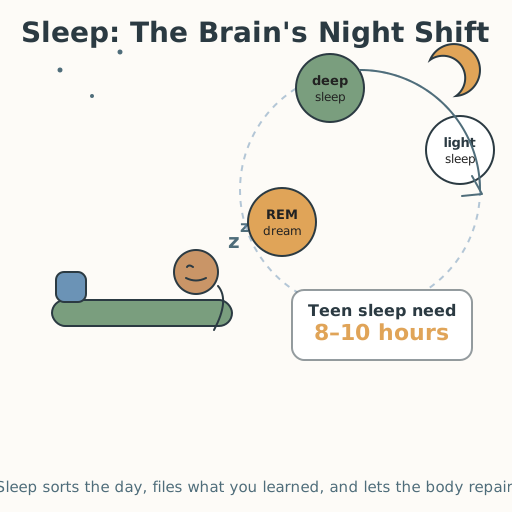
- Sleep-need and cycle diagram · 1 per learner or projected A simple chart of the sleep cycle (light → deep → REM) and the teen sleep-need range (8–10 hours)
- Writing journal · 1 per learner
Low-tech / no-cost
- Paper timeline of one night Draw the hours of a night across a page and shade the deep-sleep and dream stretches
- Voice and body Walk the "cycle" across the room — light, deep, dream, repeat — to feel the rhythm
Enriched / lab & device
- Sleep-tracking app or chart (optional) · 1 per learner For a learner who wishes, a week of sleep tracking to compare against their own energy and focus
- Short clip on sleep and memory · 1 per class An age-appropriate look at how sleep consolidates learning
Works in different contexts
- large-group Project the cycle and the 8–10 hour range, then learners map their own night; share in small circles
- multi-age Younger learners name what helps them sleep; older learners analyze their own sleep debt and design one hygiene change
- self-directed A learner maps their own night against the cycle and writes one paragraph linking sleep to their focus or mood
- level-grouped Learners ready to extend explain memory consolidation and connect sleep loss to Lesson 1's chronic-stress picture
- outdoor-only Notice the day–night rhythm directly — light, temperature, and activity across a day — and talk about how they signal the body to sleep
Lesson 2 — Sleep: The Brain’s Night Shift
Summary
Learners explore what sleep does for mood and thinking — it consolidates memory, helps regulate emotion, and restores the body — and meet the teen sleep-need range of about 8–10 hours per night (S-050). They map their own night against the sleep cycle and design one small, dignified sleep-hygiene change.
Objectives
- Analyze how chronic stress, sleep, and movement shape mood, thinking, and long-term health — focusing on the sleep side. (D03.S1.10.01)
Connection
Every animal sleeps — birds on a wire, fish drifting in the current, humans in beds and mats and hammocks across the world. Sleep is not laziness and not lost time; it is the brain’s night shift, the hours when it sorts the day, files what you learned, and lets your body repair. When you cut it short — for homework, a feed that never ends, a job, or a restless home — you borrow against yourself, and the interest shows up in your mood, your memory, and your health. Whether your night is quiet or noisy, long or interrupted, understanding what sleep is for is the first step to protecting it.
Materials
- Sleep-need and cycle diagram (light → deep → REM; 8–10 hours)
- Writing journal
Preparation
- Copy or draw the sleep-cycle diagram.
- Retrieval: from Lesson 1, recall the two branches of the nervous system — the alarm and the calm. Sleep is one of the body’s most powerful “calm” states; today we see what it does.
- Preview the sleep-hygiene change so you can model one.
Facilitator note
This lesson is written to the learner (“you”). The idea to land: sleep is an active state that consolidates memory, regulates mood, and restores the body — and teens need about 8–10 hours a night (S-050). The 8–10 hour figure is the standard international benchmark for adolescents (13–18 years) from the American Academy of Sleep Medicine consensus (S-050); hold it as a general guide, not a rule — family life, work, caregiving, and living conditions all shape real sleep, and no learner should be shamed for a short night. For the memory-consolidation and mood-regulation claims, speak accurately and with hedging: sleep researchers have found that during deep sleep and REM the brain strengthens and sorts what was learned, and that short sleep is linked to lower mood and poorer focus — these are general, well-replicated findings, offered as description, not as a score on any learner.
Model once, then let learners practice (S-011). The egalitarian lens: sleep is not distributed equally — shift work, crowded housing, light and noise, and caregiving responsibilities all cut into sleep, and those burdens fall unevenly, so sleep is a fairness question as well as a personal habit. The global lens: people sleep differently everywhere — some in one long night, some with a midday rest, some in shared rooms — and no pattern is more “correct” than another. The technology & environment lens: screens, light, and the always-on feed are among the loudest thieves of sleep; noticing them is part of the analysis. The ethics lens: the goal is agency and dignity, never blame — a tired learner is not failing. The social-emotional lens: sleep and mood are tightly linked; invite, never force sharing, and hold this gently. Preview the retrieval pass: this lesson will be recalled in Lessons 4 and 11.
Procedure
- Recall (5 min). From Lesson 1: the body has an alarm branch and a calm branch. Notice that sleep is the deepest, most natural “calm” the body knows. Ask yourself: how many hours did I actually sleep last night?
- Meet the night shift (10 min). Look at the diagram. Sleep is not one flat state; it cycles — light sleep, then deep sleep (when the body repairs and the brain files facts), then REM (rapid-eye-movement, when we dream and the brain sorts emotion) — and the cycle repeats through the night (S-050 for the need range; the cycle is the standard, well-established picture). Notice the band at the bottom: teens need about 8–10 hours.
- Map your night (12 min). Draw a timeline of last night. Shade in roughly when you fell asleep, when you woke, and any waking in between. Compare your total against the 8–10 hour band. Do this without judging yourself — it is information, not a grade.
- Follow the links (12 min). Learn the two links. Memory: during deep sleep and REM the brain strengthens what you learned that day — sleep is when studying “settles in.” Mood: short sleep is linked to lower mood, irritability, and poorer focus. In your journal, write one sentence about how your focus or mood tends to go when you sleep too little.
- Design one change (10 min). Choose one small, dignified sleep-hygiene step you could actually take: a steadier bedtime, a screen-free half hour before bed, dimmer light, a cooler room, less late caffeine, a quiet wind-down. Pick one that fits your life — not an idealized one.
- Close (3 min). Remember: sleep is not lost time; it is the night shift your brain works for you. Protecting it, even a little, is an act of care for yourself.
Differentiation
- Support: Offer a simplified night map (asleep → woke) and a menu of two hygiene options to choose from.
- Extension: Explain, in your own words, how cutting sleep could interact with chronic stress (Lesson 1) to weigh on mood — and name the most realistic change you could make.
Assessment
- Formative (self): Can the learner state the teen sleep-need range, one thing sleep does for the brain, and one hygiene change that fits their life?
- Portfolio artifact (summative for the unit): The night-map and one-change plan, added to the unit portfolio as the “sleep: the brain’s night shift” reflection.
Home connection
Ask an adult you trust: what was sleep like when you were my age — and what is one thing you do now to protect your sleep? Listen, then share the one change you chose.
Resources
- On recommended sleep duration for adolescents (8–10 hours, ages 13–18): American Academy of Sleep Medicine consensus statement (Paruthi et al., 2016), https://aasm.org/resources/pdf/pediatricsleepdurationconsensus.pdf (S-050).
- On modeling + guided practice: Kirschner, Sweller & Clark (2006), https://doi.org/10.1207/s15326985ep4102_1 (S-011).