Lesson 09 — Tech in My Pocket: Help or Distortion?
Learners evaluate fitness trackers and apps with a critical eye: what they measure and miss, how they motivate, and how they can support or distort a healthy relationship with movement and the body. They draw their own line between help and distortion.
Objectives
Objectives
- D03.S2.10.02 Evaluate how technology, such as fitness trackers and apps, supports or distorts a healthy relationship with movement and the body.
Essential question
How do fitness trackers and apps support — or distort — a healthy relationship with movement and my body?
Key vocabulary
Materials
Standard materials
- Help-or-distortion two-column sheet · 1 per learner A two-column organizer — "how this tech can help" on one side, "how it can distort" on the other — for evaluating a tracker or app
- Writing journal · 1 per learner
Low-tech / no-cost
- Paper folded into two columns List helps and distortions without any device at hand
- Voice and discussion Debate the tracker question aloud in pairs or a circle
Enriched / lab & device
- A real tracker, smartwatch, or fitness app (optional) · 1 per group To examine its features, prompts, and numbers directly
- Review or privacy summary of one popular app · 1 per pair To evaluate how the app measures, motivates, and monetizes
Works in different contexts
- large-group Model one feature as help and one as distortion on the board, then learners evaluate their own; share in small circles
- multi-age Younger learners name one good and one tricky thing about trackers; older learners evaluate accuracy, gamification, and body-image risk
- self-directed A learner evaluates one app or tracker alone and writes a paragraph on where the line between help and distortion falls for them
- level-grouped Learners ready to extend analyze how design (streaks, goals, comparisons) can nudge behavior for good or ill
- outdoor-only Compare a tracker's numbers against a real walk — notice what the device counts and what it silently leaves out (joy, fresh air, company)
Lesson 9 — Tech in My Pocket: Help or Distortion?
Summary
Learners evaluate fitness trackers and apps with a critical eye: what they measure and miss, how they motivate, and how the same tool can support or distort a healthy relationship with movement and the body. They draw their own line between help and distortion, grounded in what healthy movement actually is.
Objectives
- Evaluate how technology, such as fitness trackers and apps, supports or distorts a healthy relationship with movement and the body. (D03.S2.10.02)
Connection
A device on your wrist now counts your steps, scores your sleep, and reminds you to move — and millions of people wear one, hoping it will make them healthier. Sometimes it does: a nudge to walk, a record of progress, a little encouragement. Sometimes it strains: a red ring of “not enough,” a broken streak that stings, a number that becomes a judgment on your worth. The tool is not good or bad on its own — it is a mirror with a shape, and the shape matters. Whether you live with a screen in your pocket or none at all, learning to read these tools is a skill you will use for the rest of your life, because the question is never just about the tracker — it is about who decides what your body is for.
Materials
- Help-or-distortion two-column sheet
- Writing journal
Preparation
- Copy or draw the two-column sheet.
- Retrieval: from Lesson 3, recall what healthy movement actually is — aerobic plus muscle-strengthening activity, done with joy and recovery (S-341); and from Lesson 7, the principles of progressive effort and recovery. Today we ask: does the tech in my pocket serve that picture, or distort it?
- Prepare one worked example of a feature as help and one as distortion.
Facilitator note
This lesson is written to the learner (“you”). The idea to land: a fitness tracker or app is a tool that can support or distort a healthy relationship with movement and the body — and the learner can evaluate which, feature by feature, against what healthy movement actually is. The anchor for “healthy” is the WHO picture of balanced activity (S-341); the cautionary anchor is the well-documented reality that media and technology can shape body image and self-worth (S-226 documents the research program on media and tech’s impact on adolescent development; S-411 documents how media and social messages shape body image). Hold the specific claims about trackers honestly and with hedging: the research on wearables is real but mixed and maturing — devices can help some people build consistent habits, while their step counts, calorie estimates, and sleep scores are only approximate, and their streaks and comparisons can feed anxiety and negative body image for others. Present these as tendencies to evaluate, not as a verdict that “trackers are bad.”
The technology lens is the spine: read the tool as a designed object — every prompt, streak, and score was chosen by someone to shape behavior, sometimes helpfully, sometimes for engagement or profit. The critical-thinking lens: ask what does it measure, what does it miss, and how accurate is it? — a step count is not a life, and a calorie number is an estimate, not a fact. The ethics lens: is the tool nudging me toward care or toward shame? Tools that punish with “you’re behind” deserve the same scrutiny as tools that encourage. The egalitarian lens: trackers are not equally available or equally fair — they assume a wrist, a phone, a budget, and a body that can step — and their “norms” (10,000 steps, closing rings) are not universal truths, just targets someone set. The social-emotional lens: numbers about our bodies can sting; invite, never force, and let learners share only what they choose. Preview: the same “claim vs. evidence” eye returns for diets in Lesson 10.
Procedure
- Recall (5 min). From Lesson 3, what is healthy movement? (Aerobic plus muscle-strengthening activity, with joy and recovery.) From Lesson 7, progress comes from small steps plus rest. Hold that picture up — today we test the tech against it.
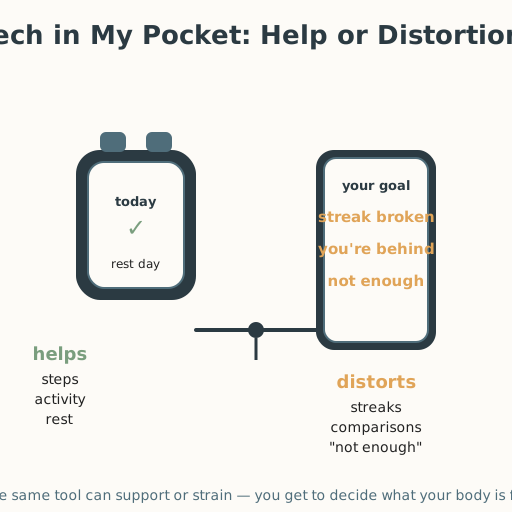
- Meet the two sides (10 min). Look at the two-column sheet. Watch a worked example: a tracker that helps — it reminds you to move, records a walk, cheers a rest day as part of the plan. A tracker that distorts — it breaks your streak with a red “you failed,” compares you to strangers, and turns a number into a verdict on your body. Notice: the same tool can do both.
- Examine a real tool (15 min). Choose a tracker, smartwatch, or fitness app you know — or imagine one. List its features in the two columns: which ones serve your healthy movement (nudges, records, rest), and which ones strain it (streaks, comparisons, “not enough” scores, calorie guilt)? Be specific.
- Ask the sharp questions (10 min). For each feature, ask: what does it measure, and what does it miss? (A step count misses a swim, a wheelchair push, a dance, a quiet stretch.) How accurate is it? (Step counts and calorie burns are estimates.) Who set this target, and for whom? (10,000 steps is a marketing number, not a medical truth.)
- Draw your line (10 min). In your journal, write: here is where this tool helps me, and here is where I will not let it drive. Name one way you would use it wisely — or one reason you would leave it off.
- Close (5 min). Remember: the tool is a mirror with a shape. You get to decide what your body is for — and no streak, ring, or number outranks that.
Differentiation
- Support: Offer a short feature list to sort into “helps” and “strains,” and a sentence starter (“This tool helps me when ___, but I will not let it ___.”).
- Extension: Analyze why a designer built a streak or comparison feature (engagement? profit? care?) and argue what a caring design would do differently.
Assessment
- Formative (self): Can the learner name one way a tracker supports and one way it distorts a healthy relationship with movement, and state their own line?
- Portfolio artifact (summative for the unit): The help-or-distortion evaluation, added to the unit portfolio as the “tech in my pocket” analysis.
Home connection
Ask an adult you trust: have you ever used a step counter or fitness app — did it help you or stress you? Compare your two columns.
Resources
- On balanced physical activity as the anchor for “healthy movement”: WHO, “Physical activity” fact sheet, https://www.who.int/news-room/fact-sheets/detail/physical-activity (S-341).
- On media and technology’s impact on adolescent development and wellbeing: Common Sense Media Research Program, https://www.commonsensemedia.org/research (S-226).
- On how media and social messages shape body image: National Eating Disorders Association, “Body Image,” https://www.nationaleatingdisorders.org/body-image-0 (S-411).
- On reading media critically (asking where information comes from and what it is for): Common Sense Education, “News & Media Literacy” (S-063).